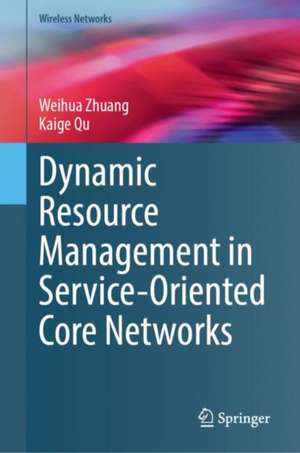
Dynamic Resource Management in Service-Oriented Core Networks: Wireless Networks
Autor Weihua Zhuang, Kaige Quen Limba Engleză Hardback – 5 noi 2021
This book provides a timely and comprehensive study of dynamic resource management for network slicing in service-oriented fifth-generation (5G) and beyond core networks. This includes the perspective of developing efficient computation resource provisioning and scheduling solutions to guarantee consistent service performance in terms of end-to-end (E2E) data delivery delay.
Network slicing is enabled by the software defined networking (SDN) and network function virtualization (NFV) paradigms. For a network slice with a target traffic load, the E2E service delivery is enabled by virtual network function (VNF) placement and traffic routing with static resource allocations. When data traffic enters the network, the traffic load is dynamic and can deviate from the target value, potentially leading to QoS performance degradation and network congestion. Data traffic has dynamics in different time granularities. For example, the traffic statistics (e.g., mean and variance) can be non-stationary and experience significant changes in a coarse time granularity, which are usually predictable. Within a long time duration with stationary traffic statistics, there are traffic dynamics in small timescales, which are usually highly bursty and unpredictable. To provide continuous QoS performance guarantee and ensure efficient and fair operation of the network slices over time, it is essential to develop dynamic resource management schemes for the embedded services in the presence of traffic dynamics during virtual network operation. Queueing theory is used in system modeling, and different techniques including optimization and machine learning are applied to solving the dynamic resource management problems.
Based on a simplified M/M/1 queueing model with Poisson traffic arrivals, an optimization model for flow migration is presented to accommodate the large-timescale changes in the average traffic rates with average E2E delay guarantee, while addressing a trade-off between load balancing and flow migration overhead. To overcome the limitations of Poisson traffic model, the authors present a machine learning approach for dynamic VNF resource scaling and migration. The new solution captures the inherent traffic patterns in a real-world traffic trace with non-stationary traffic statistics in large timescale, predicts resource demands for VNF resource scaling, and triggers adaptive VNF migration decision making, to achieve load balancing, migration cost reduction, and resource overloading penalty suppression in the long run. Both supervised and unsupervised machine learning tools are investigated for dynamic resource management. To accommodate the traffic dynamics in small time granularities, the authors present a dynamic VNF scheduling scheme to coordinate the scheduling among VNFs of multiple services, which achieves network utility maximization with delay guarantee for each service.
Researchers and graduate students working in the areas of electrical engineering, computing engineering and computer science will find this book useful as a reference or secondary text. Professionals in industry seeking solutions to dynamic resource management for 5G and beyond networks will also want to purchase this book.
Din seria Wireless Networks
- 20%
 Preț: 1084.44 lei
- 15%
 Preț: 660.27 lei
- 18%
 Preț: 921.60 lei
- 18%
 Preț: 1151.76 lei
- 20%
 Preț: 1010.16 lei
- 18%
 Preț: 980.62 lei
- 18%
 Preț: 1273.49 lei
- 15%
 Preț: 665.43 lei
- 18%
 Preț: 1152.69 lei
- 20%
 Preț: 1322.14 lei
- 20%
 Preț: 669.98 lei
-
 Preț: 398.83 lei
- 20%
 Preț: 1208.06 lei
- 18%
 Preț: 980.14 lei
- 20%
 Preț: 1022.07 lei
-
 Preț: 402.32 lei
- 18%
 Preț: 753.28 lei
- 15%
 Preț: 661.27 lei
- 18%
 Preț: 1040.48 lei
- 20%
 Preț: 338.97 lei
- 18%
 Preț: 1041.80 lei
- 20%
 Preț: 344.73 lei
- 20%
 Preț: 669.40 lei
- 15%
 Preț: 653.25 lei
- 20%
 Preț: 784.37 lei
- 18%
 Preț: 917.75 lei
- 18%
 Preț: 923.95 lei
- 18%
 Preț: 749.43 lei
- 20%
 Preț: 625.10 lei
- 18%
 Preț: 926.49 lei
- 20%
 Preț: 619.74 lei
- 20%
 Preț: 1252.34 lei
- 18%
 Preț: 752.59 lei
-
 Preț: 506.83 lei
- 24%
 Preț: 773.57 lei
- 24%
 Preț: 904.32 lei
- 18%
 Preț: 751.29 lei
- 18%
 Preț: 756.18 lei
- 20%
 Preț: 731.05 lei
- 18%
 Preț: 752.16 lei
- 20%
 Preț: 668.29 lei
- 20%
 Preț: 845.18 lei
- 18%
 Preț: 753.21 lei
- 20%
 Preț: 669.84 lei
Preț: 964.15 lei
Preț vechi: 1205.18 lei
-20%
Puncte Express: 1446
Carte tipărită la comandă
Livrare economică 04-18 decembrie
Livrare prin curier în România Termenul estimat este afișat lângă disponibilitate.
Transport gratuit pentru acest produs Plată online sau ramburs, în funcție de opțiunile comenzii.
Retur gratuit în 14 zile Comandă securizată și suport în română.
Specificații
ISBN-13: 9783030871352
ISBN-10: 3030871355
Pagini: 188
Ilustrații: XII, 173 p. 189 illus., 59 illus. in color.
Dimensiuni: 160 x 241 x 16 mm
Greutate: 0.4 kg
Ediția:1st ed. 2021
Editura: Springer
Colecția Wireless Networks
Seria Wireless Networks
Locul publicării:Cham, Switzerland
ISBN-10: 3030871355
Pagini: 188
Ilustrații: XII, 173 p. 189 illus., 59 illus. in color.
Dimensiuni: 160 x 241 x 16 mm
Greutate: 0.4 kg
Ediția:1st ed. 2021
Editura: Springer
Colecția Wireless Networks
Seria Wireless Networks
Locul publicării:Cham, Switzerland
V-ar putea interesa
-
 Computer Networks: A Systems ApproachLarry L. Peterson-41%Preț: 558.53 lei941.05 lei
-
 -20%Preț: 237.78 lei297.22 lei
-
 -20%Preț: 347.80 lei434.74 lei
-
 -20%Preț: 384.66 lei480.83 lei
-
 5G Mobile Core NetworkRajaneesh Sudhakar Shetty-20%Preț: 265.36 lei331.69 lei
-
 -20%Preț: 335.34 lei419.18 lei
-
 Advances in AI for Cloud, Edge, and Mobile Computing ApplicationsShrikaant Kulkarni-20%Preț: 1296.62 lei1620.78 lei
-
 -18%Preț: 834.48 lei1017.65 lei
-
 Computational Intelligence in Recent Communication NetworksMariya Ouaissa-20%Preț: 1319.88 lei1649.85 lei
-
 -24%Preț: 672.92 lei885.41 lei
-
 Wireless InternetLeandros A. Maglaras-20%Preț: 502.86 lei628.58 lei
-
 Machine Learning for NetworkingÉric Renault-20%Preț: 431.67 lei539.58 lei
-
 -20%Preț: 558.53 lei698.17 lei
-
 -20%Preț: 642.40 lei803.00 lei
-
 Intelligent Mobile Edge Computing and SensingWanming Hao-20%Preț: 1322.14 lei1652.68 lei
-
 Applied Soft Computing and Communication NetworksSabu M. Thampi-20%Preț: 1448.49 lei1810.62 lei
-
 Resource Management in Distributed SystemsAnwesha Mukherjee-20%Preț: 1210.28 lei1512.85 lei
-
 Service ScienceJianping Wang-20%Preț: 456.40 lei570.50 lei
-
 -20%Preț: 1079.54 lei1349.43 lei
-
 AI and MicroservicesDileep Kumar Pandiya-20%Preț: 263.90 lei329.88 lei
Cuprins
Chapter 1 Introduction-. 1.1 Service-Oriented Core Networks-. 1.1.1 Software-Defined Networking (SDN)-. 1.1.2 Network Function Virtualization (NFV)-. 1.1.3 Service Function Chaining-. 1.2 Network Slicing Framework-. 1.2.1 Infrastructure Domain-. 1.2.2 Tenant Domain-. 1.2.3 SDN-NFV Integration-. 1.3 Multi-Timescale Dynamic Resource Management-. 1.3.1 Multi-Timescale Core Network Traffic Dynamics-. 1.3.2 Dynamic Resource Provisioning in Large Timescale-. 1.3.3 Dynamic Resource Scheduling in Small Timescale-. 1.4 Research Contributions-. 1.5 Outline-. References-. Chapter 2 System Model-. 2.1 Services-. 2.2 Virtual Resource Pool-. 2.3 Placement and Scheduling of Virtual Network Function (VNF)-. 2.3 Migration Cost and Reconfiguration Overhead-. References-. Chapter 3 Dynamic Flow Migration: A Model-Based Optimization Approach-. 3.1 Model Assumptions-. 3.1.1 M/M/1 VNF Packet Processing Queueing Model-. 3.1.2 Generalized Processor Sharing (GPS)-. 3.2 Optimization Model for Dynamic Flow Migration-. 3.3 Mixed Integer Quadratically Constrained Programming (MIQCP) Problem Transformation-. 3.3.1 Optimality Gap-. 3.3.2 Optimal Solution Mapping-. 3.4 Low-Complexity Heuristic Flow Migration Algorithm-. 3.4.1 Algorithm Overview-. 3.4.2 Redistribution of Hop Delay Bounds-. 3.4.3 Migration Decision-. 3.4.4 Iterative Resource Loading Threshold Update-. 3.4.5 Complexity Analysis-. 3.5 Simulation Results-. 3.6 Summary-. References-. Chapter 4 Dynamic VNF Resource Scaling and Migration: A Machine Learning Approach-. 4.1 Nonstationary Traffic Model-. 4.2 Machine Learning Tools for Analysis and Decision-. 4.2.1 Bayesian Conjugate Analysis-. 4.2.2 Gaussian Process Regression-. 4.2.3 Reinforcement Learning-. 4.3 Resource Demand Prediction for Dynamic VNF Resource Scaling-. 4.3.1 Bayesian Online Change Point Detection-. 4.3.2 Traffic Parameter Learning-. 4.3.3 Resource Demand Prediction-. 4.4 Deep Reinforcement Learning for Dynamic VNF Migration-. 4.4.1 MarkovDecision Process-. 4.4.2 Penalty-Aware Deep Q-Learning Algorithm-. 4.5 Simulation Results-. 4.6 Summary-. References-. Chapter 5 Dynamic VNF Scheduling for Network Utility Maximization-. 5.1 Discrete-Time VNF Packet Processing Queueing Model-. 5.1.1 Physical Packet Processing Queue-. 5.1.2 Delay-Aware Virtual Packet Processing Queue-. 5.2 Stochastic VNF Scheduling: Problem and Solution-. 5.2.1 Stochastic Problem Formulation-. 5.2.2 Lyapunov Optimization and Problem Transformation-. 5.2.3 Online Distributed Algorithm-. 5.3 VNF Scheduling with Packet Rushing-. 5.3.1 Packet Rushing Analysis-. 5.3.2 Modified VNF Scheduling Algorithm-. 5.4 Simulation Results-. 5.5 Summary-. References-. Chapter 6 Conclusions and Future Research Directions-. 6.1 Conclusions-. 6.2 Future Research Directions-. References.
Notă biografică
Dr. Xiaodan Shao received the Ph.D. degree in information and communication engineering from Zhejiang University, China, in 2022. From 2022 to 2024, she was a Alexander von Humboldt Research Fellow with the Institute for Digital Communications, Friedrich-Alexander-University Erlangen-Nuremberg (FAU), Erlangen, Germany. She is currently a Postdoctoral Fellow at University of Waterloo, Waterloo, ON, Canada. Her current research interests include six-dimensional movable antenna (6DMA), integrated sensing and communications, digital agent, statistical signal processing and optimization methods. Dr. Weihua Zhuang received the B.Sc. and M.Sc. degrees in electrical engineering from Dalian Marine University, China, and the Ph.D. degree in electrical engineering from the University of New Brunswick, Canada. Since 1993, she has been a Faculty Member with the Department of Electrical and Computer Engineering, University of Waterloo, Canada, where she is a University Professor and the Tier I Canada Research Chair in wireless communication networks. Her research interests include network architecture, algorithms and protocols, and service provisioning in future communication systems. She is an elected member of the Board of Governors and the President of the IEEE Vehicular Technology Society. She is a fellow of the Royal Society of Canada, the Canadian Academy of Engineering, and the Engineering Institute of Canada. Dr. Xuemin (Sherman) Shen received the Ph.D. degree in electrical engineering from Rutgers University, New Brunswick, NJ, USA, in 1990. He is a University Professor with the Department of Electrical and Computer Engineering, University of Waterloo, Canada. His research focuses on network resource management, wireless network security, Internet of Things, 5G and beyond, and vehicular networks. Dr. Shen is a registered Professional Engineer of Ontario, Canada, an Engineering Institute of Canada Fellow, a Canadian Academy of Engineering Fellow, a Royal Society of Canada Fellow, a Chinese Academy of Engineering Foreign Member, and a Distinguished Lecturer of the IEEE Vehicular Technology Society and Communications Society. Dr. Shen received "West Lake Friendship Award" from Zhejiang Province in 2023, President's Excellence in Research from the University of Waterloo in 2022, the Canadian Award for Telecommunications Research from the Canadian Society of Information Theory (CSIT) in 2021, the R.A. Fessenden Award in 2019 from IEEE, Canada, Award of Merit from the Federation of Chinese Canadian Professionals (Ontario) in 2019, James Evans Avant Garde Award in 2018 from the IEEE Vehicular Technology Society, Joseph LoCicero Award in 2015 and Education Award in 2017 from the IEEE Communications Society (ComSoc), and Technical Recognition Award from Wireless Communications Technical Committee (2019) and AHSN Technical Committee (2013). He has also received the Excellent Graduate Supervision Award in 2006 from the University of Waterloo and the Premier’s Research Excellence Award (PREA) in 2003 from the Province of Ontario, Canada.
Textul de pe ultima copertă
This book provides a timely and comprehensive study of dynamic resource management for network slicing in service-oriented fifth-generation (5G) and beyond core networks. This includes the perspective of developing efficient computation resource provisioning and scheduling solutions to guarantee consistent service performance in terms of end-to-end (E2E) data delivery delay.
Based on a simplified M/M/1 queueing model with Poisson traffic arrivals, an optimization model for flow migration is presented to accommodate the large-timescale changes in the average traffic rates with average E2E delay guarantee, while addressing a trade-off between load balancing and flow migration overhead. To overcome the limitations of Poisson traffic model, the authors present a machine learning approach for dynamic VNF resource scaling and migration. The new solution captures the inherent traffic patterns in a real-world traffic trace with non-stationary traffic statistics in large timescale, predicts resource demands for VNF resource scaling, and triggers adaptive VNF migration decision making, to achieve load balancing, migration cost reduction, and resource overloading penalty suppression in the long run. Both supervised and unsupervised machine learning tools are investigated for dynamic resource management. To accommodate the traffic dynamics in small time granularities, the authors present a dynamic VNF scheduling scheme to coordinate the scheduling among VNFs of multiple services, which achieves network utility maximization with delay guarantee for each service.
Researchers and graduate students working in the areas of electrical engineering, computing engineering and computer science will find this book useful as a reference or secondary text. Professionals in industry seeking solutions to dynamic resource management for 5G and beyond networks will also want to purchase this book.
Caracteristici
Presents research on dynamic resource management for network slicing in service-oriented 5G and beyond core networks Introduces applications of machine learning techniques in dynamic resource management Includes advanced algorithms and solutions for dynamic resource management