
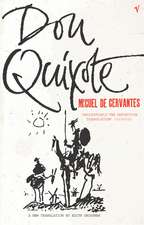
Don Quixote
Autor Miguel De Cervantes Saavedraen Limba Engleză Paperback – 28 mar 2011
În câmpiile aride și prăfuite din La Mancha, la începutul secolului al XVII-lea, timpul pare să se fi oprit pentru un hidalgo de vreo cincizeci de ani. Alegerea acestui decor spaniol nu este întâmplătoare; asprimea peisajului contrastează violent cu iluziile cavalerești ale lui Alonso Quixano, oferind scena perfectă pentru o prăbușire a mitului în realitate. Suntem de părere că Don Quixote nu este doar o parodie a genului cavaleresc, ci o explorare melancolică a condiției umane, unde granița dintre nebunie și noblețe devine fluidă.
Subliniem modul în care Miguel De Cervantes Saavedra revoluționează structura narativă prin utilizarea metateatrului și a intertextualității, tehnici ce conferă romanului o modernitate surprinzătoare chiar și după patru secole. Stilul are ceva din profunzimea psihologică și ironia fină pe care o regăsim în Don Quixote de la Mancha din seria Oxford World's Classics, fără să fie o imitație — Cervantes reușește aici să echilibreze discursurile retorice arhaice ale cavalerului cu spiritul practic și pământean al lui Sancho Panza.
Această lucrare se poziționează ca punctul culminant al operei sale, rafinând temele explorate în Exemplary Stories. Dacă în acele povestiri autorul experimenta cu ambiguitatea morală și realismul satiric, în Don Quixote el atinge o maturitate filosofică ce l-a determinat pe Dostoievski să o numească „cea mai mare expresie a minții umane”. Este un text dens, dar ritmat de aventurile burlești ale celor doi protagoniști, oferind o experiență de lectură ce trece constant de la râs la o reflecție profundă asupra viselor noastre.
Preț: 206.38 lei
Carte indisponibilă temporar
Specificații
ISBN-10: 1613820178
Pagini: 986
Dimensiuni: 152 x 229 x 57 mm
Greutate: 1.57 kg
Editura: Simon & Brown
V-ar putea interesa
-
 CLASSICS THE ODYSSEYHomerPreț: 28.01 lei
 -
 AmericanahChimamanda Ngozi AdichiePreț: 63.50 lei
 -
 Summer of SaltKatrina LenoPreț: 62.08 lei
 -
 Don QuixoteMiguel De Cervantes-11%Preț: 76.49 lei85.88 lei
 -
 BelovedToni Morrison-18%Preț: 58.14 lei71.27 lei
 -
 The Brothers KaramazovFyodor Dostoevsky-14%Preț: 70.57 lei82.37 lei
 -
 The Count of Monte CristoAlexandre Dumas-17%Preț: 71.53 lei86.08 lei
 -
 Monkey King: Journey to the WestWu Ch'Eng-En-19%Preț: 127.18 lei156.43 lei
 -
 Paradise LostJohn MiltonPreț: 137.66 lei
 -
 The AeneidVirgil-18%Preț: 100.06 lei121.90 lei
 -
 The OdysseyHomer-19%Preț: 86.44 lei106.47 lei
 -
 The Karamazov BrothersFyodor Dostoevsky-12%Preț: 67.78 lei77.02 lei
 -
 Don Quixote de la ManchaMiguel De Cervantes Saavedra-13%Preț: 72.59 lei83.57 lei
 -
 Crime and PunishmentFyodor Dostoyevsky-36%Preț: 123.67 lei193.17 lei
 -
 The Mayor of CasterbridgeThomas Hardy-17%Preț: 102.09 lei123.13 lei
 -
 The War of the WorldsH. G. Wells-19%Preț: 97.55 lei120.40 lei
 -
 Animal FarmGeorge Orwell-20%Preț: 84.29 lei105.18 lei
 -
 UlyssesJames Joyce-35%Preț: 125.93 lei194.63 lei
 -
 The Grapes of WrathJohn Steinbeck-25%Preț: 53.89 lei71.89 lei
 -
 LessAndrew Sean GreerPreț: 106.26 lei
 -
 Wide Sargasso SeaJean RhysPreț: 77.30 lei
 -
 Johnny Got His GunDalton TrumboPreț: 63.05 lei
 -
 The Story Orchestra: In the Hall of the Mountain KingJessica Courtney Tickle-18%Preț: 100.92 lei122.42 lei
 -
 Classic Starts®: Don QuixoteMiguel de Cervantes de-25%Preț: 42.44 lei56.68 lei
 -
 -35%Preț: 69.11 lei106.55 lei
 -
 One Last StopCasey McQuiston-32%Preț: 48.60 lei71.87 lei
 -
 Her Body And Other PartiesCarmen Maria Machado-19%Preț: 57.41 lei70.84 lei
 -
 Don QuixoteMiguel de Cervantes-26%Preț: 63.58 lei85.50 lei
 -
 Don QuixoteMiguel de CervantesPreț: 28.01 lei
De ce să citești această carte
Pentru cititorul care dorește să descopere originile romanului modern, această ediție este esențială. Veți câștiga nu doar plăcerea unei aventuri clasice, ci și o înțelegere profundă a modului în care ficțiunea ne modelează percepția asupra realității. Este o recomandare pentru oricine apreciază umorul inteligent și personajele care refuză să se conformeze unei lumi lipsite de magie.
Despre autor
Miguel De Cervantes Saavedra (1547-1616) a fost un romancier, poet și dramaturg spaniol, considerat cea mai importantă figură a literaturii de limbă spaniolă. Viața sa a fost la fel de tumultuoasă ca a personajelor sale, lucrând ca perceptor de taxe și luptând în bătălia de la Lepanto. Deși a scris poezie în Poemas și proză scurtă de succes, gloria sa eternă este legată de Don Quixote. Supranumit „Principele Geniilor”, Cervantes a reușit să transforme experiențele sale de viață și dificultățile financiare într-o operă ce a definit canonul literar occidental.
Descriere scurtă
Descriere
Part of Penguin's beautiful hardback Clothbound Classics series, designed by the award-winning Coralie Bickford-Smith, these delectable and collectible editions are bound in high-quality, colourful, tactile cloth with foil stamped into the design.
Don Quixote has become so entranced by reading romances of chivalry that he determines to become a knight errant and pursue bold adventures, accompanied by his squire, the cunning Sancho Panza. As they roam the world together, the aging Quixote's fancy leads them wildly astray, tilting at windmills, fighting with friars, and distorting the rural Spanish landscape into a fantasy of impenetrable fortresses and wicked sorcerers. At the same time the relationship between the two men grows in fascinating subtlety. Often considered to be the first modern novel, Don Quixote is a wonderful burlesque of the popular literature its disordered protagonist is obsessed with.
Notă biografică
Recenzii
"A more profound and powerful work than this is not to be met with...The final and greatest utterance of the human mind." —Fyodor Dostoyevsky
"What a monument is this book! How its creative genius, critical, free, and human, soars above its age!" —Thomas Mann
"Don Quixote looms so wonderfully above the skyline of literature, a gaunt giant on a lean nag, that the book lives and will live through his sheer vitality....The parody has become a paragon." —Vladimir Nabokov
"The highest creation of genius has been achieved by Shakespeare and Cervantes, almost alone." --Samuel Taylor Coleridge"A more profound and powerful work than this is not to be met with...The final and greatest utterance of the human mind." --Fyodor Dostoyevsky"What a monument is this book! How its creative genius, critical, free, and human, soars above its age!" --Thomas Mann"Don Quixote looms so wonderfully above the skyline of literature, a gaunt giant on a lean nag, that the book lives and will live through his sheer vitality....The parody has become a paragon." --Vladimir Nabokov if (contentWritten=="no" && CoreSetId=="0" && SYM=="ACD") { contentWritten="yes"; document.write(""); } else { document.write(""); }