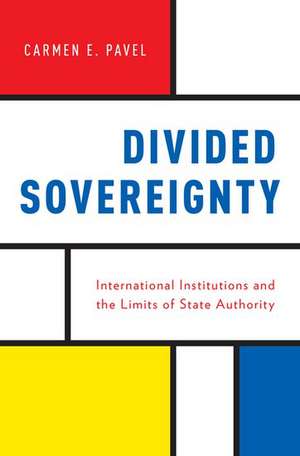
Divided Sovereignty: International Institutions and the Limits of State Authority
Autor Carmen Pavelen Limba Engleză Paperback – 27 iul 2017
În literatura academică dedicată relațiilor internaționale, persistă o lacună majoră în ceea ce privește mecanismele practice prin care suveranitatea statală poate fi limitată atunci când aceasta devine un instrument de opresiune. Divided Sovereignty vine să completeze acest gol teoretic, propunând o regândire a autorității politice. Remarcăm curajul cu care Carmen Pavel contestă prezumția tradițională conform căreia cetățenii trebuie să acorde autoritate exclusivă instituțiilor din interiorul propriilor granițe. Volumul argumentează că instituțiile internaționale coercitive, cum este Curtea Penală Internațională, nu trebuie privite ca amenințări la adresa democrației, ci ca o formă de „asigurare” colectivă împotriva abuzurilor grave.
Spre deosebire de abordările cosmopolite radicale, autoarea propune un model pragmatic, bazat pe mandate înguste și bine definite. Putem afirma că textul reușește să navigheze între scepticismul față de „guvernanța globală” și necesitatea morală de a stopa atrocitățile. Comparabil cu Sovereignty, State Failure and Human Rights de Neil Englehart în rigoarea analizei eșecului statal, acest volum merge mai departe, oferind soluții instituționale concrete pentru partajarea suveranității. Dacă Englehart se concentrează pe capacitatea statului de a proteja drepturile, Carmen Pavel investighează cum putem construi un strat suplimentar de protecție externă.
În contextul operei autoarei, această monografie reprezintă o evoluție firească de la temele explorate în The Oxford Handbook of Freedom. Dacă în lucrările anterioare accentul era pus pe conceptul filosofic de libertate, în Divided Sovereignty, Carmen Pavel aplică aceste principii în arena politicii internaționale dure, transformând libertatea individuală într-un fundament pentru legitimitatea sau limitarea puterii coercitive a statului.
Preț: 246.25 lei
Preț vechi: 324.32 lei
-24%
Carte tipărită la comandă
Livrare economică 20 noiembrie-01 decembrie
Specificații
ISBN-10: 0190692170
Pagini: 242
Dimensiuni: 155 x 231 x 15 mm
Greutate: 0.34 kg
Editura: Oxford University Press
Colecția OUP USA
Locul publicării:New York, United States
V-ar putea interesa
-
 Failed StatesNoam Chomsky-26%Preț: 62.72 lei84.58 lei
 -
 -22%Preț: 416.25 lei531.75 lei
 -
 Rights and Resistance: Interpersonal and Political Implications of Our RightsChristopher Heath Wellman-30%Preț: 440.66 lei627.19 lei
 -
 Dream States: A Lurking Nightmare for World OrderBenjamin J. Cohen-21%Preț: 146.99 lei185.68 lei
 -
 The Universal Republic: A Realistic Utopia?Mathias Koenig-Archibugi-33%Preț: 615.75 lei915.32 lei
 -
 International Law: A Very Short IntroductionVaughan Lowe-20%Preț: 56.67 lei70.85 lei
 -
 Preț: 264.14 lei
 -
 Preț: 110.98 lei
 -
 Comparative Government and PoliticsJohn McCormick-13%Preț: 299.36 lei345.77 lei
 -
 The Assault on the StateStephen E. HansonPreț: 133.59 lei
 -
 At the Margins of the Modern StateSeyla BenhabibPreț: 158.97 lei
 -
 GazaJulie M. NormanPreț: 159.84 lei
 -
 The State and the SoldierKori SchakePreț: 172.85 lei
 -
 Not Your Victim: How our Obsession with Race Entra ps and Divides UsMarie Kawthar DaoudaPreț: 143.00 lei
 -
 Humanitarian Intervention: Moral and Philosophical IssuesAleksandar Jokic-19%Preț: 332.12 lei408.55 lei
 -
 The Preventive StateAlan DershowitzPreț: 170.27 lei
 -
 Crimes Against HumanityGeoffrey RobertsonPreț: 145.40 lei
 -
 -24%Preț: 204.25 lei270.52 lei
 -
 On PowerMark R. Levin-20%Preț: 108.64 lei135.48 leiRecomandat
 -
 Perfect VictimsMohammed El-Kurd-24%Preț: 76.73 lei100.63 lei
De ce să citești această carte
Această carte este esențială pentru studenții și cercetătorii în științe politice care caută o alternativă realistă la idealismul cosmopolit. Cititorul va câștiga o înțelegere profundă a modului în care normele jus cogens pot limita legal suveranitatea și de ce divizarea autorității între nivelul național și cel internațional este nu doar posibilă, ci necesară pentru prevenirea atrocităților umane în statele care își agresează proprii cetățeni.
Despre autor
Carmen Pavel este un cercetător respectat în domeniul filosofiei politice și al teoriei relațiilor internaționale, fiind cunoscută pentru analizele sale riguroase asupra libertății și autorității. Contribuția sa ca editor la The Oxford Handbook of Freedom demonstrează o preocupare constantă pentru fundamentele normative ale societăților deschise. În prezent, cercetările sale se concentrează pe designul instituțional internațional și pe limitele etice ale suveranității statale, fiind o voce importantă în dezbaterile contemporane despre justiția globală și dreptul internațional, publicând sub egida unor edituri prestigioase precum Oxford University Press.
Descriere
Recenzii
Pavel provides a systematic and thoughtful account of the reasons why coercive international institutions are needed, the nature of their authority, and why individuals should support them and states should comply with their rules. Her book is a valuable contribution to the nascent shift in theorizing about global justice toward taking institutions seriously.
Divided Sovereignty makes a compelling case for supplementing sovereign states with coercive international institutions. Though it shares a concern for global justice, the book presents a powerful alternative to the institutional visions typically outlined by cosmopolitans. By prioritizing good institutional design over abstract morality, and defending the importance of collective self-determination, Pavel reorients recent debates. This is an original and important book.
Notă biografică
Cuprins
- Introduction
- 1. Why Divided Sovereignty?
- 2. Method and Justification
- 3. Outline of the Book
- Chapter 1 Sovereignty, the Social Contract, and the Incompleteness of the State System
- 1. The Institutions of the Social Contract
- 2. On Sovereignty and Delegation of Authority
- 3. Problems of Institutional Design
- 4. Conceptual and practical Hurdles to Divided Sovereignty
- 5. Conclusion
- Chapter 2 Divided Sovereignty: the Principal-Agent Model
- 1. Sovereignty Limiting Norms and their Current Effects
- 2. Divided Sovereignty: The Principal-Agent Model
- 2.1 The Origins of the Model
- 2.2 The Principle-Agent Model for International Institutions
- 2.3 Delegation
- 2.4 The Role of Consent
- 3. Agency Costs at the International Level
- 4. Why Use Principal-Agent Theory?
- 5. Conclusion
- Chapter 3 Domestic and International Implications: Slavery, Genocide and Civil War
- 1. The Scope and Limits of International Authority
- 2. Constitutional Interpretation and Change
- 3. Slavery
- 4. Genocide
- 5. Civil Wars and Failed States
- 6. Conclusion
- Chapter 4 Theories and Institutional Facts
- 1. One Step Theorizing: Cosmopolitan Justice
- 2. Two Step Theorizing: The Case of Humanitarian Intervention
- 3. Objections
- 4. Conclusion
- Chapter 5 Romanticizing Institutions
- 1. Cosmopolitan Global Democracy
- 2. Rule of Law Experiments
- 3. Rule of Law for Global Democracy
- 4. Institutional Assumptions and Bureaucratic Pathologies
- 5. Conclusion
- Chapter 6 Institutional Pluralism
- 1. Institutions in International Criminal Law
- 2. Fragmentation and Conflict
- 3. The Benefits of a Pluralist System
- 4. Complex Social Orders
- 5. A Hobbesian Challenge
- 6. Conclusion
- Chapter 7 The Possibility of Rule-Governed Behavior in International Politics
- 1. Cooperation under Anarchy
- 2. Assumptions and Implications of International Relations Theorizing
- 3. Self-Preservation as the Dominant State Preference
- 4. The Possibility of a Rule-Governed Order
- Conclusion