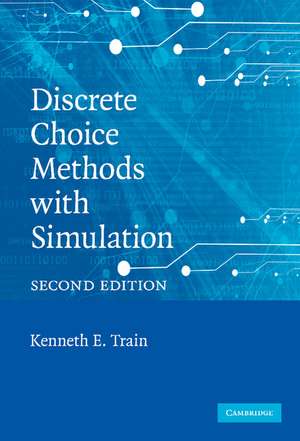
Discrete Choice Methods with Simulation
Autor Kenneth Trainen Limba Engleză Hardback – 10 iun 2013
Cea de-a doua ediție a volumului Discrete Choice Methods with Simulation reprezintă o actualizare esențială pentru cercetătorii care utilizează metode statistice avansate în analiza decizională. Observăm că această versiune extinde cadrul teoretic original prin includerea a două capitole noi, de importanță critică în econometria modernă: tratarea endogenității și utilizarea algoritmilor de tip expectation-maximization (EM). Suntem de părere că aceste adăugiri consolidează poziția cărții ca resursă completă pentru înțelegerea modului în care agenții economici, firmele și gospodăriile fac alegeri sub diferite constrângeri. Structura cărții este organizată riguros în două părți. Prima parte este dedicată modelelor comportamentale, trecând în revistă proprietățile fundamentale și variațiile modelelor logit, GEV și probit. A doua parte se concentrează pe estimare, unde Kenneth E. Train detaliază tehnicile de simulare și procedurile Bayesiene, inclusiv algoritmul Metropolis-Hastings. Cititorii familiarizați cu Applied Choice Analysis de David A. Hensher vor aprecia aici accentul pus pe fundamentarea matematică a simulărilor și pe integrarea metodelor dezvoltate în ultimul sfert de secol, pe care Kenneth E. Train le prezintă într-un format unitar. Față de alte texte care se concentrează pe implementarea software, cum este Discrete Choice Analysis with R, acest volum pune preț pe înțelegerea mecanismelor de simulare care permit depășirea limitelor analitice ale modelelor clasice. Găsim în acest text un echilibru între rigoarea academică și aplicabilitatea practică, fiind o resursă indispensabilă pentru cei care lucrează în domenii precum economia mediului, sănătate publică sau planificarea transporturilor.
Preț: 1045.76 lei
Preț vechi: 1216.01 lei
-14%
Carte tipărită la comandă
Livrare economică 05-19 decembrie
Specificații
ISBN-10: 0521766559
Pagini: 400
Ilustrații: 46 b/w illus. 17 tables
Dimensiuni: 157 x 235 x 28 mm
Greutate: 0.75 kg
Ediția:Revised
Editura: Cambridge University Press
Locul publicării:New York, United States
V-ar putea interesa
-
 Introduction to Business Analytics Using SimulationJonathan P. PinderPreț: 348.45 lei
 -
 The Oxford Handbook of Applied Bayesian AnalysisAnthony O' Hagan-19%Preț: 483.37 lei596.76 lei
 -
 -20%Preț: 512.50 lei643.91 lei
 -
 Econometric Analysis of Cross Section and Panel DataJeffrey M. Wooldridge-18%Preț: 744.63 lei907.13 lei
 -
 SimulationSheldon M. Ross-31%Preț: 515.83 lei749.22 lei
 -
 EconometricsFumio Hayashi-14%Preț: 486.87 lei566.12 lei
 -
 -9%Preț: 1388.37 lei1525.67 lei
 -
 Marketing AnalyticsWayne L. Winston-20%Preț: 282.71 lei353.38 lei
 -
 A Guide to Modern EconometricsMarno VerbeekPreț: 486.57 lei
 -
 Simulation Modeling and Analysis, Sixth EditionAverill Law-33%Preț: 775.69 lei1158.75 lei
 -
 Econometric Analysis, Global EditionWilliam Greene-9%Preț: 612.05 lei672.58 lei
 -
 -11%Preț: 659.13 lei740.59 lei
 -
 A Guide to EconometricsPeter KennedyPreț: 253.92 lei
 -
 Interpreting and Comparing Effects in Logistic, Probit, and Logit RegressionJacques A. P. A. P. HagenaarsPreț: 354.40 lei
 -
 -22%Preț: 621.60 lei797.41 lei
 -
 -15%Preț: 668.91 lei786.95 lei
 -
 Statistics for ScientistsUmberto Michelucci-20%Preț: 279.62 lei349.53 lei
 -
 Stochastic Models, Statistics and Their ApplicationsAnsgar Steland-20%Preț: 1190.22 lei1487.78 lei
 -
 Transportation Policy and Project EvaluationHuajie YangPreț: 395.58 lei
De ce să citești această carte
Recomandăm această carte profesioniștilor și cercetătorilor care au nevoie de un fundament teoretic solid pentru modelarea alegerilor discrete. Cititorul câștigă o înțelegere profundă a tehnicilor de simulare și a metodelor Bayesiene, esențiale pentru a analiza comportamente complexe în economie și marketing. Este, în prezent, singura lucrare care integrează progresele majore din domeniu realizate în ultimele două decenii.
Despre autor
Kenneth E. Train este profesor asociat adjunct la Departamentul de Economie și la Școala Absolventă de Politici Publice din cadrul University of California, Berkeley. Expertiza sa academică este dublată de o vastă experiență practică, deținând poziția de director în cadrul firmei de consultanță Cambridge Systematics. Specialist recunoscut în econometrie și teoria deciziei, Train a influențat semnificativ modul în care sunt aplicate modelele de alegere discretă în sectoarele energiei și transporturilor prin lucrările sale de referință.