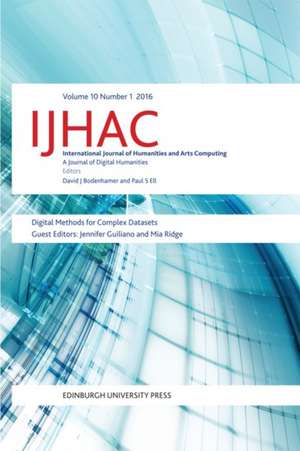
Digital Methods for Complex Datasets
Editat de Jennifer Guiliano, Mia Ridgeen Limba Engleză Paperback – 15 mar 2016
Domeniul umanioarelor digitale a evoluat rapid de la simpla digitizare a textelor către o gestionare sofisticată a seturilor de date eterogene, o schimbare de paradigmă pe care lucrarea Digital Methods for Complex Datasets o surprinde cu precizie. Remarcăm efortul editorilor Jennifer Guiliano și Mia Ridge de a muta discuția de la „big data” — înțeles strict prin prisma puterii de calcul — către înțelegerea complexității inerente a surselor umane. Această abordare recunoaște că datele din științele umaniste sunt, prin natura lor, fragmentare și incerte, refuzând simplificarea acestora în binare tehnice rigide. Structura volumului reflectă o progresie logică, pornind de la cadrele colaborative necesare în inițiativele de campus, până la studii de caz aplicate. Apreciem varietatea surselor analizate: de la ontologii de rețea din perioada modernă timpurie și partituri muzicale medievale, până la arhive web internaționale și analytics educațional. Capitolele tratează implicațiile practice ale tehnicilor de web scraping și modelare pe teme (topic modelling), subliniind necesitatea ca rezultatele să fie contextualizate prin expertiza cercetătorului, nu doar prin algoritmi. Comparabil cu Research Methods for the Digital Humanities de lewis levenberg în rigurozitatea metodologică, acest volum este actualizat pentru provocările specifice ale interoperabilității datelor și utilizării Linked Open Data. În timp ce alte lucrări se concentrează pe prezentarea generală a instrumentelor, volumul de față, publicat de EDINBURGH UNIVERSITY PRESS, insistă pe documentarea procesului de construcție a seturilor de date. Este o resursă esențială pentru cei care doresc să navigheze între rigoarea informaticii și nuanțele interpretative ale studiilor literare sau istorice.
Preț: 163.07 lei
Preț vechi: 198.40 lei
-18%
Carte disponibilă
Livrare economică 09-23 noiembrie
Specificații
ISBN-10: 1474417426
Pagini: 138
Dimensiuni: 150 x 229 x 10 mm
Greutate: 0.23 kg
Ediția:1
Editura: EDINBURGH UNIVERSITY PRESS
V-ar putea interesa
-
 -29%Preț: 362.93 lei514.65 lei
 -
 World AuthorshipTobias Boes-33%Preț: 906.90 lei1347.32 lei
 -
 Enumerations: Data and Literary StudyAndrew PiperPreț: 207.11 lei
 -
 Preț: 242.59 lei
 -
 Digital_HumanitiesAnne BurdickPreț: 233.63 lei
 -
 Preț: 437.63 lei
 -
 -18%Preț: 1112.48 lei1356.68 lei
 -
 Digital HumanitiesDavid M. BerryPreț: 150.31 lei
 -
 Reading by NumbersKatherine Bode-19%Preț: 686.79 lei847.88 lei
 -
 The Digital HumanitiesEileen Gardiner-20%Preț: 197.37 lei246.71 lei
 -
 Literature in the Digital AgeAdam HammondPreț: 214.56 lei
 -
 World Literature and DissentLorna Burns-11%Preț: 329.18 lei369.33 lei
 -
 Cultural Heritage Infrastructures in Digital HumanitiesAgiatis Benardou-18%Preț: 1150.52 lei1403.06 lei
 -
 Research Methods for Reading Digital Data in the Digital HumanitiesGabriele Griffin-16%Preț: 212.14 lei251.47 lei
 -
 Preț: 204.71 lei
 -
 Poetic Thinking TodayAmir EshelPreț: 194.99 lei
 -
 Digital Media Ethics 3eCharles Ess-20%Preț: 170.96 lei213.71 lei
 -
 Digital Humanities and the Study of Intermediality in Comparative Cultural StudiesSteven Totosy De ZepetnekPreț: 322.61 lei
 -
 Digital Humanities in Latin AmericaHector Fernandez L'Hoeste-15%Preț: 525.92 lei618.73 lei
 -
 Digital HumanitiesBryan Carter-11%Preț: 637.65 lei716.46 lei
 -
 Metamodernism: Historicity, Affect, and Depth after PostmodernismRobin van den Akker-18%Preț: 338.32 lei414.87 lei
 -
 Digital HumanitiesOlivier Le Deuff-20%Preț: 954.79 lei1193.48 lei
 -
 Research Methods for the Digital Humanitieslewis levenbergPreț: 341.34 lei
 -
 Meaning in TranslationMarcel Thelen-23%Preț: 949.18 lei1232.70 lei
De ce să citești această carte
Recomandăm această carte cercetătorilor și studenților din sfera umanioarelor digitale care doresc să depășească utilizarea superficială a instrumentelor informatice. Cititorul câștigă o înțelegere profundă a modului în care Linked Open Data și modelarea textuală pot fi aplicate pe surse dificile, precum arhivele web sau muzica medievală. Este un ghid metodologic care validează importanța contextului uman în fața algoritmilor de procesare masivă a datelor.
Despre autor
Jennifer Guiliano este o specialistă recunoscută în domeniul istoriei și al umanioarelor digitale, concentrându-se pe intersecția dintre tehnologie și cercetarea academică. Alături de ea, Mia Ridge contribuie cu o vastă experiență în zona tehnologiilor pentru biblioteci și muzee, fiind curator specializat în date digitale la British Library. Împreună, cele două coordonatoare reunesc în acest volum voci autoritare din informatică și științe sociale pentru a defini noile standarde de bune practici în gestionarea datelor complexe.
Descriere scurtă
Notă biografică
Mia Ridge is a Digital Curator in the British Library's Digital Scholarship team. Mia's PhD in digital humanities (Department of History, Open University) was titled 'Making digital history: The impact of digitality on public participation and scholarly practices in historical research'. Mia has held international Fellowships at Trinity College Dublin/CENDARI (Ireland, 2014), the Polis Center Institute on 'Spatial Narrative and Deep Maps' (USA, 2012) and the Roy Rosenzweig Center for History and New Media 'One Week|One Tool' program (USA, 2013), and had short Residencies at the Powerhouse Museum (Australia, 2012) and the Cooper-Hewitt Design Museum (USA, 2012). She is Chair of the Museums Computer Group (MCG), a member of the Executive Council of the Association for Computers and the Humanities (ACH) and a convenor of the Institute of Historical Research's Digital History Seminar. Formerly Lead Web Developer at the Science Museum Group, Mia has worked internationally as a business analyst, user experience consultant and web programmer in the cultural heritage and commercial sectors. Her edited volume, 'Crowdsourcing our Cultural Heritage' (Ashgate) was published in October 2014.
Cuprins
Notes on Contributors
The Future of Digital Methods for Complex Datasets: An Introduction
Jennifer Guiliano and Mia Ridge
Mindset and Guidelines: Insights to Enhance Collaborative, Campus-wide, Cross-sectoral Digital Humanities Initiatives
Chad Gaffield
Towards Interoperable Network Ontologies for the Digital Humanities
Alison Langmead, Jessica M. Otis, Christopher N. Warren,
Scott B. Weingart, and Lisa D. Zilinksi
Medieval Music in Linked Open Data: A Case Study on Linking Medieval Motets
Tamsyn Rose-Steel and Ece Turnator
Modeling the Humanities: Data Lessons from the World of Education
Armanda Lewis
Semi-supervised Textual Analysis and Historical Research Helping Each Other: Some Thoughts and Observations
Federico Nanni, Hiram Kümper, and Simone Paolo Ponzetto
Lost in the Infinite Archive: The Promise and Pitfalls of Web Archives
Ian Milligan
The World Wide Web as Complex Data Set: Expanding the Digital Humanities into the Twentieth Century and Beyond through Internet Research
Michael L. Black
Mechanized Margin to Digitized Center: Black Feminism's Contributions to Combatting Erasure within the Digital Humanities
Nicole M. Brown, Ruby Mendenhall, Michael L. Black, Mark Van Moer, Assata Zerai, and Karen Flynn