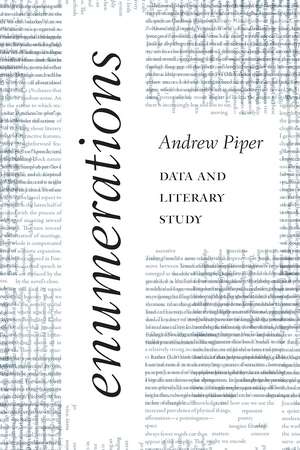
Enumerations: Data and Literary Study
Autor Andrew Piperen Limba Engleză Paperback – 29 aug 2018
În peisajul academic actual, Enumerations se plasează la intersecția fertilă dintre studiile literare tradiționale și informatică, oferind o fundamentare teoretică necesară disciplinei Digital Humanities. Remarcăm efortul autorului de a depăși simpla colectare de date, propunând o interogație profundă asupra modului în care cantitatea transformă înțelegerea noastră despre text. În timp ce disciplinele socio-umane au integrat demult metodele cantitative, critica literară a manifestat adesea rezistență; Andrew Piper demonstrează însă că analiza a 1,4 miliarde de cuvinte sau a peste 3 milioane de semne de punctuație nu anulează valoarea estetică, ci relevă tipare invizibile lecturii tradiționale.
Lucrarea extinde cadrul propus de Macroanalysis de Matthew L. Jockers prin adăugarea unei dimensiuni hermeneutice mai accentuate. Dacă Jockers se concentra pe potențialul revoluționar al procesării la scară largă, Piper revine la „particulele elementare” ale literaturii, investigând cum datele schimbă percepția asupra intrigii sau a personajului. Structura volumului este riguros organizată pe domenii cheie: începe cu micro-analiza punctuației, trece prin mecanismele intrigii și ale toposurilor, și culminează cu o reflecție asupra conceptului de corpus și a vulnerabilității acestuia. Această progresie reflectă tranziția de la elementul textual izolat către ansambluri complexe de date.
Apreciem modul în care această lucrare continuă preocupările autorului din Can We Be Wrong?, unde acesta aborda problema dovezilor textuale în era datelor. Față de Book Was There, care explora materialitatea lecturii, Enumerations face pasul decisiv către modelarea computațională, oferind 26 de tabele și 48 de diagrame care susțin argumentația. Este o resursă esențială pentru cercetătorii care doresc să înțeleagă nu doar „cât”, ci mai ales „ce înseamnă” cantitatea în studiul ficțiunii.
Preț: 207.11 lei
Carte disponibilă
Livrare economică 10-24 noiembrie
Livrare express 24-30 octombrie pentru 27.16 lei
Specificații
ISBN-10: 022656875X
Pagini: 256
Ilustrații: 48 line drawings, 26 tables
Dimensiuni: 152 x 229 x 20 mm
Greutate: 0.4 kg
Ediția:First Edition
Editura: University of Chicago Press
Colecția University of Chicago Press
V-ar putea interesa
-
 -29%Preț: 362.93 lei514.65 lei
 -
 World AuthorshipTobias Boes-33%Preț: 906.90 lei1347.32 lei
 -
 Preț: 242.59 lei
 -
 Digital_HumanitiesAnne BurdickPreț: 233.63 lei
 -
 Preț: 437.63 lei
 -
 -18%Preț: 1112.48 lei1356.68 lei
 -
 Digital HumanitiesDavid M. BerryPreț: 150.31 lei
 -
 Reading by NumbersKatherine Bode-19%Preț: 686.79 lei847.88 lei
 -
 The Digital HumanitiesEileen Gardiner-20%Preț: 197.37 lei246.71 lei
 -
 Literature in the Digital AgeAdam HammondPreț: 214.56 lei
 -
 World Literature and DissentLorna BurnsPreț: 399.02 lei
 -
 Cultural Heritage Infrastructures in Digital HumanitiesAgiatis Benardou-18%Preț: 1150.52 lei1403.06 lei
 -
 Research Methods for Reading Digital Data in the Digital HumanitiesGabriele Griffin-16%Preț: 212.14 lei251.47 lei
 -
 Digital Methods for Complex DatasetsJennifer Guiliano-18%Preț: 163.07 lei198.40 lei
 -
 Preț: 204.71 lei
 -
 Poetic Thinking TodayAmir EshelPreț: 194.99 lei
 -
 Digital Media Ethics 3eCharles Ess-20%Preț: 170.96 lei213.71 lei
 -
 Digital Humanities and the Study of Intermediality in Comparative Cultural StudiesSteven Totosy De ZepetnekPreț: 322.61 lei
 -
 Digital Humanities in Latin AmericaHector Fernandez L'Hoeste-15%Preț: 525.92 lei618.73 lei
 -
 Digital HumanitiesBryan Carter-11%Preț: 637.65 lei716.46 lei
 -
 Metamodernism: Historicity, Affect, and Depth after PostmodernismRobin van den Akker-18%Preț: 338.32 lei414.87 lei
 -
 Digital HumanitiesOlivier Le Deuff-20%Preț: 954.79 lei1193.48 lei
 -
 Research Methods for the Digital Humanitieslewis levenbergPreț: 341.34 lei
 -
 Meaning in TranslationMarcel Thelen-23%Preț: 949.18 lei1232.70 lei
De ce să citești această carte
Recomandăm această carte cercetătorilor și studenților din domeniul filologiei și al științelor umaniste digitale care doresc să stăpânească instrumentele de analiză computațională. Cititorul va câștiga o perspectivă nouă asupra structurii narative, învățând cum să utilizeze datele masive pentru a valida sau infirma ipoteze critice clasice. Este un ghid teoretic și metodologic indispensabil pentru viitorul criticii literare, oferind rigoare științifică fără a sacrifica profunzimea interpretării.
Despre autor
Andrew Piper este profesor de literatură germană și europeană la McGill University, fiind una dintre figurile centrale ale domeniului Digital Humanities. Interesele sale de cercetare vizează intersecția dintre tehnologie, date și practicile de lectură. De-a lungul carierei, a explorat istoria cărții și transformările culturii scrise sub influența mediilor digitale în lucrări precum Dreaming in Books și Book Was There. Prin activitatea sa, Piper pledează pentru o abordare interdisciplinară, combinând rigoarea analizei statistice cu sensibilitatea criticii literare tradiționale.
Descriere scurtă
In Enumerations, Andrew Piper answers that question across a variety of domains fundamental to the study of literature. He focuses on the elementary particles of literature, from the role of punctuation in poetry, the matter of plot in novels, the study of topoi, and the behavior of characters, to the nature of fictional language and the shape of a poet’s career. How does quantity affect our understanding of these categories? What happens when we look at 3,388,230 punctuation marks, 1.4 billion words, or 650,000 fictional characters? Does this change how we think about poetry, the novel, fictionality, character, the commonplace, or the writer’s career? In the course of answering such questions, Piper introduces readers to the analytical building blocks of computational text analysis and brings them to bear on fundamental concerns of literary scholarship. This book will be essential reading for anyone interested in Digital Humanities and the future of literary study.
Notă biografică
Cuprins
1. Punctuation (Opposition)
2. Plot (Lack)
3. Topoi (Dispersion)
4. Fictionality (Sense)
5. Characterization (Constraint)
6. Corpus (Vulnerability)
Conclusion (Implications)
Appendix
Data Sets
Notes
Index