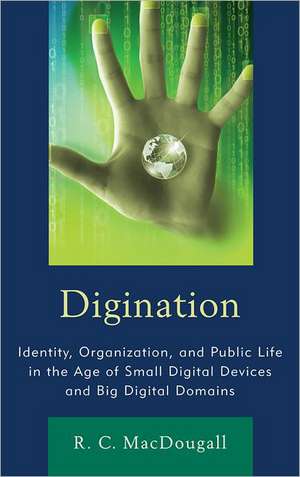
Digination: Identity, Organization, and Public Life in the Age of Small Digital Devices and Big Digital Domains: The Fairleigh Dickinson University Press Series in Communication Studies
Autor Robert C. MacDougallen Limba Engleză Hardback – 16 dec 2011
That time-honored trope: the notion that technology is not the problem, rather, it's how people use technology that's the problem is shown to be wanting. Highlighting Marshall McLuhan's "tetrads" or laws of media as a primary tool of analysis, R.C. MacDougall argues in line with other media ecologists that it's not so much how we use certain tools that matters, it's that we use them. More than any other technological form perhaps, communication technologies play particularly powerful and systemic roles in our culture, or any culture for that matter. Late adopters and even abstainers are not exempt from the psychological, social and cultural effects (and side-effects) of modern digital communication technology. While there are certainly varying degrees of immersion-that is to say, while some of us live in the high-rise downtown district, some at the city limits, and still others out in the proverbial "woods"-we all live in Digination today.
Din seria The Fairleigh Dickinson University Press Series in Communication Studies
- 27%
 Preț: 277.94 lei
 - 34%
 Preț: 634.63 lei
 - 28%
 Preț: 347.34 lei
 - 37%
 Preț: 660.78 lei
 - 24%
 Preț: 331.88 lei
 - 29%
 Preț: 341.60 lei
 - 28%
 Preț: 384.28 lei
 - 26%
 Preț: 285.77 lei
 - 32%
 Preț: 523.33 lei
 - 30%
 Preț: 505.11 lei
 - 29%
 Preț: 345.71 lei
 - 33%
 Preț: 546.23 lei
 - 29%
 Preț: 343.17 lei
 - 23%
 Preț: 329.49 lei
 - 35%
 Preț: 563.86 lei
 - 29%
 Preț: 344.70 lei
 - 30%
 Preț: 435.64 lei
 - 33%
 Preț: 582.81 lei
 - 36%
 Preț: 732.44 lei
 - 26%
 Preț: 280.34 lei
 - 33%
 Preț: 549.82 lei
 - 33%
 Preț: 550.09 lei
 - 27%
 Preț: 254.62 lei
 - 32%
 Preț: 360.88 lei
 - 27%
 Preț: 254.83 lei
 - 34%
 Preț: 571.39 lei
 - 23%
 Preț: 315.83 lei
 - 34%
 Preț: 571.49 lei
 - 30%
 Preț: 538.21 lei
Preț: 641.40 lei
Preț vechi: 906.39 lei
-29%
Puncte Express: 962
Carte tipărită la comandă
Livrare economică 30 noiembrie-14 decembrie
Livrare prin curier în România Termenul estimat este afișat lângă disponibilitate.
Transport gratuit pentru acest produs Plată online sau ramburs, în funcție de opțiunile comenzii.
Retur gratuit în 14 zile Comandă securizată și suport în română.
Specificații
ISBN-13: 9781611474398
ISBN-10: 1611474396
Pagini: 320
Dimensiuni: 162 x 240 x 26 mm
Greutate: 0.59 kg
Ediția:New.
Editura: Bloomsbury Publishing
Colecția Fairleigh Dickinson University Press
Seria The Fairleigh Dickinson University Press Series in Communication Studies
Locul publicării:New York, United States
ISBN-10: 1611474396
Pagini: 320
Dimensiuni: 162 x 240 x 26 mm
Greutate: 0.59 kg
Ediția:New.
Editura: Bloomsbury Publishing
Colecția Fairleigh Dickinson University Press
Seria The Fairleigh Dickinson University Press Series in Communication Studies
Locul publicării:New York, United States
Cuprins
Chapter 1 Understanding our Digination
Chapter 2 Lost Logos: Finding the Art and Argument in McLuhan's Message
Chapter 3 Indigenous E-mail: Identity Construction and the Oral/Textual Interface
Chapter 4 Blogs:The News Medium
Chapter 5 Information, Interactivity, and the Denizen of Digination
Chapter 6 Search Engineering and the Emerging Information Ecology
Chapter 7 Portable Digital Music Devices and the Sound-Tracked Lifeworld
Chapter 8 Podcasting and Lifeworld:From Sound Track to Narractive Track
Chapter 9 Knitting, Napping, and Notebook Computers (and other mnemotechnical systems)
Chapter 10 eBay Ethics:Prefiguring the "Digital Democracy"
Chapter 11 Media Ecology and a Biological Approach to Understanding Our Digination
Chapter 12 Appendix: The Tetrads
Chapter 13 References
Chapter 14 Index
Chapter 2 Lost Logos: Finding the Art and Argument in McLuhan's Message
Chapter 3 Indigenous E-mail: Identity Construction and the Oral/Textual Interface
Chapter 4 Blogs:The News Medium
Chapter 5 Information, Interactivity, and the Denizen of Digination
Chapter 6 Search Engineering and the Emerging Information Ecology
Chapter 7 Portable Digital Music Devices and the Sound-Tracked Lifeworld
Chapter 8 Podcasting and Lifeworld:From Sound Track to Narractive Track
Chapter 9 Knitting, Napping, and Notebook Computers (and other mnemotechnical systems)
Chapter 10 eBay Ethics:Prefiguring the "Digital Democracy"
Chapter 11 Media Ecology and a Biological Approach to Understanding Our Digination
Chapter 12 Appendix: The Tetrads
Chapter 13 References
Chapter 14 Index
Recenzii
Digination's core premise is that technology impacts everyone in many ways-socially, culturally, politically, and psychologically. Life in a digital nation is not simply a reality where humans utilize technology. Conversely, technology is an agent that affects people both individually and collectively as a society. Through a media ecologist's lens, MacDougall (Curry College) weaves theory, empirical data, and his own perspective into an account of technology and its influence on humankind. The volume, part of the publisher's "Communication Studies" series, is divided into 11 chapters. The author begins with an examination of the contributions of media theorist Marshall McLuhan, whose influence is evident throughout the work. The core of the book consists of seven chapters, each focusing on an individual technology. E-mail, blogs, search engines, personal music devices, podcasts, laptops, and eBay take their turn as subjects in this examination. Finally, an appendix of McLuhan tetrads or charts that visually represent the societal effects of individual technologies closes the book. An interesting, timely analysis of the human relationship with the machine. Summing Up: Recommended.
I am impressed with the scope and depth of Dr. MacDougall's understanding of media and their influence on psyche and society alike. [Digination] is going to be useful . [MacDougall] demonstrates an unusual degree of ability to work with the more sophisticated tools that I and my father developed for the study of human technologies.
Digination represents a major contribution to the media ecology literature. I particularly enjoyed the way in which media ecology and biology are combined.
I am impressed with the scope and depth of Dr. MacDougall's understanding of media and their influence on psyche and society alike. [Digination] is going to be useful . [MacDougall] demonstrates an unusual degree of ability to work with the more sophisticated tools that I and my father developed for the study of human technologies.
Digination represents a major contribution to the media ecology literature. I particularly enjoyed the way in which media ecology and biology are combined.