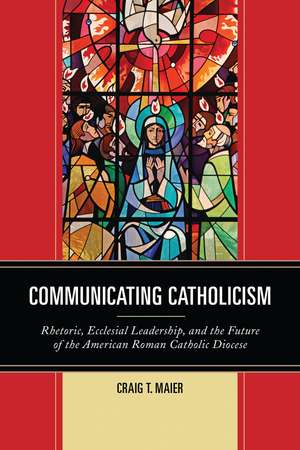
Communicating Catholicism: Rhetoric, Ecclesial Leadership, and the Future of the American Roman Catholic Diocese: The Fairleigh Dickinson University Press Series in Communication Studies
Autor Craig T. Maieren Limba Engleză Hardback – 12 sep 2016
Several decades ago, J. Michael Sproule invited rhetorical and communication scholars to focus on institutions to increase our understanding of the profound role complex organizations play in contemporary life, assess the purpose and significance of communication in pursuit of their missions, and "give a human face to the otherwise institutional voice of corporate suasion." Following Sproule, this book defines a new field called diocesan institutional rhetoric that strives to transform dioceses from structures characterized by closure and adversity into sites of hope-full, response-able, Spirit-led opportunity.
Today, rhetorical and communication issues emerge everywhere in American Catholicism. Drawing together relevant literature in Catholic theology, philosophy of communication, and corporate communication scholarship-as well as over twelve years' experience working as a communication professional in a diocesan chancery-this book helps diocesan leaders, scholars, and observers to think differently and more fruitfully about the future of American Catholic ecclesial leadership.
Din seria The Fairleigh Dickinson University Press Series in Communication Studies
- 27%
 Preț: 277.94 lei
 - 34%
 Preț: 634.63 lei
 - 28%
 Preț: 347.34 lei
 - 37%
 Preț: 660.78 lei
 - 24%
 Preț: 331.88 lei
 - 29%
 Preț: 341.60 lei
 - 28%
 Preț: 384.28 lei
 - 26%
 Preț: 285.77 lei
 - 32%
 Preț: 523.33 lei
 - 30%
 Preț: 505.11 lei
 - 29%
 Preț: 345.71 lei
 - 29%
 Preț: 343.17 lei
 - 23%
 Preț: 329.49 lei
 - 35%
 Preț: 563.86 lei
 - 29%
 Preț: 344.70 lei
 - 30%
 Preț: 435.64 lei
 - 33%
 Preț: 582.81 lei
 - 36%
 Preț: 732.44 lei
 - 26%
 Preț: 280.34 lei
 - 33%
 Preț: 549.82 lei
 - 33%
 Preț: 550.09 lei
 - 27%
 Preț: 254.62 lei
 - 32%
 Preț: 360.88 lei
 - 27%
 Preț: 254.83 lei
 - 34%
 Preț: 571.39 lei
 - 23%
 Preț: 315.83 lei
 - 34%
 Preț: 571.49 lei
 - 30%
 Preț: 538.21 lei
Preț: 546.23 lei
Preț vechi: 817.19 lei
-33%
Puncte Express: 819
Carte tipărită la comandă
Livrare economică 21 noiembrie-05 decembrie
Livrare prin curier în România Termenul estimat este afișat lângă disponibilitate.
Transport gratuit pentru acest produs Plată online sau ramburs, în funcție de opțiunile comenzii.
Retur gratuit în 14 zile Comandă securizată și suport în română.
Specificații
ISBN-13: 9781611479614
ISBN-10: 1611479614
Pagini: 254
Dimensiuni: 158 x 238 x 24 mm
Greutate: 0.57 kg
Editura: Bloomsbury Publishing
Colecția Fairleigh Dickinson University Press
Seria The Fairleigh Dickinson University Press Series in Communication Studies
Locul publicării:New York, United States
ISBN-10: 1611479614
Pagini: 254
Dimensiuni: 158 x 238 x 24 mm
Greutate: 0.57 kg
Editura: Bloomsbury Publishing
Colecția Fairleigh Dickinson University Press
Seria The Fairleigh Dickinson University Press Series in Communication Studies
Locul publicării:New York, United States
Cuprins
Acknowledgements
Foreword: Rhetoric in the Catholic Church by Paul A. Soukup, S.J.
Introduction: The American Diocese in "Dark Times"
Part I: The Call of a Catholic Moment
Chapter One: The Rhetorical Challenge of Ecclesial Leadership
Chapter Two: Framing Diocesan Institutional Rhetoric
Chapter Three: The Corporate Historical Responsibility of Ecclesial Leadership
Part II: The Response of Ecclesial Leadership
Chapter Four: The Historicity of a Catholic Moment
Chapter Five: Chapter Five: Diocesan Institutional Rhetoric and Administrative Play
Chapter Six: The Joy of Ecclesial Leadership
Conclusion: Diocesan Institutional Rhetoric and the Culture of Encounter
References
Index
About the Author
Foreword: Rhetoric in the Catholic Church by Paul A. Soukup, S.J.
Introduction: The American Diocese in "Dark Times"
Part I: The Call of a Catholic Moment
Chapter One: The Rhetorical Challenge of Ecclesial Leadership
Chapter Two: Framing Diocesan Institutional Rhetoric
Chapter Three: The Corporate Historical Responsibility of Ecclesial Leadership
Part II: The Response of Ecclesial Leadership
Chapter Four: The Historicity of a Catholic Moment
Chapter Five: Chapter Five: Diocesan Institutional Rhetoric and Administrative Play
Chapter Six: The Joy of Ecclesial Leadership
Conclusion: Diocesan Institutional Rhetoric and the Culture of Encounter
References
Index
About the Author
Recenzii
Communicating Catholicism: Rhetoric, Ecclesial Leadership, and the Future of the American Roman Catholic Diocese is an extraordinary, definitive, and comprehensive work that adheres to rigorous standards of scholarship and is an impressive, seminal contribution that is very highly recommended for seminary and academic library collections in general, and Roman Catholic Church supplemental studies reading lists in particular.
Through an American lens, Maier examines the Church's unique position of fulfilling an unchanging supernatural commission of world-wide evangelization, in a constantly changing natural world.... In the case studies, Maier dissects each event and offers a critique and analysis of what went wrong and what went right.... Any diocesan communicator will be able to identify with these situations and perhaps be inspired to consider adopting a new, ongoing strategy of sophisticated diocesan institutional rhetoric, to prepare for the next 'crisis', which will soon come.
Through an American lens, Maier examines the Church's unique position of fulfilling an unchanging supernatural commission of world-wide evangelization, in a constantly changing natural world.... In the case studies, Maier dissects each event and offers a critique and analysis of what went wrong and what went right.... Any diocesan communicator will be able to identify with these situations and perhaps be inspired to consider adopting a new, ongoing strategy of sophisticated diocesan institutional rhetoric, to prepare for the next 'crisis', which will soon come.