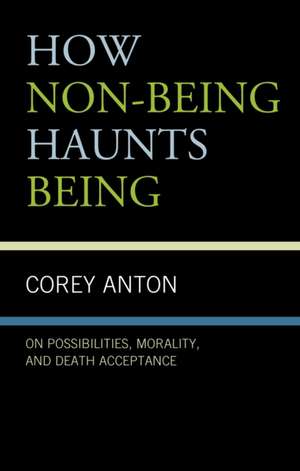
How Non-being Haunts Being: On Possibilities, Morality, and Death Acceptance: The Fairleigh Dickinson University Press Series in Communication Studies
Autor Corey Antonen Limba Engleză Paperback – 14 noi 2022
Din seria The Fairleigh Dickinson University Press Series in Communication Studies
- 27%
 Preț: 277.94 lei
 - 34%
 Preț: 634.63 lei
 - 28%
 Preț: 347.34 lei
 - 37%
 Preț: 660.78 lei
 - 24%
 Preț: 331.88 lei
 - 29%
 Preț: 341.60 lei
 - 28%
 Preț: 384.28 lei
 - 26%
 Preț: 285.77 lei
 - 32%
 Preț: 523.33 lei
 - 30%
 Preț: 505.11 lei
 - 29%
 Preț: 345.71 lei
 - 33%
 Preț: 546.23 lei
 - 29%
 Preț: 343.17 lei
 - 23%
 Preț: 329.49 lei
 - 35%
 Preț: 563.86 lei
 - 29%
 Preț: 344.70 lei
 - 30%
 Preț: 435.64 lei
 - 33%
 Preț: 582.81 lei
 - 36%
 Preț: 732.44 lei
 - 26%
 Preț: 280.34 lei
 - 33%
 Preț: 549.82 lei
 - 33%
 Preț: 550.09 lei
 - 27%
 Preț: 254.62 lei
 - 32%
 Preț: 360.88 lei
 - 34%
 Preț: 571.39 lei
 - 23%
 Preț: 315.83 lei
 - 34%
 Preț: 571.49 lei
 - 30%
 Preț: 538.21 lei
Preț: 254.83 lei
Preț vechi: 349.54 lei
-27%
Puncte Express: 382
Carte tipărită la comandă
Livrare economică 17 noiembrie-01 decembrie
Livrare prin curier în România Termenul estimat este afișat lângă disponibilitate.
Transport gratuit de la 400.00 lei Plată online sau ramburs, în funcție de opțiunile comenzii.
Retur gratuit în 14 zile Comandă securizată și suport în română.
Specificații
ISBN-13: 9781683932864
ISBN-10: 1683932862
Pagini: 194
Ilustrații: 4 b/w illustrations;
Dimensiuni: 150 x 228 x 16 mm
Greutate: 0.27 kg
Editura: Bloomsbury Publishing
Colecția Fairleigh Dickinson University Press
Seria The Fairleigh Dickinson University Press Series in Communication Studies
Locul publicării:New York, United States
ISBN-10: 1683932862
Pagini: 194
Ilustrații: 4 b/w illustrations;
Dimensiuni: 150 x 228 x 16 mm
Greutate: 0.27 kg
Editura: Bloomsbury Publishing
Colecția Fairleigh Dickinson University Press
Seria The Fairleigh Dickinson University Press Series in Communication Studies
Locul publicării:New York, United States
Descriere
How Non-being Haunts Being reveals how the human world is not reducible to "what is." Human life is an open expanse of "what was" and "what will be," "what might be" and "what should be." It is a world of desires, dreams, fictions, historical figures, planned events, spatial and temporal distances, in a word, absent presences and present absences.
Corey Anton draws upon and integrates thinkers such as Jean-Paul Sartre, Henri Bergson, Kenneth Burke, Terrence Deacon, Lynn Margulis, R. D. Laing, Gregory Bateson, Douglas Harding, and E. M. Cioran. He discloses the moral possibilities liberated through death acceptance by showing how living beings, who are of space not merely in it, are fundamentally on loan to themselves.
A heady multidisciplinary work, How Non-being Haunts Being explores how absence, incompleteness, and negation saturate life, language, thought, and culture. It details how meaning and moral agency depend upon forms of non-being, and it argues that death acceptance in no way inevitably slides into nihilism. Thoroughgoing death acceptance, in fact, opens opportunities for deeper levels of self-understanding and for greater compassion regarding our common fate. Sure to provoke thought and to stimulate much conversation, it offers countless insights into the human condition.
Corey Anton draws upon and integrates thinkers such as Jean-Paul Sartre, Henri Bergson, Kenneth Burke, Terrence Deacon, Lynn Margulis, R. D. Laing, Gregory Bateson, Douglas Harding, and E. M. Cioran. He discloses the moral possibilities liberated through death acceptance by showing how living beings, who are of space not merely in it, are fundamentally on loan to themselves.
A heady multidisciplinary work, How Non-being Haunts Being explores how absence, incompleteness, and negation saturate life, language, thought, and culture. It details how meaning and moral agency depend upon forms of non-being, and it argues that death acceptance in no way inevitably slides into nihilism. Thoroughgoing death acceptance, in fact, opens opportunities for deeper levels of self-understanding and for greater compassion regarding our common fate. Sure to provoke thought and to stimulate much conversation, it offers countless insights into the human condition.
Cuprins
Preface
Chapter 1: Nothing at the Heart of Existence
Chapter 2: Life and Many Modes of Bodily Non-Being
Chapter 3: Language, Absence, Negation, and Context
Chapter 4: Death and the Possibilities of Human Morality
Chapter 5: A Mythological/Mathematical Postscript
Chapter 1: Nothing at the Heart of Existence
Chapter 2: Life and Many Modes of Bodily Non-Being
Chapter 3: Language, Absence, Negation, and Context
Chapter 4: Death and the Possibilities of Human Morality
Chapter 5: A Mythological/Mathematical Postscript
Recenzii
How Non-being Haunts Being makes much ado about nothing. A nimble scholar and graceful writer, Corey Anton explains why and how "human experience and reality as a whole can show itself for what it is only as we grasp how nothing or non-being relates to being." Revelatory and provocative. Timely and important.
Our humanity rests on the struggle of reconciling ourselves with death and the afterlife. Professor Anton's work revives this ancient dilemma. Please consider Corey Anton's recent work How Non-Being Haunts Being: On Possibilities, Morality and Death Acceptance as a must read for students of media ecology.
The further I got into Anton's ontological exploration of being and its relation to nonbeing in this most welcome book, the more I considered the old idiom, "nothing ventured, nothing gained"-only perhaps with a new theoretical twist. Like many of his erudite discussions on the nature of "no-thing," the book provides a much-needed theoretical reversal of our taken-for-granted assumptions about the nature of being and human agency. By the end of the book, I was thoroughly convinced that we should adopt a new idiom, "nothing ventured, everything gained"-metaphysically that is. For Anton successfully persuades us that "nothing" is at the heart of our existence and by adopting this new perspective we open to the possibilities of our being limited only by our lack of imagination, communicative abilities, and theoretical prowess.. This book is a wonderful read and my brief descriptions of each chapter do not do justice to the wealth of insight the book provides. Anton-with grace and humility-finds a masterful way of weaving hefty ontology discernments into very practical discussions on matters of everyday importance to our lives. In other words, we not only learn a new ontological perspective but the implications such a new perspective has for a variety of personal, social, cultural, and political issues.
Our humanity rests on the struggle of reconciling ourselves with death and the afterlife. Professor Anton's work revives this ancient dilemma. Please consider Corey Anton's recent work How Non-Being Haunts Being: On Possibilities, Morality and Death Acceptance as a must read for students of media ecology.
The further I got into Anton's ontological exploration of being and its relation to nonbeing in this most welcome book, the more I considered the old idiom, "nothing ventured, nothing gained"-only perhaps with a new theoretical twist. Like many of his erudite discussions on the nature of "no-thing," the book provides a much-needed theoretical reversal of our taken-for-granted assumptions about the nature of being and human agency. By the end of the book, I was thoroughly convinced that we should adopt a new idiom, "nothing ventured, everything gained"-metaphysically that is. For Anton successfully persuades us that "nothing" is at the heart of our existence and by adopting this new perspective we open to the possibilities of our being limited only by our lack of imagination, communicative abilities, and theoretical prowess.. This book is a wonderful read and my brief descriptions of each chapter do not do justice to the wealth of insight the book provides. Anton-with grace and humility-finds a masterful way of weaving hefty ontology discernments into very practical discussions on matters of everyday importance to our lives. In other words, we not only learn a new ontological perspective but the implications such a new perspective has for a variety of personal, social, cultural, and political issues.