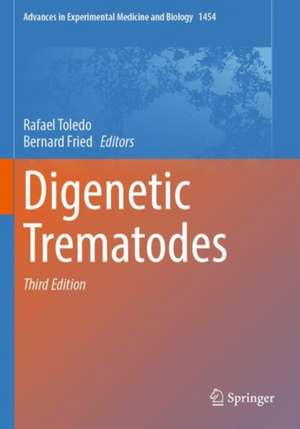
Digenetic Trematodes: Advances in Experimental Medicine and Biology, cartea 1454
Editat de Rafael Toledo, Bernard Frieden Limba Engleză Paperback – 17 iul 2025
Din seria Advances in Experimental Medicine and Biology
- 30%
 Preț: 752.07 lei
 - 5%
 Preț: 1334.86 lei
 - 5%
 Preț: 1212.42 lei
 - 5%
 Preț: 1335.15 lei
 - 5%
 Preț: 1207.57 lei
 - 5%
 Preț: 1142.42 lei
 - 18%
 Preț: 1163.92 lei
 - 5%
 Preț: 1057.02 lei
 - 5%
 Preț: 1487.84 lei
 - 5%
 Preț: 1200.13 lei
 - 18%
 Preț: 980.33 lei
 - 5%
 Preț: 942.82 lei
 - 18%
 Preț: 992.48 lei
 - 18%
 Preț: 1274.22 lei
 - 5%
 Preț: 1275.48 lei
 - 18%
 Preț: 1157.14 lei
 - 5%
 Preț: 1138.79 lei
 - 18%
 Preț: 1165.27 lei
 - 5%
 Preț: 1206.95 lei
 - 18%
 Preț: 1268.90 lei
 - 5%
 Preț: 1347.73 lei
 - 18%
 Preț: 1462.85 lei
 - 18%
 Preț: 1459.28 lei
 - 18%
 Preț: 1283.66 lei
 - 5%
 Preț: 1679.37 lei
 - 5%
 Preț: 1352.87 lei
 - 18%
 Preț: 1166.87 lei
 - 5%
 Preț: 1138.79 lei
 - 24%
 Preț: 966.03 lei
 - 15%
 Preț: 667.86 lei
 - 5%
 Preț: 1137.79 lei
 - 18%
 Preț: 981.18 lei
 - 18%
 Preț: 980.36 lei
 - 5%
 Preț: 1199.06 lei
 - 20%
 Preț: 1742.49 lei
 - 5%
 Preț: 750.62 lei
 - 18%
 Preț: 1451.34 lei
 - 5%
 Preț: 1133.64 lei
 - 18%
 Preț: 2616.27 lei
 - 5%
 Preț: 1075.08 lei
 - 18%
 Preț: 1443.07 lei
 - 5%
 Preț: 745.85 lei
 - 5%
 Preț: 1146.99 lei
 - 5%
 Preț: 696.54 lei
 - 18%
 Preț: 1037.10 lei
 - 5%
 Preț: 1363.25 lei
 - 5%
 Preț: 1084.55 lei
 - 5%
 Preț: 701.25 lei
Preț: 2212.49 lei
Preț vechi: 2328.94 lei
-5%
Puncte Express: 3319
Carte tipărită la comandă
Livrare economică 27 noiembrie-03 decembrie
Livrare prin curier în România Termenul estimat este afișat lângă disponibilitate.
Transport gratuit pentru acest produs Plată online sau ramburs, în funcție de opțiunile comenzii.
Retur gratuit în 14 zile Comandă securizată și suport în română.
Specificații
ISBN-13: 9783031601231
ISBN-10: 3031601238
Pagini: 604
Dimensiuni: 178 x 254 x 33 mm
Greutate: 1.12 kg
Ediția:Third Edition 2024
Editura: Springer
Colecția Advances in Experimental Medicine and Biology
Seria Advances in Experimental Medicine and Biology
ISBN-10: 3031601238
Pagini: 604
Dimensiuni: 178 x 254 x 33 mm
Greutate: 1.12 kg
Ediția:Third Edition 2024
Editura: Springer
Colecția Advances in Experimental Medicine and Biology
Seria Advances in Experimental Medicine and Biology
V-ar putea interesa
-
 Into the Clear Blue SkyRob JacksonPreț: 79.10 lei
 -
 Adventures in FermentationJohnny DrainPreț: 166.76 lei
 -
 Diagnostic Parasitology for Veterinary TechniciansCharles M. Hendrix-30%Preț: 540.56 lei768.69 lei
 -
 AliveMadeline Schwartzman-16%Preț: 239.96 lei286.87 lei
 -
 Veterinary Parasitology Reference ManualWilliam J. Foreyt-19%Preț: 420.98 lei519.72 lei
 -
 Veterinary Clinical ParasitologyAnne M Zajac-5%Preț: 603.17 lei634.92 lei
 -
 Troubled WaterSeth M SiegelPreț: 169.69 lei
 -
 Ecotoxicology: A Case-based ApproachLeah Bendell-23%Preț: 627.26 lei814.63 lei
 -
 -18%Preț: 945.22 lei1152.70 lei
 -
 Microbial NutraceuticalsSudhir Pratap Singh-23%Preț: 1061.68 lei1378.81 lei
 -
 Animal Biology and Care, 4th EditionEmily Jewell-5%Preț: 383.54 lei403.73 lei
 -
 Science Under SiegeMichael E MannPreț: 196.89 lei
 -
 Milk Into CheeseDavid Asher-18%Preț: 386.50 lei469.95 lei
 -
 Advances in Environmental Research: Volume 18Justin A Daniels-26%Preț: 730.58 lei992.26 lei
 -
 On ExtinctionMelanie ChallengerPreț: 109.95 lei
 -
 Space to GrowMatthew WeinzierlPreț: 196.09 lei
 -
 DoctoredCharles PillerPreț: 113.40 lei
 -
 FermentTim Spector-5%Preț: 149.00 lei156.83 lei
 -
 The Future of AgricultureSarah BearchellPreț: 71.26 lei
 -
 Deep WaterJames BradleyPreț: 94.57 lei
Cuprins
Part I: General Aspects of the Trematodes.- 1.Form and Function in the Digenea.- 2.Systematics of the Trematoda.- Part II: Trematodes of Interest in Human and Animal Health.- 3.Schistosomiasis.- 4.Other Schistosomotoidae and Diplostomoidea.- 5.Fascioliasis.- 6.Paragonimiasis.- 7.Liver Flukes: Clonorchis and Opisthorchis.- 8.Echinostomes and Other Intestinal Trematode Infections.- 9.Amphistomes.- 10.Dicrocoeliidae Family: Major Species Causing Veterinary Diseases.- 11.Selected Wildlife Trematodes.- Part III: Clinical Aspects of Trematode Infections.- 12.Epidemiology and Geographical Distribution of Human Trematode Infections.- 13.Trematode Genomics and Proteomics.- 14.Diagnosis of human trematode infections.
Recenzii
Notă biografică
Dr Rafael Toledo is a parasitologist with a research interest on host-parasite interactions, with emphasis on the immunological aspects of intestinal trematode infections. He is currently Full Professor of Parasitology at the University of Valencia. He began working on trematode biology and systematics, with emphasis on echinostomes. During his post-doctoral stage at the University of Puerto Rico, he focused on immunological aspects of host-parasite interactions. Currently, his research is dedicated to the immunological interactions is the experimental model Echinostoma-rodent and other intestinal helminth infections. He has written and/or edited more than 150 works including original research articles in peer-reviewed journals, reviews, book chapters, and books.
Dr Bernard Fried† was Kreider Professor Emeritus at Lafayette College, USA. He was the author or coauthor of more than 500 scientific publications, including articles, reviews, books, and book chapters. He received a Ph.D in Zoology (Parasitology) from the University of Connecticut in 1961 and was an NIH Postdoctoral Fellow in Parasitology at Emory University in Atlanta, GA from 1961 to 1963. He was Professor of Biology at Lafayette College from 1963 to 2000 and his research was focused in the biology of helminths and gastropods and applications of TLC to the biological sciences.
Dr Bernard Fried† was Kreider Professor Emeritus at Lafayette College, USA. He was the author or coauthor of more than 500 scientific publications, including articles, reviews, books, and book chapters. He received a Ph.D in Zoology (Parasitology) from the University of Connecticut in 1961 and was an NIH Postdoctoral Fellow in Parasitology at Emory University in Atlanta, GA from 1961 to 1963. He was Professor of Biology at Lafayette College from 1963 to 2000 and his research was focused in the biology of helminths and gastropods and applications of TLC to the biological sciences.
Textul de pe ultima copertă
Although digenetic trematodes have been largely neglected, they constitute a major group of helminths that parasitize human and animals causing significant morbidity and mortality. This is of special importance today, since the geographical limits and the populations at risk, traditionally limited to developing or low-income countries, are currently expanding and changing in relation to factors such as growing international markets, improved transportation systems, and demographic changes. This has led to a growing international interest in trematode infections, although factors such as the difficulties entailed in the diagnosis, the complexity of human and agricultural practices, the lack of assessments of economic costs, or the limited number of effective drugs are preventing the development of control measures of these diseases in humans and livestock. In-depth studies are needed to clarify the current epidemiology of these helminth infections and to identify new and specific targets for both effective diagnosis and treatments. The main goal of the third edition of this book is to present the major trematodes and their corresponding diseases in the framework of modern parasitology, considering matters such as the application of novel techniques and analysis of data in the context of host-parasite interactions and also with the resident microbiota, showing the application of modern techniques and concepts to the studies on digenetic trematodes. This is an ideal book for parasitologists, microbiologists, zoologists, immunologists, public health professionals, clinicians and graduate and post-graduate students.
Caracteristici
Covers the trematodes of interest in human and animal health comprehensively Updates the current status of knowledge on the trematodiases that cover novel techniques Includes a novel chapter on the genomics and proteomics of trematodes Provides comprehensive material for researchers, clinicians, veterinarians, biologists, and pre and post-graduate students.