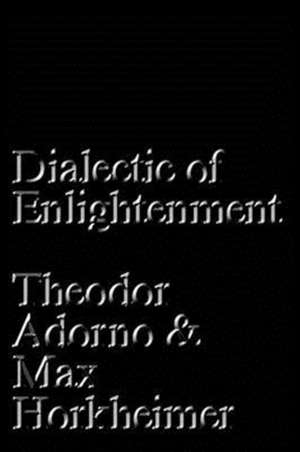
Dialectic of Enlightenment
Autor Max Horkheimer, Theodor Adornoen Limba Engleză Paperback – 6 sep 2016
Theodor Adorno and Max Horkheimer are the leading figures of the Frankfurt School and this book is their magnum opus. Dialectic of Enlightenment is one of the most celebrated works of modern social philosophy that continues to impress in its wide-ranging ambition. Writing just after the Second World War and reflecting on the bureaucracy and myths of National Socialism and the inanity of the dawn of consumerism, Adorno and Horkheimer addressed themselves to a question which went to the very heart of the modern age: 'why mankind, instead of entering into a truly human condition, is sinking into a new kind of barbarism'.
Modernity, far from redeeming the promises and hopes of the Enlightenment, had resulted in a stultification of mankind and administered society, characterised by simulation and candy-floss entertainment. Tracing humanity's modern fall to the very rationality that was to be its liberation, the authors exposed the domination and violence that underpin the Enlightenment project.
| Toate formatele și edițiile | Preț | Express |
|---|---|---|
| Paperback (2) | 116.91 lei 3-5 săpt. | +12.22 lei 5-11 zile |
| Verso Books – 6 sep 2016 | 116.91 lei 3-5 săpt. | +12.22 lei 5-11 zile |
| Stanford University Press – 13 mar 2007 | 188.42 lei 3-5 săpt. | +18.00 lei 5-11 zile |
| Hardback (1) | 676.92 lei 6-8 săpt. | |
| Stanford University Press – 27 mar 2002 | 676.92 lei 6-8 săpt. |
Preț: 116.91 lei
Nou
20.69€ • 24.26$ • 18.17£
Carte disponibilă
Livrare economică 12-26 ianuarie 26
Livrare express 27 decembrie 25 - 02 ianuarie 26 pentru 22.21 lei
Specificații
ISBN-10: 1784786799
Pagini: 288
Dimensiuni: 206 x 135 x 20 mm
Greutate: 0.27 kg
Editura: Verso Books
V-ar putea interesa
-
 Light on YogaB. K. S. IyengarPreț: 148.60 lei
 -
 Miss Rumphius: Story and PicturesBarbara CooneyPreț: 46.13 lei
 -
 The Political Philosophy of FénelonRyan Patrick HanleyPreț: 310.08 lei
 -
 -14%Preț: 556.80 lei647.44 lei
 -
 Early Modern Cartesianisms: Dutch and French ConstructionsTad M. Schmaltz-14%Preț: 678.83 lei789.34 lei
 -
 Humean Moral PluralismMichael B. Gill-34%Preț: 508.22 lei764.27 lei
 -
 Isaiah Berlin and the EnlightenmentLaurence Brockliss-34%Preț: 501.81 lei754.84 lei
 -
 -31%Preț: 403.74 lei582.10 lei
 -
 Kant on Mind, Action, and EthicsJulian Wuerth-34%Preț: 634.52 lei954.26 lei
 -
 Essays on KantHenry E. Allison-8%Preț: 340.58 lei369.59 lei
 -
 -12%Preț: 209.37 lei238.47 lei
 -
 The Essential Thich Nhat HanhThich Nhat HanhPreț: 88.34 lei
 -
 This Is ItAlan WattsPreț: 62.60 lei
 -
 The Complete Correspondence, 1928–1940Theodor AdornoPreț: 393.69 lei
 -
 Sound FiguresTheodor AdornoPreț: 153.48 lei
 -
 Kant’s ‘Critique of Pure Reason’Theodor AdornoPreț: 221.74 lei
 -
 Metaphysics: Concept and ProblemsTheodor AdornoPreț: 185.56 lei
 -
 Preț: 108.31 lei
 -
 Giraffes Can't DanceAndreae Giles-27%Preț: 40.85 lei55.59 lei
 -
 Kleine Schriften 3Allegra De Laurentiis-23%Preț: 878.88 lei1141.39 lei
 -
 -23%Preț: 878.81 lei1141.31 lei
 -
 Kasuistik und Theorie des Gewissens. Von Pascal bis KantAlberto Frigo-23%Preț: 877.19 lei1139.20 lei
 -
 Kommentar zu Nietzsches "Unzeitgemäße Betrachtungen" III und IVBarbara Neymeyr-19%Preț: 486.47 lei600.58 lei
 -
 ¿Qué me quieres, amor?Manuel RivasPreț: 48.07 lei
 -
 La Ciudad de las BestiasIsabel AllendePreț: 81.60 lei
Notă biografică
Theodor Adorno and Max Horkheimer, illustrated by AP
Descriere
A classic of twentieth-century thought, charting how reason regressed back into myth and superstition