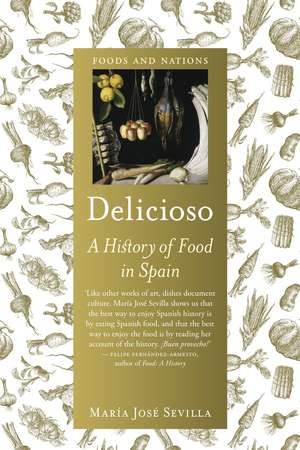
Delicioso: A History of Food in Spain: Foods and Nations
Autor María José Sevillaen Limba Engleză Paperback – 3 oct 2025
Spanish cuisine is a melting-pot of cultures, flavors, and ingredients: Greek and Roman; Jewish, Moorish, and Middle Eastern. It has been enriched by Spanish climate, geology, and spectacular topography, which have encouraged a variety of regional food traditions and “Cocinas,” such as Basque, Galician, Castilian, Andalusian, and Catalan. It has been shaped by the country’s complex history, as foreign occupations brought religious and cultural influences that determined what people ate and still eat. And it has continually evolved with the arrival of new ideas and foodstuffs from Italy, France, and the Americas, including cocoa, potatoes, tomatoes, beans, and chili peppers. Having become a powerhouse of creativity and innovation in recent decades, Spanish cuisine has placed itself among the best in the world.
This is the first book in English to trace the history of the food of Spain from antiquity to the present day. From the use of pork fat and olive oil to the Spanish passion for eggplants and pomegranates, María José Sevilla skillfully weaves together the history of Spanish cuisine, the circumstances affecting its development and characteristics, and the country’s changing relationship to food and cookery.
This is the first book in English to trace the history of the food of Spain from antiquity to the present day. From the use of pork fat and olive oil to the Spanish passion for eggplants and pomegranates, María José Sevilla skillfully weaves together the history of Spanish cuisine, the circumstances affecting its development and characteristics, and the country’s changing relationship to food and cookery.




Preț: 200.36 lei
Puncte Express: 301
Carte disponibilă
Livrare economică 05-19 noiembrie
Livrare prin curier în România Termenul estimat este afișat lângă disponibilitate.
Transport gratuit de la 400.00 lei Plată online sau ramburs, în funcție de opțiunile comenzii.
Retur gratuit în 14 zile Comandă securizată și suport în română.
Specificații
ISBN-13: 9781836390817
ISBN-10: 1836390815
Pagini: 344
Ilustrații: 85 color plates, 12 halftones
Dimensiuni: 156 x 234 x 23 mm
Greutate: 0.85 kg
Editura: REAKTION BOOKS
Colecția Reaktion Books
Seria Foods and Nations
ISBN-10: 1836390815
Pagini: 344
Ilustrații: 85 color plates, 12 halftones
Dimensiuni: 156 x 234 x 23 mm
Greutate: 0.85 kg
Editura: REAKTION BOOKS
Colecția Reaktion Books
Seria Foods and Nations
Notă biografică
María José Sevilla's previous books include Life and Food in the Basque Country (1989), Spain on a Plate (1992) and Mediterranean Flavours (1995). She lives in London, UK, and the Sierra de Aracena in Andalusia, Spain.
Cuprins
Introduction one A Land at the Edge of the Unknown two Moors, Jews and Christians three Life in the Castle four A Golden Age five Madrid, Versailles, Naples and, Best of All, Chocolate six Politics at the Table seven Hunger, Hope and Success eight The Cocinas of Spain References Select Bibliography Acknowledgements Photo Acknowledgements Index
Recenzii
"In the past two decades, the reputation of Spanish food on the world’s culinary stage has skyrocketed, with chefs like Ferran Adrià, the Roca brothers, the Arzaks and José Andrés in the lead. But as Delicioso, a new history of Spanish food explains, it is not a sudden phenomenon. The illustrated book is a dense, scholarly survey that starts with prehistory some 80,000 years ago. It traces the contributions to the Spanish table by ancient Rome; Moorish, Christian and Jewish cultures; European royalty; and foods of the New World. The effects of social and political change, years of war and the rise of the influential Spanish chefs of today are covered, as are ingredients like olives, anchovies and chocolate; markets; dishes like cocido; and time-honored utensils. There’s a quick survey of food across Spain, region by region."
"Some people travel for the thrill of adventure, some to see something new, but others travel to taste the tradition of a place through food. Sevilla’s Delicioso: A History of Food in Spain will get your culinary travel-loving loved one ready for their next trip. Sevilla’s book explores every era, dish, and history behind each iconic Spanish ingredient. From tinned Basque seafood to paella and the iconic chocolate for dipping churros in, the reader is immediately immersed in what makes Spain truly delicious."
Won
"Sevilla’s history of Spain and surrounding islands through edibles incorporates cooking into an exacting cultural overview. From the Celtic origins of Iberia, initial chapters examine early settlement through 1492, menu by menu. With a burst of specifics, the history of the Columbian exchange accompanies growth of the salt cod industry and worldwide pepper and saffron trades. By examining Jewish, Moorish, and Islamic immigrants and their tastes, the text accounts for a complex diet rich in flavors and aromas, from pulses, moles, lenten eggs and beans, and gazpacho to lamb and anchovy grills, tartas, and manchego cheese. Meticulous footnotes and bibliography precede primary and secondary indexing that points the way to the stews and bitter oranges of Andaluz, Castilian black pudding and roast meats, the mozdrabe cuisine of Cordoba, and periods of starvation during World War II and the Spanish Civil War. Memorable passages treating individual foods—potatoes, sugar, tomatoes, chocolate, rice—epitomize the Spanish skill at incorporating newcomers to the marketplace in piquant fritters, omelets, marzipan, and restaurant tapas . . . A prize for the culinary section of public, high school, or college libraries. Highly recommended."
"Like other works of art, dishes document culture. Sevilla shows us that the best way to enjoy Spanish history is by eating Spanish food, and that the best way to enjoy the food is by reading her account of the history. ¡Buen provecho!"
"An epic and very readable history of Spanish food culture from Palaeolithic times to the present day. Excellent and very interesting."