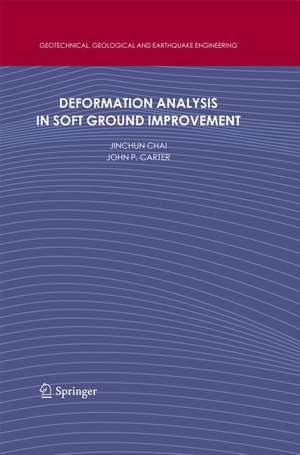
Deformation Analysis in Soft Ground Improvement: Geotechnical, Geological and Earthquake Engineering, cartea 18
Autor Jinchun Chai, John P. Carteren Limba Engleză Hardback – 14 iul 2011
The book commences with a brief description of the various ground improvement methods and then describes general techniques for modelling the behaviour of soft clay subsoils by the finite element method, as well as details of the methods for modelling soft soils improved by the installation of PVDs. It also includes chapters describing the theory of vacuum consolidation and methods for calculating vacuum pressure-induced ground deformation, as well as a theory which can be used to predict the response of soft ground improved by the installation of soil-cement columns. An important distinguishing feature of this book is the routine use of comparisons of predictions of the proposed models with the results of laboratory studies, and particularly field case studies, in order to validate the proposed methods of analysis. The field case histories are from soft soil sites at various locations around the world.
The book is directed towards students of geotechnical engineering as well as geotechnical practitioners. In the main itprovides complete derivations of most of the important theoretical results, as the intention was to write a book that could be used as both a teaching text and a reference work for students and practitioners.
Audience: The book is intended for geotechnical practitioners as well as for students.
Din seria Geotechnical, Geological and Earthquake Engineering
- 15%
 Preț: 666.16 lei
 - 18%
 Preț: 1394.30 lei
 - 15%
 Preț: 703.83 lei
 - 18%
 Preț: 921.95 lei
 - 15%
 Preț: 634.46 lei
 - 18%
 Preț: 1953.02 lei
 - 18%
 Preț: 792.60 lei
 -
 Preț: 390.11 lei
 - 18%
 Preț: 917.56 lei
 - 18%
 Preț: 977.98 lei
 - 15%
 Preț: 617.05 lei
 - 18%
 Preț: 959.38 lei
 - 15%
 Preț: 636.29 lei
 - 20%
 Preț: 621.40 lei
 - 24%
 Preț: 870.99 lei
 - 20%
 Preț: 678.41 lei
 - 15%
 Preț: 642.16 lei
 - 18%
 Preț: 1283.74 lei
 - 15%
 Preț: 618.88 lei
 - 15%
 Preț: 616.24 lei
 - 18%
 Preț: 1227.12 lei
 - 18%
 Preț: 994.79 lei
 - 18%
 Preț: 989.70 lei
 - 15%
 Preț: 676.39 lei
 - 18%
 Preț: 996.70 lei
 - 15%
 Preț: 677.51 lei
 - 15%
 Preț: 675.30 lei
 - 18%
 Preț: 989.70 lei
 - 15%
 Preț: 675.97 lei
 - 18%
 Preț: 997.36 lei
 - 15%
 Preț: 672.24 lei
 -
 Preț: 432.86 lei
 - 18%
 Preț: 1003.27 lei
 - 18%
 Preț: 1158.76 lei
Preț: 667.91 lei
Preț vechi: 785.78 lei
-15%
Puncte Express: 1002
Carte tipărită la comandă
Livrare economică 24 noiembrie-08 decembrie
Livrare prin curier în România Termenul estimat este afișat lângă disponibilitate.
Transport gratuit pentru acest produs Plată online sau ramburs, în funcție de opțiunile comenzii.
Retur gratuit în 14 zile Comandă securizată și suport în română.
Specificații
ISBN-13: 9789400717206
ISBN-10: 9400717202
Pagini: 268
Ilustrații: XVIII, 250 p.
Dimensiuni: 160 x 241 x 20 mm
Greutate: 0.52 kg
Ediția:2011
Editura: Springer
Colecția Geotechnical, Geological and Earthquake Engineering
Seria Geotechnical, Geological and Earthquake Engineering
Locul publicării:Dordrecht, Netherlands
ISBN-10: 9400717202
Pagini: 268
Ilustrații: XVIII, 250 p.
Dimensiuni: 160 x 241 x 20 mm
Greutate: 0.52 kg
Ediția:2011
Editura: Springer
Colecția Geotechnical, Geological and Earthquake Engineering
Seria Geotechnical, Geological and Earthquake Engineering
Locul publicării:Dordrecht, Netherlands
V-ar putea interesa
-
 Isaaks, E: Applied GeostatisticsEdward H. (Department of Applied Earth SciencesStanford University) Isaaks-27%Preț: 1179.43 lei1615.66 lei
 -
 Hydrofracking: What Everyone Needs to Know®Alex Prud'homme-20%Preț: 59.96 lei75.38 lei
 -
 Hydrofracking: What Everyone Needs to Know®Alex Prud'homme-22%Preț: 287.35 lei369.44 lei
 -
 Acid Mine Drainage, Rock Drainage, and Acid Sulfate SoilsJames A Jacobs-9%Preț: 962.89 lei1058.12 lei
 -
 ColtanMichael NestPreț: 174.50 lei
 -
 H2O: A Biography of WaterPhilip Ball-26%Preț: 68.90 lei93.62 lei
 -
 Metal SustainabilityReed M Izatt-9%Preț: 1073.15 lei1179.29 lei
 -
 Rock MechanicsBarry H. G. Brady-23%Preț: 705.03 lei915.62 lei
 -
 Plates PlumesFoulger-8%Preț: 609.63 lei662.65 lei
 -
 Open Pit Mine Planning and Design, Two Volume Set & CD-ROM PackWilliam A. Hustrulid-9%Preț: 1121.31 lei1232.21 lei
 -
 -18%Preț: 996.70 lei1215.49 lei
 -
 GPR Remote Sensing in ArchaeologyDean Goodman-15%Preț: 549.88 lei646.92 lei
 -
 Applied MineralogySwapna Mukherjee-15%Preț: 706.25 lei830.88 lei
Public țintă
ResearchCuprins
Preface.- Notation.- 1 Introduction.- 2 Modelling Soft Clay Behaviour.- 3 Vertical Drains.- 4 Vacuum Consolidation.- 5 Soil-cement Columns.- 6 Concluding Remarks.- Index.
Textul de pe ultima copertă
This book deals with the behaviour of soft ground improved by some of the more common methods, including the installation of prefabricated vertical drains (PVDs), or the installation of soil-cement columns formed by deep mixing, or the preloading of soft ground by application of a vacuum pressure in addition to, or instead of, a surcharge loading. In particular, it describes the theories and the numerical modelling techniques that may be applied to these soft ground improvement schemes to estimate the immediate and time-dependent mechanical response of the in situ soil. Particular emphasis has been placed on methods that reliably predict ground deformations associated with ground improvement techniques.
The book commences with a brief description of the various ground improvement methods and then describes general techniques for modelling the behaviour of soft clay subsoils by the finite element method, as well as details of the methods for modelling soft soils improved by the installation of PVDs. It also includes chapters describing the theory of vacuum consolidation and methods for calculating vacuum pressure-induced ground deformation, as well as a theory which can be used to predict the response of soft ground improved by the installation of soil-cement columns. An important distinguishing feature of this book is the routine use of comparisons of predictions of the proposed models with the results of laboratory studies, and particularly field case studies, in order to validate the proposed methods of analysis. The field case histories are from soft soil sites at various locations around the world.
The book is directed towards students of geotechnical engineering as well as geotechnical practitioners. In the main itprovides complete derivations of most of the important theoretical results, as the intention was to write a book that could be used as both a teaching text and a reference work for students and practitioners.
Audience: The book is intended for geotechnical practitioners as well as for students.
The book commences with a brief description of the various ground improvement methods and then describes general techniques for modelling the behaviour of soft clay subsoils by the finite element method, as well as details of the methods for modelling soft soils improved by the installation of PVDs. It also includes chapters describing the theory of vacuum consolidation and methods for calculating vacuum pressure-induced ground deformation, as well as a theory which can be used to predict the response of soft ground improved by the installation of soil-cement columns. An important distinguishing feature of this book is the routine use of comparisons of predictions of the proposed models with the results of laboratory studies, and particularly field case studies, in order to validate the proposed methods of analysis. The field case histories are from soft soil sites at various locations around the world.
The book is directed towards students of geotechnical engineering as well as geotechnical practitioners. In the main itprovides complete derivations of most of the important theoretical results, as the intention was to write a book that could be used as both a teaching text and a reference work for students and practitioners.
Audience: The book is intended for geotechnical practitioners as well as for students.
Caracteristici
Synthesize theory and practice aspects Rich of case history analysis Both numerical and analytical analysis methods State-of-art information Suited for both researchers and practitioners