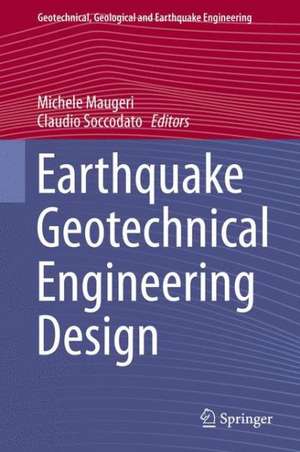
Earthquake Geotechnical Engineering Design: Geotechnical, Geological and Earthquake Engineering, cartea 28
Editat de Michele Maugeri, Claudio Soccodatoen Limba Engleză Hardback – 27 mar 2014
Over the past five years considerable progress has been made in Earthquake Geotechnical Engineering Design (EGED). The most recent advances are presented in this book in 6 parts.
The evaluation of the site amplification is covered in Part I of the book. In Part II the evaluation of the soil foundation stability against natural slope failure and liquefaction is treated. In the following 3 Parts of the book the EGED for different geotechnical systems is presented as follows: the design of levees and dams including natural slopes in Part III; the design of foundations and soil structure interaction analysis in Part IV; underground structures in Part V. Finally in Part VI, new topics like the design of reinforced earth retaining walls and landfills are covered.
Din seria Geotechnical, Geological and Earthquake Engineering
- 15%
 Preț: 666.16 lei
 - 18%
 Preț: 1394.30 lei
 - 15%
 Preț: 703.83 lei
 - 18%
 Preț: 921.95 lei
 - 15%
 Preț: 634.46 lei
 - 18%
 Preț: 1953.02 lei
 - 18%
 Preț: 792.60 lei
 -
 Preț: 390.11 lei
 - 18%
 Preț: 917.56 lei
 - 18%
 Preț: 977.98 lei
 - 15%
 Preț: 617.05 lei
 - 18%
 Preț: 959.38 lei
 - 15%
 Preț: 636.29 lei
 - 20%
 Preț: 621.40 lei
 - 24%
 Preț: 870.99 lei
 - 20%
 Preț: 678.41 lei
 - 15%
 Preț: 642.16 lei
 - 18%
 Preț: 1194.47 lei
 - 15%
 Preț: 618.88 lei
 - 15%
 Preț: 616.24 lei
 - 18%
 Preț: 1227.12 lei
 - 18%
 Preț: 929.54 lei
 - 18%
 Preț: 922.72 lei
 - 15%
 Preț: 631.12 lei
 - 18%
 Preț: 965.57 lei
 - 15%
 Preț: 657.02 lei
 - 18%
 Preț: 922.41 lei
 - 15%
 Preț: 655.53 lei
 - 18%
 Preț: 924.52 lei
 - 15%
 Preț: 651.96 lei
 -
 Preț: 432.86 lei
 - 18%
 Preț: 949.97 lei
 - 18%
 Preț: 1122.25 lei
Preț: 654.93 lei
Preț vechi: 770.51 lei
-15%
Puncte Express: 982
Carte tipărită la comandă
Livrare economică 18 noiembrie-02 decembrie
Livrare prin curier în România Termenul estimat este afișat lângă disponibilitate.
Transport gratuit pentru acest produs Plată online sau ramburs, în funcție de opțiunile comenzii.
Retur gratuit în 14 zile Comandă securizată și suport în română.
Specificații
ISBN-13: 9783319031811
ISBN-10: 3319031813
Pagini: 400
Ilustrații: XII, 388 p. 306 illus., 212 illus. in color.
Dimensiuni: 160 x 241 x 27 mm
Greutate: 0.76 kg
Ediția:2014
Editura: Springer
Colecția Geotechnical, Geological and Earthquake Engineering
Seria Geotechnical, Geological and Earthquake Engineering
Locul publicării:Cham, Switzerland
ISBN-10: 3319031813
Pagini: 400
Ilustrații: XII, 388 p. 306 illus., 212 illus. in color.
Dimensiuni: 160 x 241 x 27 mm
Greutate: 0.76 kg
Ediția:2014
Editura: Springer
Colecția Geotechnical, Geological and Earthquake Engineering
Seria Geotechnical, Geological and Earthquake Engineering
Locul publicării:Cham, Switzerland
V-ar putea interesa
-
 Tropical CyclonesJames P. Terry-15%Preț: 636.41 lei748.72 lei
 -
 Evaluation of Uncertainties and Risks in GeologyGyörgy Bardossy-15%Preț: 662.95 lei779.94 lei
 -
 Natural Disasters and Extreme Events in AgricultureMannava Vk Sivakumar-24%Preț: 899.78 lei1183.91 lei
 -
 Detecting and Modelling Regional Climate ChangeManola Brunet India-18%Preț: 1000.02 lei1219.53 lei
 -
 Bifurcations, Instabilities, Degradation in GeomechanicsGeorge Exadaktylos-18%Preț: 1197.50 lei1460.37 lei
 -
 Stochastic Climate TheorySerguei G. Dobrovolski-18%Preț: 1260.98 lei1537.78 lei
 -
 Managing Weather and Climate Risks in AgricultureMannava Vk Sivakumar-18%Preț: 1239.41 lei1511.49 lei
 -
 Design and Construction of TunnelsPietro Lunardi-18%Preț: 1137.99 lei1387.80 lei
 -
 -18%Preț: 1188.26 lei1449.09 lei
 -
 Intelligent Distributed Computing IVMohammad Essaaidi-18%Preț: 1176.44 lei1434.69 lei
 -
 Messina Seismological Observatory Memorial VolumeAntonio BottariPreț: 369.10 lei
 -
 Diversite Morphologique Dans La Ville Contemporaine: Senegal/FranceStéphanie de RoguinPreț: 348.93 lei
 -
 Observation de La Terre Par Teledetection: Quel Consensus?François Becker-23%Preț: 685.30 lei890.00 lei
Public țintă
ResearchCuprins
Spatially constrained inversion of surface wave data to build shear wave velocity models.- Site Classification and spectral amplification for seismic code provisions.- Sand Liquefaction observed during Recent earthquake and Basic Laboratory Studies on Aging effect.-
Liquefaction In Tokyo Bay And Kanto Regions In The 2011 Great East Japan Earthquake.- Allowable settlement and inclination of houses defined after the 2011 Tohoku - Pacific Ocean Earthquake in Japan.- Seismic Performance of River Levees; Experience and Prediction.- Earthquake Performance Design of Dams using Destructive Potential Factors.- Seismic response of shallow footings: a promising application for the macro-element approach.- Large-Scale Modeling of Ground and Soil-Structure Earthquake Response.- Seismic displacement based design of structures: relevance of soil structure interaction.- Performance and seismic design of underground structures.- Reinforced Soil Walls during the Recent Great Earthquakes in Japan and Geo-Risk based Design.- Performance Based Seismic Design of Geosynthetic Barriers for Waste Containment.
Liquefaction In Tokyo Bay And Kanto Regions In The 2011 Great East Japan Earthquake.- Allowable settlement and inclination of houses defined after the 2011 Tohoku - Pacific Ocean Earthquake in Japan.- Seismic Performance of River Levees; Experience and Prediction.- Earthquake Performance Design of Dams using Destructive Potential Factors.- Seismic response of shallow footings: a promising application for the macro-element approach.- Large-Scale Modeling of Ground and Soil-Structure Earthquake Response.- Seismic displacement based design of structures: relevance of soil structure interaction.- Performance and seismic design of underground structures.- Reinforced Soil Walls during the Recent Great Earthquakes in Japan and Geo-Risk based Design.- Performance Based Seismic Design of Geosynthetic Barriers for Waste Containment.
Textul de pe ultima copertă
Pseudo-static analysis is still the most-used method to assess the stability of geotechnical systems that are exposed to earthquake forces. However, this method does not provide any information about the deformations and permanent displacements induced by seismic activity. Moreover, it is questionable to use this approach when geotechnical systems are affected by frequent and rare seismic events. Incidentally, the peak ground acceleration has increased from 0.2-0.3 g in the seventies to the current value of 0.6-0.8 g. Therefore, a shift from the pseudo-static approach to performance-based analysis is needed.
Over the past five years considerable progress has been made in Earthquake Geotechnical Engineering Design (EGED). The most recent advances are presented in this book in 6 parts.
The evaluation of the site amplification is covered in Part I of the book. In Part II the evaluation of the soil foundation stability against natural slope failure and liquefaction is treated. In the following 3 Parts of the book the EGED for different geotechnical systems is presented as follows: the design of levees and dams including natural slopes in Part III; the design of foundations and soil structure interaction analysis in Part IV; underground structures in Part V. Finally in Part VI, new topics like the design of reinforced earth retaining walls and landfills are covered.
Over the past five years considerable progress has been made in Earthquake Geotechnical Engineering Design (EGED). The most recent advances are presented in this book in 6 parts.
The evaluation of the site amplification is covered in Part I of the book. In Part II the evaluation of the soil foundation stability against natural slope failure and liquefaction is treated. In the following 3 Parts of the book the EGED for different geotechnical systems is presented as follows: the design of levees and dams including natural slopes in Part III; the design of foundations and soil structure interaction analysis in Part IV; underground structures in Part V. Finally in Part VI, new topics like the design of reinforced earth retaining walls and landfills are covered.
Caracteristici
Performance Design instead of prescriptive design Design of infrastructures to withstand high values of acceleration Performance of shallow foundations against liquefaction Seismic performance of river levees and dams and waste contaminant landfill Dynamic soil-structure interaction and underground structures