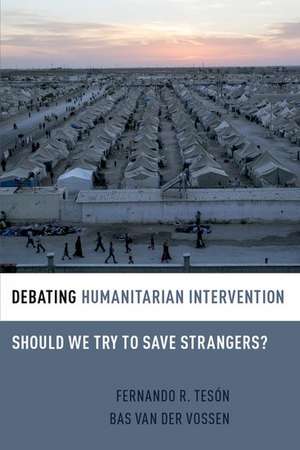
Debating Humanitarian Intervention: Should We Try to Save Strangers?: Debating Ethics
Autor Fernando Tesón, Bas van der Vossenen Limba Engleză Hardback – 16 noi 2017
Din seria Debating Ethics
- 16%
 Preț: 161.92 lei
 - 15%
 Preț: 178.87 lei
 - 16%
 Preț: 161.51 lei
 - 19%
 Preț: 127.69 lei
 - 24%
 Preț: 126.64 lei
 - 16%
 Preț: 312.08 lei
 - 19%
 Preț: 295.85 lei
 - 13%
 Preț: 285.09 lei
 -
 Preț: 286.15 lei
 -
 Preț: 275.55 lei
 - 16%
 Preț: 169.43 lei
 - 15%
 Preț: 221.91 lei
 - 15%
 Preț: 214.98 lei
 - 5%
 Preț: 179.72 lei
 - 16%
 Preț: 172.45 lei
Preț: 1141.55 lei
Preț vechi: 1637.56 lei
-30%
Puncte Express: 1712
Carte tipărită la comandă
Livrare economică 04-15 decembrie
Livrare prin curier în România Termenul estimat este afișat lângă disponibilitate.
Transport gratuit pentru acest produs Plată online sau ramburs, în funcție de opțiunile comenzii.
Retur gratuit în 14 zile Comandă securizată și suport în română.
Specificații
ISBN-13: 9780190202903
ISBN-10: 0190202904
Pagini: 290
Dimensiuni: 213 x 145 x 23 mm
Greutate: 0.52 kg
Editura: Oxford University Press
Colecția OUP USA
Seria Debating Ethics
Locul publicării:New York, United States
ISBN-10: 0190202904
Pagini: 290
Dimensiuni: 213 x 145 x 23 mm
Greutate: 0.52 kg
Editura: Oxford University Press
Colecția OUP USA
Seria Debating Ethics
Locul publicării:New York, United States
V-ar putea interesa
-
 -31%Preț: 617.04 lei888.00 lei
 -
 Preț: 278.27 lei
 -
 -23%Preț: 390.12 lei504.05 lei
 -
 -23%Preț: 590.28 lei768.46 lei
 -
 Consciousness and Moral ResponsibilityNeil Levy-29%Preț: 390.70 lei546.55 lei
 -
 Utilitarianism: A Very Short IntroductionKatarzyna de Lazari-Radek-19%Preț: 57.46 lei71.12 lei
 -
 -30%Preț: 610.54 lei870.11 lei
 -
 Virtue and Law in Plato and BeyondJulia Annas-27%Preț: 554.80 lei764.88 lei
 -
 Neuroethics: Anticipating the futureJudy Illes-30%Preț: 818.15 lei1174.82 lei
 -
 -30%Preț: 575.20 lei821.38 lei
 -
 -28%Preț: 374.87 lei522.91 lei
 -
 -22%Preț: 285.24 lei366.19 lei
 -
 -18%Preț: 251.78 lei306.80 lei
 -
 Philosophical Progress: In Defence of a Reasonable OptimismDaniel Stoljar-30%Preț: 404.73 lei578.24 lei
 -
 Oxford Studies in Metaethics 12Russ Shafer-Landau-19%Preț: 300.26 lei368.76 lei
 -
 -31%Preț: 642.99 lei926.34 lei
 -
 Doing and Allowing HarmFiona Woollard-31%Preț: 608.80 lei882.31 lei
 -
 Thinking about BriberyPhilip Nichols-27%Preț: 280.60 lei383.39 lei
 -
 Moral and Political Conceptions of Human RightsReidar Maliks-14%Preț: 746.46 lei867.98 lei
 -
 The Cambridge Handbook of Evolutionary EthicsMichael RusePreț: 252.58 lei
 -
 -15%Preț: 459.23 lei540.27 lei
 -
 The Blackwell Guide to Kant's EthicsThomas E. HillPreț: 359.51 lei
 -
 Preț: 257.59 lei
Recenzii
the book is an excellent contribution in terms of bringing together different arguments on intervention, the moral dilemma involved and the implicit political logic...the book...presents a much more condensed and balanced overview. It would be of great help to students and researchers working on issues pertaining to sovereignty, international justice, intervention and non-intervention to find multiple sources in a single book.
this book provides an important overview of the humanitarian intervention debate and forces the reader to rethink both the conditions under which humanitarian intervention can be justified, as well as the limitations of military responses in addressing humanitarian need. As a result, this book will be of interest to both academics and students wishing to challenge their own underlying assumptions about humanitarian intervention, on either side of this long-running debate.
this book provides an important overview of the humanitarian intervention debate and forces the reader to rethink both the conditions under which humanitarian intervention can be justified, as well as the limitations of military responses in addressing humanitarian need. As a result, this book will be of interest to both academics and students wishing to challenge their own underlying assumptions about humanitarian intervention, on either side of this long-running debate.
Notă biografică
Fernando R. Tesón is the Tobias Simon Eminent Scholar at Florida State University College of Law. He is the author, inter alia, of Justice at a Distance: Extending Freedom Globally (Cambridge University Press, 2015) [with Loren Lomasky] and Humanitarian Intervention: An Inquiry into Law and Morality , 3rd ed. (Transnational Publishers 2005), and dozens of articles in specialized journals.Bas van der Vossen is Associate Professor of Philosophy in the Smith Institute of Political Economy and Philosophy and the Philosophy Department at Chapman University. His research focuses on questions in political philosophy, and he is an Associate Editor of the journal Social Philosophy and Policy.