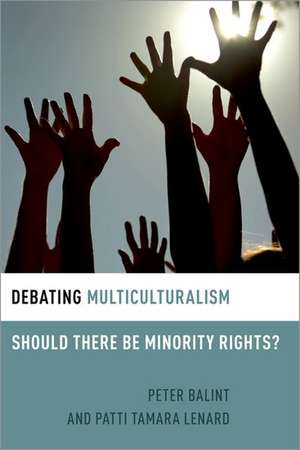
Debating Multiculturalism: Should There be Minority Rights?: Debating Ethics
Autor Patti Tamara Lenard, Peter Balinten Limba Engleză Paperback – 29 apr 2022














Preț: 172.84 lei
Preț vechi: 207.00 lei
-17%
Puncte Express: 259
Carte disponibilă
Livrare economică 06-17 noiembrie
Livrare express 27-31 octombrie pentru 59.80 lei
Livrare prin curier în România Termenul estimat este afișat lângă disponibilitate.
Transport gratuit de la 400.00 lei Plată online sau ramburs, în funcție de opțiunile comenzii.
Retur gratuit în 14 zile Comandă securizată și suport în română.
Specificații
ISBN-13: 9780197528389
ISBN-10: 0197528384
Pagini: 320
Dimensiuni: 211 x 140 x 23 mm
Greutate: 0.36 kg
Editura: Oxford University Press
Colecția OUP USA
Seria Debating Ethics
Locul publicării:New York, United States
ISBN-10: 0197528384
Pagini: 320
Dimensiuni: 211 x 140 x 23 mm
Greutate: 0.36 kg
Editura: Oxford University Press
Colecția OUP USA
Seria Debating Ethics
Locul publicării:New York, United States
Recenzii
To this reader at least, this lively debate volume shows very clearly that traditional liberalism, with its core principles of public neutrality and toleration, requires multiculturalism—the position laid out here by Peter Balint. Others will find in Patti Lenard`s 'political inclusion' model a new way of defending a more orthodox multiculturalism of minority rights. But the perhaps most powerful message of this book is the narrow range of disagreement on the necessity of multiculturalism in liberal-democratic societies.
Has multiculturalism failed, and if so, why has it failed? Lenard and Balint explore these questions while offering their positions for and against multiculturalism. Lenard justifies multiculturalism on the basis of political inclusion. Balint criticizes multiculturalism on the basis of liberal neutrality. The authors broadly agree about the ideals of liberal democracy and they both take minority rights seriously. But they disagree about the 'knowability' of culture, the application of multiculturalism to Indigenous peoples and national minorities, and the sources and risks of social fragmentation. Readers will find two cogent arguments and an illuminating debate that remind us why multicultural ideals are still worth defending and yet remain contested today.
Has multiculturalism failed, and if so, why has it failed? Lenard and Balint explore these questions while offering their positions for and against multiculturalism. Lenard justifies multiculturalism on the basis of political inclusion. Balint criticizes multiculturalism on the basis of liberal neutrality. The authors broadly agree about the ideals of liberal democracy and they both take minority rights seriously. But they disagree about the 'knowability' of culture, the application of multiculturalism to Indigenous peoples and national minorities, and the sources and risks of social fragmentation. Readers will find two cogent arguments and an illuminating debate that remind us why multicultural ideals are still worth defending and yet remain contested today.
Notă biografică
Peter Balint is a Senior Lecturer in International & Political Studies at UNSW Canberra. His most recent book Respecting Toleration: Traditional Liberalism and Contemporary Diversity (Oxford University Press, 2017), was awarded an APSA CRISP Prize in 2018. His research is in political theory and is primarily focussed on the principles for diversity, including respect, toleration, neutrality, and social cohesion. He is regularly asked to consult government on issues of migration, multiculturalism, and citizenship.Patti Tamara Lenard is Professor of Applied Ethics in the Graduate School of Public and International Affairs, University of Ottawa.. She is the author of Trust, Democracy and Multicultural Challenges (Penn State, 2012) and How Should Democracies Fight Terrorism? (Polity, 2020). She is active in the fields of political theory of migration, counter-terrorism, and democracy more generally. In Ottawa, she runs a small community organization called Rainbow Haven, whichsponsors, settles and advocates for LGBTQ refugees and asylum seekers.
Cuprins
- Introduction: Multiculturalism and Minority Rights
- Peter Balint and Patti Tamara Lenard
- PART I: Pro Multiculturalism
- Patti Tamara Lenard
- Chapter 1: Introduction to Part I
- Chapter 2: What is Culture? Why Political Inclusion?
- Chapter 3: Cultural Claims and Political Inclusion
- Chapter 4: Cultural Preservation and Multicultural Accommodation
- Chapter 5: Non-Interference and Political Inclusion
- Chapter 6: Shared Public Culture in Diverse States
- PART II: Against Multicultural Minority Rights
- Peter Balint
- Chapter 7: Introduction to Part II
- Chapter 8: We are All Neutralists Now!
- Chapter 9: Neutrality without Minority Rights
- Chapter 10: National Minorities, Indigenous Peoples, and Historical Injustice
- Chapter 11: Multiculturalism and the Demands on Citizens
- Chapter 12: Conclusion to Part II
- Part III: Responses
- Chapter 13: Response to Balint
- Culture not Colanders: Why Neutralism Fails to Respond Effectively to the Challenges of Cultural Diversity
- Patti Tamara Lenard
- Chapter 14: Response to Lenard
- Multiculturalism without Minority (or Majority) Rights
- Peter Balint