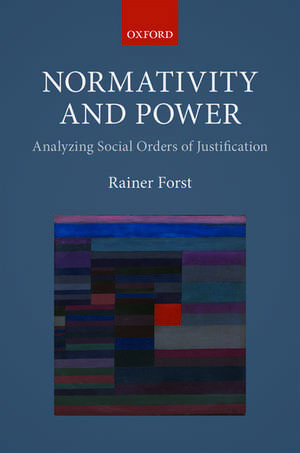
Normativity and Power: Analyzing Social Orders of Justification
Autor Rainer Forsten Limba Engleză Hardback – 19 oct 2017
Preț: 374.87 lei
Preț vechi: 522.91 lei
-28%
Puncte Express: 562
Carte tipărită la comandă
Livrare economică 10-15 decembrie
Livrare prin curier în România Termenul estimat este afișat lângă disponibilitate.
Transport gratuit de la 400.00 lei Plată online sau ramburs, în funcție de opțiunile comenzii.
Retur gratuit în 14 zile Comandă securizată și suport în română.
Specificații
ISBN-13: 9780198798873
ISBN-10: 0198798873
Pagini: 202
Dimensiuni: 165 x 243 x 19 mm
Greutate: 0.52 kg
Editura: OUP OXFORD
Colecția OUP Oxford
Locul publicării:Oxford, United Kingdom
ISBN-10: 0198798873
Pagini: 202
Dimensiuni: 165 x 243 x 19 mm
Greutate: 0.52 kg
Editura: OUP OXFORD
Colecția OUP Oxford
Locul publicării:Oxford, United Kingdom
V-ar putea interesa
-
 -31%Preț: 617.04 lei888.00 lei
 -
 Preț: 278.27 lei
 -
 -23%Preț: 390.12 lei504.05 lei
 -
 -23%Preț: 590.28 lei768.46 lei
 -
 Consciousness and Moral ResponsibilityNeil Levy-29%Preț: 390.70 lei546.55 lei
 -
 Utilitarianism: A Very Short IntroductionKatarzyna de Lazari-Radek-19%Preț: 57.46 lei71.12 lei
 -
 -30%Preț: 610.54 lei870.11 lei
 -
 Virtue and Law in Plato and BeyondJulia Annas-27%Preț: 554.80 lei764.88 lei
 -
 Neuroethics: Anticipating the futureJudy Illes-30%Preț: 818.15 lei1174.82 lei
 -
 -30%Preț: 575.20 lei821.38 lei
 -
 -22%Preț: 285.24 lei366.19 lei
 -
 -18%Preț: 251.78 lei306.80 lei
 -
 Philosophical Progress: In Defence of a Reasonable OptimismDaniel Stoljar-29%Preț: 418.68 lei588.46 lei
 -
 Oxford Studies in Metaethics 12Russ Shafer-Landau-19%Preț: 300.26 lei368.76 lei
 -
 -31%Preț: 642.99 lei926.34 lei
 -
 Doing and Allowing HarmFiona Woollard-31%Preț: 608.80 lei882.31 lei
 -
 Ethical LifeWebb KeanePreț: 213.90 lei
 -
 Thinking about BriberyPhilip Nichols-27%Preț: 280.60 lei383.39 lei
 -
 Moral and Political Conceptions of Human RightsReidar Maliks-14%Preț: 746.46 lei867.98 lei
 -
 The Cambridge Handbook of Evolutionary EthicsMichael RusePreț: 252.58 lei
 -
 -15%Preț: 459.23 lei540.27 lei
 -
 The Blackwell Guide to Kant's EthicsThomas E. HillPreț: 359.51 lei
 -
 Preț: 257.59 lei
Recenzii
As a whole, Forst's book suggests an answer to the question of how organization scholars as social scientists can engage with normative ideas. In particular, Forst's book helps clarify two questions: first, how organizational scholars can make a distinct contribution to societal deliberation on normative ideas; and second, why research on normative ideas can only ever play a supporting role for societal deliberation on normative ideas.
Rainer Forst is the most systematic, methodologically self-conscious moral and political philosopher writing today. In this volume he manages to do something no one else could do: fruitfully connect metaethical constructivism and critical theory, through a probing exploration of the reciprocal relations between social power and normativity.
Rainer Forst's account of the right to justification has positioned him as a central figure in political philosophy. In this new book, Forst engages with other political ideas that are often thought to compete with his vision of humans as fundamentally justificatory beings, integrating the right to justification with issues of exploitation, power, cultural narrative, and progress. Everyone interested in any of these issues will want to read this book.
Rainer Forst is one of the most illuminating political philosophers now working. His writing carries forward the systematic project of the Frankfurt School with an admirable combination of analytical rigor and historical depth. At a time when liberal democracy has come to seem troublingly fragile, it is salutary to have this clear-eyed and uncompromising defense of its ideal of inclusive justification.
Rainer Forst develops a powerful version of critical theory that spans philosophy, social theory, and critique where the principle of general and reciprocal justification is fundamental. Justification is not merely a theoretical question; it is a political and practical question. Such a theory must be attentive to complex historical ways in which human beings actually justify practices as well as the way in which practices themselves are always open to criticism by an appeal to rational justification. In developing his theory, he shows how it can account for power, justice, and democracy... He is imaginative, bold, and always thought provoking.
Forst's characteristically brilliant and lucid essays demonstrate the potency of his signature idea—the right to justification—to perform a defining task of political philosophy: the critical analysis of social and political power. With stunning intellectual range, Forst tacks between abstract principle and concrete examples to make a compelling case that justice demands attentiveness to the structures through which we justify (or fail to justify) ourselves to others. This important book, by one of the leading political philosophers of our time, is essential reading for understanding justice in a global age.
Rainer Forst is the most systematic, methodologically self-conscious moral and political philosopher writing today. In this volume he manages to do something no one else could do: fruitfully connect metaethical constructivism and critical theory, through a probing exploration of the reciprocal relations between social power and normativity.
Rainer Forst's account of the right to justification has positioned him as a central figure in political philosophy. In this new book, Forst engages with other political ideas that are often thought to compete with his vision of humans as fundamentally justificatory beings, integrating the right to justification with issues of exploitation, power, cultural narrative, and progress. Everyone interested in any of these issues will want to read this book.
Rainer Forst is one of the most illuminating political philosophers now working. His writing carries forward the systematic project of the Frankfurt School with an admirable combination of analytical rigor and historical depth. At a time when liberal democracy has come to seem troublingly fragile, it is salutary to have this clear-eyed and uncompromising defense of its ideal of inclusive justification.
Rainer Forst develops a powerful version of critical theory that spans philosophy, social theory, and critique where the principle of general and reciprocal justification is fundamental. Justification is not merely a theoretical question; it is a political and practical question. Such a theory must be attentive to complex historical ways in which human beings actually justify practices as well as the way in which practices themselves are always open to criticism by an appeal to rational justification. In developing his theory, he shows how it can account for power, justice, and democracy... He is imaginative, bold, and always thought provoking.
Forst's characteristically brilliant and lucid essays demonstrate the potency of his signature idea—the right to justification—to perform a defining task of political philosophy: the critical analysis of social and political power. With stunning intellectual range, Forst tacks between abstract principle and concrete examples to make a compelling case that justice demands attentiveness to the structures through which we justify (or fail to justify) ourselves to others. This important book, by one of the leading political philosophers of our time, is essential reading for understanding justice in a global age.
Notă biografică
Rainer Forst is Professor of Political Theory and Philosophy at Goethe University Frankfurt and is co-director of the Cluster of Excellence 'The Formation of Normative Orders' and of the Center for Advanced Studies 'Justitia Amplificata'. In 2012 he was awarded the Gottfried Wilhelm Leibniz Prize of the German Research Foundation. Among his works that have recently appeared in translation are The Right to Justification (2012), Toleration in Conflict (2013), Justification and Critique (2014), and Justice, Democracy and the Right to Justification (a debate with critics, 2014). He is a member of the Berlin-Brandenburg Academy of Sciences and Humanities and sits on the boards of a number of international journals. Most notably he is an associate editor of Ethics and a member of the executive editorial committee of Political Theory.