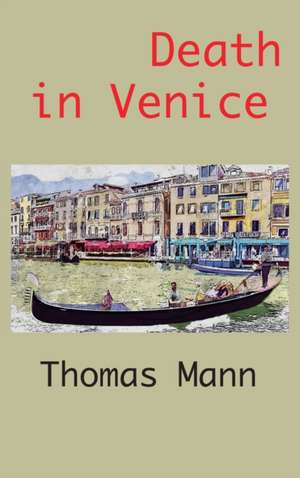
Death in Venice
Autor Thomas Mannen Limba Engleză Hardback – 15 noi 2021
Preț: 121.41 lei
Puncte Express: 182
Carte tipărită la comandă
Livrare economică 27 noiembrie-11 decembrie
Livrare prin curier în România Termenul estimat este afișat lângă disponibilitate.
Transport gratuit de la 400.00 lei Plată online sau ramburs, în funcție de opțiunile comenzii.
Retur gratuit în 14 zile Comandă securizată și suport în română.
Specificații
ISBN-13: 9781950330850
ISBN-10: 1950330850
Pagini: 134
Dimensiuni: 157 x 235 x 12 mm
Greutate: 0.36 kg
Editura: Ancient Wisdom Publications
ISBN-10: 1950330850
Pagini: 134
Dimensiuni: 157 x 235 x 12 mm
Greutate: 0.36 kg
Editura: Ancient Wisdom Publications
V-ar putea interesa
-
 The Kreutzer Sonata and Other StoriesLeo Tolstoy-18%Preț: 59.98 lei72.82 lei
 -
 Doctor FaustusThomas MannPreț: 74.34 lei
 -
 Confessions of a MaskYukio Mishima-27%Preț: 57.19 lei78.09 lei
 -
 Madonna in a Fur CoatSabahattin Ali-19%Preț: 57.42 lei71.26 lei
 -
 The MagicianColm Tòibìn-24%Preț: 60.93 lei80.32 lei
 -
 Preț: 156.34 lei
 -
 The Birth of Tragedy and The Case of WagnerFriedrich NietzschePreț: 78.08 lei
 -
 The Picture of Dorian GrayOscar WildePreț: 35.93 lei
 -
 DemianHermann HessePreț: 49.45 lei
 -
 The TrialFranz KafkaPreț: 46.01 lei
 -
 Death in Venice and Other StoriesThomas MannPreț: 51.89 lei
 -
 The Magic MountainThomas Mann-16%Preț: 80.63 lei96.20 lei
 -
 Death in MidsummerYukio MishimaPreț: 87.55 lei
 -
 Classic Stories from the Age of DecadenceJane DesmaraisPreț: 78.53 lei
 -
![Separate Rooms: A 'queer masterpiece' [AnOther Magazine], perfect for fans of Call Me By Your Name](https://i0.books-express.ro/bt/9781399734509/separate-rooms.jpg) Preț: 130.18 lei
Preț: 130.18 lei -
 ExtinctionThomas BernhardPreț: 90.69 lei
 -
 SiddharthaHermann HessePreț: 33.57 lei
 -
 The TrialFranz KafkaPreț: 43.19 lei
 -
 The ProphetKahlil GibranPreț: 27.21 lei
 -
 Death in Venice: A Queer Film ClassicWill Aitken-31%Preț: 83.83 lei120.96 lei
 -
 Night Games: And Other Stories and NovellasArthur Schnitzler-15%Preț: 97.19 lei114.49 lei
 -
 Reflections of a Nonpolitical ManThomas Mann-18%Preț: 123.70 lei151.25 lei
 -
 Of Seven Fir Trees and the Snow: Early StoriesThomas BernhardPreț: 145.44 lei
 -
 Love and EnchantmentThomas MannPreț: 71.75 lei
 -
 Man's Search For MeaningViktor E. Frankl-27%Preț: 62.25 lei84.79 lei
 -
 Man's Search For MeaningViktor E. Frankl-20%Preț: 73.72 lei92.24 lei
 -
 All The Sad Young MenF. Scott FitzgeraldPreț: 57.30 lei
 -
 Immensee and Other Stories: 101-Page seriesTheodor StormPreț: 56.18 lei
 -
 Preț: 332.57 lei
Descriere
Descriere de la o altă ediție sau format:
As the ageing Gustav von Aschenbach, a famous author who has recently been ennobled in recognition of his literary achievements, arrives in Venice for a holiday and checks into his Lido hotel, he is struck by the arresting good looks of Tadzio, an aristocratic Polish youth of around fourteen who is sojourning there with his family. Gradually, what starts as a feeling of intense curiosity develops into a profound passion, until Aschenbach begins to follow the adolescent secretly through the streets of the Serenissima and becomes utterly infatuated with his beauty.
Considered by many to be Mann's masterpiece, Death in Venice, first published in 1912 and based on the author's own stay in Venice the previous year, is presented here in a sparkling new translation by Sander Berg.
ABOUT THE SERIES: Alma Classics Evergreens is a series of popular classics. All the titles in the series are provided with an extensive critical apparatus and extra reading material, including a section of photographs and notes. The texts are based on the most authoritative edition (or collated from the most authoritative editions or manuscripts) and edited using a fresh, intelligent editorial approach. With an emphasis on the production, editorial and typographical values of a book, Alma Classics aspires to revitalize the whole experience of reading the classics.
As the ageing Gustav von Aschenbach, a famous author who has recently been ennobled in recognition of his literary achievements, arrives in Venice for a holiday and checks into his Lido hotel, he is struck by the arresting good looks of Tadzio, an aristocratic Polish youth of around fourteen who is sojourning there with his family. Gradually, what starts as a feeling of intense curiosity develops into a profound passion, until Aschenbach begins to follow the adolescent secretly through the streets of the Serenissima and becomes utterly infatuated with his beauty.
Considered by many to be Mann's masterpiece, Death in Venice, first published in 1912 and based on the author's own stay in Venice the previous year, is presented here in a sparkling new translation by Sander Berg.
ABOUT THE SERIES: Alma Classics Evergreens is a series of popular classics. All the titles in the series are provided with an extensive critical apparatus and extra reading material, including a section of photographs and notes. The texts are based on the most authoritative edition (or collated from the most authoritative editions or manuscripts) and edited using a fresh, intelligent editorial approach. With an emphasis on the production, editorial and typographical values of a book, Alma Classics aspires to revitalize the whole experience of reading the classics.
Textul de pe ultima copertă
The world-famous masterpiece by Nobel laureate Thomas Mann -- here in a new translation by Michael Henry Heim
Published on the eve of World War I, a decade after Buddenbrooks had established Thomas Mann as a literary celebrity, Death in Venice tells the story of Gustav von Aschenbach, a successful but aging writer who follows his wanderlust to Venice in search of spiritual fulfillment that instead leads to his erotic doom.
In the decaying city, besieged by an unnamed epidemic, he becomes obsessed with an exquisite Polish boy, Tadzio. "It is a story of the voluptuousness of doom," Mann wrote. "But the problem I had especially in mind was that of the artist's dignity."
Published on the eve of World War I, a decade after Buddenbrooks had established Thomas Mann as a literary celebrity, Death in Venice tells the story of Gustav von Aschenbach, a successful but aging writer who follows his wanderlust to Venice in search of spiritual fulfillment that instead leads to his erotic doom.
In the decaying city, besieged by an unnamed epidemic, he becomes obsessed with an exquisite Polish boy, Tadzio. "It is a story of the voluptuousness of doom," Mann wrote. "But the problem I had especially in mind was that of the artist's dignity."
Notă biografică
Thomas Mann (1875?1955) was one of the finest and most prolific German novelists of our century. His most famous works include Buddenbrooks, The Magic Mountain, Doctor Faustus, and the Joseph tetralogy.
Joachim Neugroschel has won three PEN translation awards and the French-American translation prize. He has also translated Thomas Mann's Death in Venice and Sacher-Masoch's Venus in Furs, both for Penguin Classics. He lives in Brooklyn, New York.
Joachim Neugroschel has won three PEN translation awards and the French-American translation prize. He has also translated Thomas Mann's Death in Venice and Sacher-Masoch's Venus in Furs, both for Penguin Classics. He lives in Brooklyn, New York.