
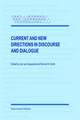
Current and New Directions in Discourse and Dialogue: Text, Speech and Language Technology, cartea 22
Editat de Jan C.J. van Kuppevelt, R.W. Smithen Limba Engleză Paperback – 30 noi 2003
| Toate formatele și edițiile | Preț | Express |
|---|---|---|
| Paperback (1) | 917.56 lei 43-57 zile | |
| SPRINGER NETHERLANDS – 30 noi 2003 | 917.56 lei 43-57 zile | |
| Hardback (1) | 918.47 lei 43-57 zile | |
| SPRINGER NETHERLANDS – 30 noi 2003 | 918.47 lei 43-57 zile |
Din seria Text, Speech and Language Technology
-
 Preț: 376.90 lei
 - 20%
 Preț: 627.33 lei
 - 18%
 Preț: 917.09 lei
 - 18%
 Preț: 915.89 lei
 - 18%
 Preț: 908.61 lei
 - 18%
 Preț: 1175.35 lei
 - 18%
 Preț: 917.27 lei
 - 18%
 Preț: 912.85 lei
 - 15%
 Preț: 615.35 lei
 - 15%
 Preț: 621.97 lei
 - 18%
 Preț: 912.53 lei
 - 20%
 Preț: 626.71 lei
 - 15%
 Preț: 619.45 lei
 - 18%
 Preț: 924.22 lei
 - 20%
 Preț: 967.02 lei
 - 18%
 Preț: 918.47 lei
 - 20%
 Preț: 954.50 lei
 - 15%
 Preț: 617.72 lei
 -
 Preț: 374.71 lei
 - 20%
 Preț: 618.33 lei
 - 18%
 Preț: 910.71 lei
 - 20%
 Preț: 955.32 lei
 - 18%
 Preț: 916.03 lei
 - 18%
 Preț: 914.96 lei
 - 15%
 Preț: 620.23 lei
 - 18%
 Preț: 916.93 lei
 - 18%
 Preț: 1182.94 lei
 - 15%
 Preț: 626.52 lei
 - 20%
 Preț: 617.38 lei
Preț: 917.56 lei
Preț vechi: 1118.98 lei
-18% Nou
Puncte Express: 1376
Preț estimativ în valută:
162.37€ • 190.39$ • 142.59£
162.37€ • 190.39$ • 142.59£
Carte tipărită la comandă
Livrare economică 02-16 februarie 26
Preluare comenzi: 021 569.72.76
Specificații
ISBN-13: 9781402016158
ISBN-10: 1402016158
Pagini: 396
Ilustrații: XII, 381 p.
Dimensiuni: 155 x 235 x 21 mm
Greutate: 0.71 kg
Ediția:Softcover reprint of the original 1st ed. 2003
Editura: SPRINGER NETHERLANDS
Colecția Springer
Seria Text, Speech and Language Technology
Locul publicării:Dordrecht, Netherlands
ISBN-10: 1402016158
Pagini: 396
Ilustrații: XII, 381 p.
Dimensiuni: 155 x 235 x 21 mm
Greutate: 0.71 kg
Ediția:Softcover reprint of the original 1st ed. 2003
Editura: SPRINGER NETHERLANDS
Colecția Springer
Seria Text, Speech and Language Technology
Locul publicării:Dordrecht, Netherlands
V-ar putea interesa
-
 Verbal Judo, Second Edition: The Gentle Art of PersuasionGeorge J. Thompson, PhDPreț: 74.59 lei
 -
 Preț: 102.97 lei
 -
 The Utility of Meaning: What Words Mean and WhyN. J. Enfield-34%Preț: 660.51 lei997.59 lei
 -
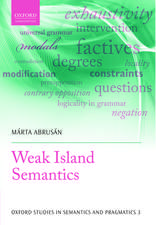 Weak Island SemanticsMárta Abrusán-8%Preț: 358.52 lei390.18 lei
 -
 -27%Preț: 935.18 lei1284.98 lei
 -
 Rhetoric: A Very Short IntroductionRichard Toye-22%Preț: 52.69 lei67.42 lei
 -
 English LexicogenesisD. Gary Miller-14%Preț: 844.30 lei981.74 lei
 -
 Semantics of Statebuilding: Language, meanings and sovereigntyNicolas Lemay-Hébert-18%Preț: 1169.95 lei1426.77 lei
 -
 On DialogueDavid BohmPreț: 181.21 lei
 -
 Stylish Academic WritingHelen SwordPreț: 177.23 lei
 -
 Organizational DiscourseFrancois CoorenPreț: 179.44 lei
 -
 -15%Preț: 618.64 lei727.80 lei
 -
 Understanding PolitenessDániel Z. KádárPreț: 377.70 lei
 -
 -15%Preț: 622.11 lei731.90 lei
 -
 Understanding SemanticsSebastian LoebnerPreț: 393.89 lei
 -
 -18%Preț: 908.91 lei1108.42 lei
 -
 -15%Preț: 610.63 lei718.39 lei
 -
 TerminologyTeresa CabrePreț: 287.06 lei
 -
 -18%Preț: 911.49 lei1111.57 lei
 -
 Expression and Interpretation of Negation: An OT TypologyHenriëtte de Swart-15%Preț: 615.84 lei724.52 lei
 -
 Studies in the Composition and Decomposition of Event PredicatesBoban Arsenijević-20%Preț: 615.17 lei768.96 lei
Public țintă
ResearchCuprins
1 Annotations and Tools for an Activity Based Spoken Language Corpus.- 1. Introduction.- 2. GSLC and Other Goteborg Corpora.- 3. Storage.- 4. Description of the Corpus Transcription Standard.- 5. Tools Which Have Been Developed.- 6. Types of Quantitative Analysis.- 7. Types of Qualitative Analysis.- 8. Conclusions and Future Directions.- References.- 2 Using Direct Variant Transduction for Rapid Development of Natural Spoken Interfaces.- 1. Introduction.- 2. Characteristics of Direct Variant Transduction.- 3. Constructing an Application with Example-Action Contexts.- 4. Context Expansion.- 5. Recognition, Classification and Matching.- 6. Dialog Control and Confirmation.- 7. Experiments.- 8. Concluding Remarks.- References.- 3 An Interface for Annotating Natural Interactivity.- 1. Introduction.- 2. Today’s Natural Interactivity Coding Tools.- 3. The Nite Project.- 4. Nite Target User Groups.- 5. General Tool Requirements.- 6. Annotation User Interface Requirements.- 7. The Audio-Visual Annotation Interface.- 8. Conclusion and Future Work.- Acknowledgements.- References.- 4 Managing Communicative Intentions with Collaborative Problem Solving.- 1. Previous Work.- 2. A Collaborative Problem-Solving Model.- 3. Examples.- 4. Use in Dialogue Systems.- 5. Conclusions and Future Work.- References.- 5 Building a Discourse-Tagged Corpus in the Framework of Rhetorical Structure Theory.- 1. Introduction.- 2. Framework.- 3. Discourse Annotation Task.- 4. Quality Assurance.- 5. Corpus Overview.- 6. Mining the RST Corpus.- 7. Conclusions and Future Work.- Acknowledgements.- References.- 6 An Empirical Study of Speech Recognition Errors in Human Computer Dialogue.- 1. Introduction.- 2. The Speech Recognition Component.- 3. Integrated Parsing of User Utterances.- 4. The DialogueProcess.- 5. From Speech Recognition Errors to Speech Act Recognition Errors.- 6. Evaluating Robustness to Speech Recognition Errors.- 7. Conclusion.- Acknowledgements.- References.- 7 Comparing Several Aspects of Human-Computer and Human-Human Dialogues.- 1. Introduction.- 2. Our Data.- 3. Analysis.- 4. Analysis of Misunderstandings.- 5. Discussion.- 6. Conclusions.- Appendix: Dialogue Act Tag Set and Examples.- References.- 8 Full Paraphrase Generation for Fragments in Dialogue.- 1. Introduction.- 2. SHARDS.- 3. Generation of Fragment Paraphrases.- 4. An Implemented System for Fragment Resolution and Paraphrase Generation.- 5. Conclusion and Future Research.- Acknowledgements.- References.- 9 Disentangling Public from non-Public Meaning.- 1. Introduction.- 2. Utterer’s Content v. Utterer’s Plan.- 3. Clarifying Utterer’s Content.- 4. Whymeta: an analysis.- 5. Concluding Remarks.- References.- 10 Adaptivity and Response Generation in a Spoken Dialogue System.- 1. Introduction.- 2. Interaction Management.- 3. Dialogue Response Generation.- 4. Confidence-based Adaptivity.- 5. Conclusion.- References.- 11 On the Means for Clarification in Dialogue.- 1. Introduction.- 2. Clarification Forms.- 3. Clarification Readings.- 4. Corpus Analysis.- 5. Conclusions.- Acknowledgements.- Appendix: Corpus Markup Decision Trees.- References.- 12 Plug and Play Spoken Dialogue Processing.- 1. Introduction.- 2. The CANTONA Plug and Play Demonstrator.- 3. Device Descriptions: Rules and Hierarchies.- 4. Plug and Play Response Generation.- 5. Plug and Play Speech Recognition and Parsing.- 6. Discussion.- Acknowledgements.- References.- 13 Conversational Implicatures and Communication Theory.- 1. Introduction.- 2. Particularized Conversational Implicatures.- 3. Generalized ConversationalImplicatures.- References.- 14 Reconciling Control and Discourse Structure.- 1. Introduction.- 2. Discourse Structure and Control Analysis.- 3. Relationship between Control and Discourse Structure.- 4. Reconciling Control inside Discourse Segments.- 5. Conclusion.- 6. Future Work.- Acknowledgements.- References.- 15 The Information State Approach to Dialogue Management.- 1. Introduction.- 2. The Information State Approach.- 3. A Multi-level Architecture for Reusable Dialogue Management.- 4. TrindiKit: A Dialogue Move Engine Toolkit.- 5. Implementations using TrindiKit.- 6. Reusing Dialogue Management Components.- References.- 16 Visualizing Spoken Discourse.- 1. Introduction: Interruptions and Dialogue.- 2. Research Goals and Procedures.- 3. Prosodie Characteristics of Interruptions.- 4. Implications for Dialogue Systems.- 5. Conclusion.- Acknowledgements.- References.