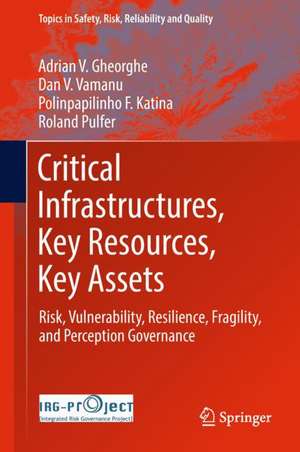
Critical Infrastructures, Key Resources, Key Assets: Topics in Safety, Risk, Reliability and Quality, cartea 34
Autor Adrian V. Gheorghe, Dan V. Vamanu, Polinpapilinho F. Katina, Roland Pulferen Limba Engleză Hardback – 22 noi 2017
Evoluția managementului riscului a trecut în ultimul deceniu de la analiza componentelor izolate la înțelegerea sistemelor-de-sisteme, unde eșecurile în cascadă reprezintă principala amenințare. Notăm cu interes modul în care Critical Infrastructures, Key Resources, Key Assets răspunde acestei complexități, propunând o schimbare de paradigmă: tratarea infrastructurilor critice nu doar ca active fizice, ci ca sisteme socio-economice dinamice. Considerăm că forța acestei lucrări rezidă în fundamentul său teoretic solid, care împrumută modele din fizica tranzițiilor de fază pentru a explica momentele de perturbare sistemică. Subliniem că volumul extinde cadrul teoretic propus de Vulnerable Systems de Wolfgang Kröger prin integrarea unor date noi din domenii emergente, precum securitatea spațială și emisiile teritoriale. În timp ce lucrările anterioare se concentrau pe cuantificarea defectelor tehnice, Adrian V. Gheorghe și colaboratorii săi introduc dimensiunea guvernanței și a vulnerabilității manageriale ca factori critici în reziliență. Această abordare este o continuare firească a temelor explorate de autor în Critical Space Infrastructures și Resilient Energy Systems, unde accentul cade pe interdependența dintre tehnologie și decizia politică. Structura celor 16 capitole indică o progresie logică de la teorie la aplicații practice riguroase. Primele secțiuni stabilesc analogiile fizice pentru reziliență, urmate de o analiză a vulnerabilității guvernanței. A doua jumătate a cărții este dedicată studiilor de caz detaliate, de la evaluarea reactoarelor nucleare la modelarea prin automate celulare a dispersiei poluanților în zone urbane complexe. Această ediție de la Springer se distinge prin capacitatea de a oferi instrumente de diagnosticare utile atât cercetătorilor, cât și factorilor de decizie din domeniul asigurărilor sau al răspunsului la urgențe.
Din seria Topics in Safety, Risk, Reliability and Quality
- 15%
 Preț: 673.85 lei
 - 15%
 Preț: 665.20 lei
 - 15%
 Preț: 668.50 lei
 - 15%
 Preț: 664.39 lei
 - 15%
 Preț: 672.68 lei
 - 15%
 Preț: 660.61 lei
 - 15%
 Preț: 618.08 lei
 - 18%
 Preț: 915.18 lei
 - 18%
 Preț: 921.70 lei
 - 32%
 Preț: 561.92 lei
 - 18%
 Preț: 996.23 lei
 - 18%
 Preț: 917.81 lei
 - 15%
 Preț: 618.26 lei
 - 15%
 Preț: 662.81 lei
 - 15%
 Preț: 666.74 lei
 - 15%
 Preț: 677.51 lei
 - 15%
 Preț: 670.48 lei
 - 19%
 Preț: 437.51 lei
 - 15%
 Preț: 667.86 lei
 - 18%
 Preț: 1035.33 lei
 - 18%
 Preț: 992.04 lei
 - 15%
 Preț: 666.33 lei
 - 24%
 Preț: 1085.94 lei
 - 19%
 Preț: 660.44 lei
 - 19%
 Preț: 593.26 lei
 - 19%
 Preț: 615.15 lei
 -
 Preț: 399.97 lei
 - 24%
 Preț: 871.36 lei
Preț: 682.44 lei
Preț vechi: 802.87 lei
-15%
Carte disponibilă
Livrare economică 14-28 noiembrie
Specificații
ISBN-10: 3319692232
Pagini: 472
Ilustrații: XXVII, 442 p. 202 illus., 192 illus. in color.
Dimensiuni: 160 x 241 x 30 mm
Greutate: 0.9 kg
Ediția:1st edition 2018
Editura: Springer
Colecția Topics in Safety, Risk, Reliability and Quality
Seria Topics in Safety, Risk, Reliability and Quality
Locul publicării:Cham, Switzerland
V-ar putea interesa
-
 -28%Preț: 306.92 lei428.04 lei
 -
 Preț: 118.71 lei
 -
 NonlinearJohn MaedaPreț: 148.56 lei
 -
 Why Stock Markets CrashDidier SornettePreț: 147.17 lei
 -
 Resilience: Why Things Bounce BackAndrew Zolli-7%Preț: 73.88 lei79.56 lei
 -
 Insuring States in an Uncertain WorldLouis W. PaulyPreț: 282.10 lei
 -
 -19%Preț: 429.80 lei530.62 lei
 -
 Critical Systems ThinkingMichael C Jackson-20%Preț: 291.32 lei364.15 lei
 -
 Critical InfrastructureKevin H McCorb-27%Preț: 1164.45 lei1585.09 lei
 -
 Thinking through Archaeological ComplexityStefani A. CrabtreePreț: 386.07 lei
 -
 Shaping Collaborative Ecosystems for TomorrowAlfonso Reyes-23%Preț: 602.21 lei782.08 lei
 -
 Critical Infrastructure Security and ResilienceDimitris Gritzalis-20%Preț: 1032.67 lei1290.83 lei
 -
 COVID-19: Systemic Risk and ResilienceIgor Linkov-5%Preț: 1088.26 lei1145.53 lei
 -
 -20%Preț: 913.07 lei1141.35 lei
 -
 Civil Protection Systems and Disaster GovernanceStanis¿aw Kowalkowski-18%Preț: 975.99 lei1190.23 lei
 -
 Preț: 449.33 lei
 -
 Nexus of SustainabilityAnatoly Zagorodny-18%Preț: 1440.50 lei1756.71 lei
 -
 -18%Preț: 1441.99 lei1758.52 lei
 -
 Risk and Resilience in the Era of Climate ChangeVinod ThomasPreț: 213.79 lei
De ce să citești această carte
Această lucrare este esențială pentru specialiștii în managementul riscului și planificare strategică. Cititorul câștigă acces la modele matematice avansate și studii de caz elvețiene aplicabile în protecția activelor naționale. Este un instrument valoros pentru cei care doresc să înțeleagă cum analogiile din fizică pot prezice comportamentul sistemelor economice și tehnice complexe în fața unor dezastre imprevizibile.
Despre autor
Adrian V. Gheorghe este un expert recunoscut internațional în domeniul ingineriei sistemelor și al analizei riscului, ocupând poziții academice de prestigiu și contribuind la numeroase volume publicate de Springer. Opera sa se concentrează pe reziliența infrastructurilor critice, de la rețele energetice la sisteme spațiale și logistica bunurilor periculoase. Alături de Dan V. Vamanu, Polinpapilinho F. Katina și Roland Pulfer, acesta formează o echipă multidisciplinară ce îmbină expertiza tehnică în fizică și matematică cu viziunea managerială și de politici publice necesară securității moderne.