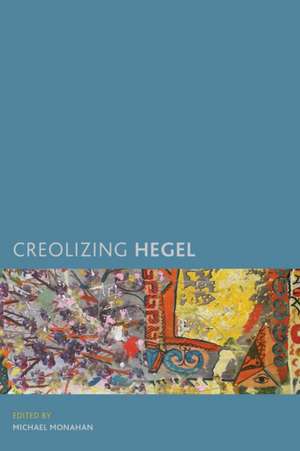
Creolizing Hegel: Creolizing the Canon
Editat de Michael Monahanen Limba Engleză Paperback – 16 sep 2018
In response to this question, Creolizing Hegel brings together transdisciplinary scholars presenting various approaches to creolizing the work of Hegel. The essays in this volume take Hegelian texts and themes across borders of method, discipline, and tradition. The task is not simply to compare and contrast Hegel with some 'outsider' figure or tradition, but rather to reconsider and reconfigure our understandings of all of the figures and ideas brought together in these cross-disciplinary essays.
Din seria Creolizing the Canon
- 29%
 Preț: 345.19 lei
 - 29%
 Preț: 344.18 lei
 - 29%
 Preț: 342.63 lei
 - 28%
 Preț: 354.40 lei
 - 23%
 Preț: 288.34 lei
 - 20%
 Preț: 370.81 lei
 - 26%
 Preț: 175.85 lei
 - 23%
 Preț: 261.67 lei
 - 22%
 Preț: 323.41 lei
 - 18%
 Preț: 227.17 lei
 - 26%
 Preț: 205.49 lei
 - 26%
 Preț: 207.60 lei
 - 35%
 Preț: 621.39 lei
 - 29%
 Preț: 209.96 lei
 - 25%
 Preț: 212.27 lei
 - 25%
 Preț: 215.62 lei
 - 32%
 Preț: 596.23 lei
 - 29%
 Preț: 609.21 lei
Preț: 331.02 lei
Preț vechi: 427.25 lei
-23%
Puncte Express: 497
Carte tipărită la comandă
Livrare economică 27 noiembrie-11 decembrie
Livrare prin curier în România Termenul estimat este afișat lângă disponibilitate.
Transport gratuit de la 400.00 lei Plată online sau ramburs, în funcție de opțiunile comenzii.
Retur gratuit în 14 zile Comandă securizată și suport în română.
Specificații
ISBN-13: 9781786600240
ISBN-10: 1786600242
Pagini: 304
Dimensiuni: 149 x 230 x 18 mm
Greutate: 0.43 kg
Editura: Bloomsbury Publishing
Colecția Rowman & Littlefield
Seria Creolizing the Canon
Locul publicării:New York, United States
ISBN-10: 1786600242
Pagini: 304
Dimensiuni: 149 x 230 x 18 mm
Greutate: 0.43 kg
Editura: Bloomsbury Publishing
Colecția Rowman & Littlefield
Seria Creolizing the Canon
Locul publicării:New York, United States
Cuprins
Introduction: What is Rational is Creolizing.Michael J. Monahan / Part I: Reason, Logic, and Dialectic / 1. Boundary, Ambivalence, Jaibería, or, How to Appropriate Hegel Rocío Zambrana / 2. CLR James, Africana Transcendental Philosophy and the Creolizing of Hegel Paget Henry / 3. Thinking Through the Negative: Adorno's Reading of Hegel / Stefan Bird-Pollan 4. Why I Am So Wise: Hegelian Reflections on Whether Reason Can be Enhanced Richard Dien WinfieldPart II: History and Aesthetics / 5. Revisiting "Hegel and Haiti": Postcolonial Readings of the Lord/Bondsman Dialectic Nicholas A. Germana / 6. Hegel and Adorno on Negative Universal History: The Dialectics of Species Life Karen Ng / 7. Hegel Among the Cannibals Oscar Guardiola-Rivera / 8. Creolizing Hegel's Theory of Tragedy Greg A.Graham / 9. Hegel, Musical Subjectivity, and Jazz Craig Matarrese / Part III: Ethical Life, Law, and Politics / 10. The Future is Now: Loepoldo Zea's Hegelianism and the Liberation of the Mexican Past Carlos Alberto Sánchez / 11. Crossing Boundaries: Hegel, Beauvoir, and hooks on Exclusion and Identity Shannon M. Mussett / 12.Ideal Theory and Racial Justice: Some Hegelian Considerations Brandon Hogan / 13. Oppression, Legal Reform, and Hegel's Natural Law Internalism Jeffrey A. Gauthier
Recenzii
Creolizing Hegel is unquestionably the most important collection of critical essays on Hegel to be published in years. None of the essays simply reject Hegel as a simply Eurocentric thinker, although all engage with his Eurocentrism. More importantly, these essays are comprehensive and cover the arch of Hegel's work. This book will be essential to anyone who is interested in political theory, ethics, and jurisprudence. The sophistication of the essays provides a much needed critical engagement with a thinker who has been both controversial and influential in the entire body of philosophical work in the 20th century.
The originality of the organizing theme and the essays in Creolizing Hegel offer something unfortunately missing in a good deal of recent Hegel studies-and much work on canonical thought, for that matter-over the past few decades: something new to say. This installment of ideas inaugurated by scholars from the Caribbean Philosophical Association, especially the groundbreaking writings of Jane Anna Gordon and Michael Monahan on the creolization of theory, is no less than the birth of a classic.
The creative inventiveness of the contributors to Creolizing Hegel shows how alive philosophers can be today to drawing surprising connections in their efforts to place philosophy in the service of liberation.
The originality of the organizing theme and the essays in Creolizing Hegel offer something unfortunately missing in a good deal of recent Hegel studies-and much work on canonical thought, for that matter-over the past few decades: something new to say. This installment of ideas inaugurated by scholars from the Caribbean Philosophical Association, especially the groundbreaking writings of Jane Anna Gordon and Michael Monahan on the creolization of theory, is no less than the birth of a classic.
The creative inventiveness of the contributors to Creolizing Hegel shows how alive philosophers can be today to drawing surprising connections in their efforts to place philosophy in the service of liberation.