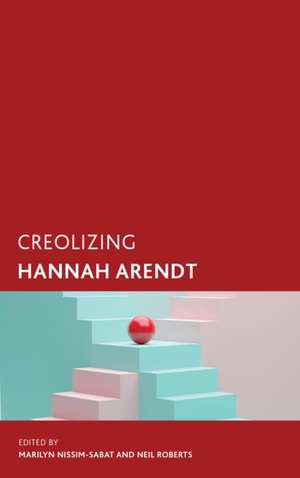
Creolizing Hannah Arendt: Creolizing the Canon
Editat de Marilyn Nissim-Sabat, Neil Robertsen Limba Engleză Hardback – 11 iun 2024
Din seria Creolizing the Canon
- 29%
 Preț: 345.19 lei
 - 29%
 Preț: 344.18 lei
 - 29%
 Preț: 342.63 lei
 - 28%
 Preț: 356.59 lei
 - 23%
 Preț: 331.02 lei
 - 23%
 Preț: 288.34 lei
 - 20%
 Preț: 370.81 lei
 - 26%
 Preț: 175.85 lei
 - 23%
 Preț: 261.67 lei
 - 22%
 Preț: 323.41 lei
 - 18%
 Preț: 227.17 lei
 - 26%
 Preț: 205.49 lei
 - 26%
 Preț: 207.60 lei
 - 35%
 Preț: 621.39 lei
 - 29%
 Preț: 209.96 lei
 - 25%
 Preț: 212.27 lei
 - 25%
 Preț: 215.62 lei
 - 32%
 Preț: 596.23 lei
 - 29%
 Preț: 609.21 lei
Preț: 613.47 lei
Preț vechi: 929.55 lei
-34%
Puncte Express: 920
Carte tipărită la comandă
Livrare economică 07-21 decembrie
Livrare prin curier în România Termenul estimat este afișat lângă disponibilitate.
Transport gratuit pentru acest produs Plată online sau ramburs, în funcție de opțiunile comenzii.
Retur gratuit în 14 zile Comandă securizată și suport în română.
Specificații
ISBN-13: 9781538176566
ISBN-10: 1538176564
Pagini: 358
Ilustrații: 1 BW Photos
Dimensiuni: 160 x 230 x 28 mm
Greutate: 0.69 kg
Editura: Bloomsbury Publishing
Colecția Rowman & Littlefield
Seria Creolizing the Canon
Locul publicării:New York, United States
ISBN-10: 1538176564
Pagini: 358
Ilustrații: 1 BW Photos
Dimensiuni: 160 x 230 x 28 mm
Greutate: 0.69 kg
Editura: Bloomsbury Publishing
Colecția Rowman & Littlefield
Seria Creolizing the Canon
Locul publicării:New York, United States
Descriere
Creolizing Hannah Arendt is the first book to explore the implications of creolizing Hannah Arendt (1906-75) and thinking for: action, liberation, freedom, power, democracy, identity, racism, prejudice, totalitarianism, immigration, judgment, revolution, decolonial politics, the human, and the modern traditions of Caribbean political thought, Africana philosophy, and existential phenomenology.
Contributors include: Cristina Beltrán, Roger Berkowitz, Angélica Maria Bernal, Robert Eaglestone, Stephen Nathan Haymes, Paget Henry, Thomas Meagher, Dana Francisco Miranda, Marilyn Nissim-Sabat, Niklas Plaetzer, Neil Roberts.
Contributors include: Cristina Beltrán, Roger Berkowitz, Angélica Maria Bernal, Robert Eaglestone, Stephen Nathan Haymes, Paget Henry, Thomas Meagher, Dana Francisco Miranda, Marilyn Nissim-Sabat, Niklas Plaetzer, Neil Roberts.
Cuprins
Acknowledgments
Introduction. Creolizing Arendt, Creolizing Thinking
Marilyn Nissim-Sabat and Neil Roberts
Chapter 1. Arendt's Creole 'Thought-Trains'
Robert Eaglestone
Chapter 2. Sylvia Wynter, Political Philosophy, and the Creolization of Hannah Arendt
Paget Henry
Chapter 3. Pearl-Diving as Method: Arendt, Glissant, and the History of Broken Traditions
Niklas Plaetzer
Chapter 4. Africana Philosophy and the World-Alienation of the Modern Age
Thomas Meagher
Chapter 5. Arendt's Political Ontology of Worldliness and Worldmaking in Conversation with the Global South
Stephen Nathan Haymes
Chapter 6. Existential Phenomenology and Creolized Thinking in Hannah Arendt's Little Rock
Writings
Marilyn Nissim-Sabat
Chapter 7. Going Public: Hannah Arendt, Immigrant Action, and the Space of Appearance
Cristina Beltrán
Chapter 8. Prejudice and Thinking: Hannah Arendt on Prejudice, Racism, and Politics
Roger Berkowitz
Chapter 9. Wretched Spaces: Manichean Divisions in the Arendtian Republic
Dana Francisco Miranda
Chapter 10. The Lost Revolution: Hannah Arendt, the Haitian Revolution, and Decolonial Theory
Angélica Maria Bernal
Index
About the Editors and Contributors
Introduction. Creolizing Arendt, Creolizing Thinking
Marilyn Nissim-Sabat and Neil Roberts
Chapter 1. Arendt's Creole 'Thought-Trains'
Robert Eaglestone
Chapter 2. Sylvia Wynter, Political Philosophy, and the Creolization of Hannah Arendt
Paget Henry
Chapter 3. Pearl-Diving as Method: Arendt, Glissant, and the History of Broken Traditions
Niklas Plaetzer
Chapter 4. Africana Philosophy and the World-Alienation of the Modern Age
Thomas Meagher
Chapter 5. Arendt's Political Ontology of Worldliness and Worldmaking in Conversation with the Global South
Stephen Nathan Haymes
Chapter 6. Existential Phenomenology and Creolized Thinking in Hannah Arendt's Little Rock
Writings
Marilyn Nissim-Sabat
Chapter 7. Going Public: Hannah Arendt, Immigrant Action, and the Space of Appearance
Cristina Beltrán
Chapter 8. Prejudice and Thinking: Hannah Arendt on Prejudice, Racism, and Politics
Roger Berkowitz
Chapter 9. Wretched Spaces: Manichean Divisions in the Arendtian Republic
Dana Francisco Miranda
Chapter 10. The Lost Revolution: Hannah Arendt, the Haitian Revolution, and Decolonial Theory
Angélica Maria Bernal
Index
About the Editors and Contributors
Recenzii
Sheds new light on a hugely influential twentieth-century political theorist. Skillfully curated by Marilyn Nissim-Sabat and Neil Roberts . . . Creolizing Hannah Arendt is well worth engaging. It will not be solely of interest to those working on Arendt, as it takes up vital questions about the future of settler colonial polities, the paradoxes of constitutional founding, and ways of effectively waging antiracist struggle, among many other issues.
Creolizing Hannah Arendt is a sophisticated collection of essays that brings forth Hannah Arendt's thinking about freedom and individuals while also integrating other theorists who have interpreted Arendt's work over the last century.
This wide-ranging volume, at once reverent and critical, brings Hannah Arendt, that most European of political theorists, into a new world. The breadth and depth of this volume and this series is extraordinary. Once again, political thought is made new by meeting out of bounds.
This extraordinary collection of essays not only throws new light on Arendt's conceptions of race and color, prejudice, migrants' political actions, but also fruitfully reappropriates Arendt's reflections on Jewish identity for creating a dialogue with thinkers of the Global South such as Edouard Glissant and Sylvia Wynter.
Marilyn Nissim-Sabat and Neil Roberts have done us all a great service in assembling this extraordinary group of scholars with the task of creolizing Hannah Arendt's monumental thought. Thinking through, with, and beyond Arendt, they bring freshness to the many pearls of wisdom she offered in her love for humanity, and they offer a model of creolizing thinking in which critique and generosity meet in the spirit of understanding. As some of these authors also conversed with Arendt, the insights they offer into her courage spirit, kind heart, and powerful mind are gifts for generation of readers to come. Creolizing Hannah Arendt is a much-needed contribution to the ongoing task of shifting the geography of reason.
Creolizing Hannah Arendt is a sophisticated collection of essays that brings forth Hannah Arendt's thinking about freedom and individuals while also integrating other theorists who have interpreted Arendt's work over the last century.
This wide-ranging volume, at once reverent and critical, brings Hannah Arendt, that most European of political theorists, into a new world. The breadth and depth of this volume and this series is extraordinary. Once again, political thought is made new by meeting out of bounds.
This extraordinary collection of essays not only throws new light on Arendt's conceptions of race and color, prejudice, migrants' political actions, but also fruitfully reappropriates Arendt's reflections on Jewish identity for creating a dialogue with thinkers of the Global South such as Edouard Glissant and Sylvia Wynter.
Marilyn Nissim-Sabat and Neil Roberts have done us all a great service in assembling this extraordinary group of scholars with the task of creolizing Hannah Arendt's monumental thought. Thinking through, with, and beyond Arendt, they bring freshness to the many pearls of wisdom she offered in her love for humanity, and they offer a model of creolizing thinking in which critique and generosity meet in the spirit of understanding. As some of these authors also conversed with Arendt, the insights they offer into her courage spirit, kind heart, and powerful mind are gifts for generation of readers to come. Creolizing Hannah Arendt is a much-needed contribution to the ongoing task of shifting the geography of reason.