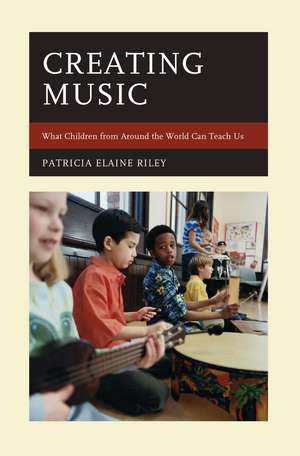
Creating Music: What Children from Around the World Can Teach Us: National Association for Music Education
Autor Patricia Elaine Rileyen Limba Engleză Paperback – 8 ian 2017
Din seria National Association for Music Education
- 22%
 Preț: 181.96 lei
 - 22%
 Preț: 178.77 lei
 - 16%
 Preț: 205.17 lei
 - 25%
 Preț: 218.65 lei
 - 25%
 Preț: 178.24 lei
 - 26%
 Preț: 176.32 lei
 -
 Preț: 254.12 lei
 - 21%
 Preț: 137.47 lei
 - 21%
 Preț: 143.19 lei
 -
 Preț: 172.25 lei
 - 25%
 Preț: 221.15 lei
 -
 Preț: 303.27 lei
 - 25%
 Preț: 181.75 lei
 - 26%
 Preț: 215.84 lei
 - 24%
 Preț: 358.37 lei
 - 26%
 Preț: 211.03 lei
 - 25%
 Preț: 179.21 lei
 - 24%
 Preț: 254.91 lei
 - 20%
 Preț: 223.04 lei
 - 23%
 Preț: 257.19 lei
 - 29%
 Preț: 458.91 lei
 - 23%
 Preț: 177.18 lei
 - 23%
 Preț: 265.50 lei
 - 25%
 Preț: 178.84 lei
 - 21%
 Preț: 136.87 lei
 - 25%
 Preț: 180.94 lei
 - 21%
 Preț: 136.31 lei
 - 26%
 Preț: 444.21 lei
 - 25%
 Preț: 349.24 lei
 - 25%
 Preț: 181.75 lei
 - 25%
 Preț: 180.89 lei
 - 29%
 Preț: 424.69 lei
Preț: 222.67 lei
Puncte Express: 334
Carte disponibilă
Livrare economică 28 octombrie-11 noiembrie
Livrare express 14-20 octombrie pentru 37.82 lei
Livrare prin curier în România Termenul estimat este afișat lângă disponibilitate.
Transport gratuit de la 400.00 lei Plată online sau ramburs, în funcție de opțiunile comenzii.
Retur gratuit în 14 zile Comandă securizată și suport în română.
Specificații
ISBN-13: 9781475830170
ISBN-10: 1475830173
Pagini: 280
Dimensiuni: 153 x 228 x 22 mm
Greutate: 0.45 kg
Editura: Bloomsbury Publishing
Colecția Rowman & Littlefield
Seria National Association for Music Education
Locul publicării:New York, United States
ISBN-10: 1475830173
Pagini: 280
Dimensiuni: 153 x 228 x 22 mm
Greutate: 0.45 kg
Editura: Bloomsbury Publishing
Colecția Rowman & Littlefield
Seria National Association for Music Education
Locul publicării:New York, United States
V-ar putea interesa
-
 -35%Preț: 594.98 lei910.83 lei
 -
 Creating Global Music in TurkeyKoray Degirmenci-33%Preț: 497.45 lei743.82 lei
 -
 Mandolin ChordsMel BayPreț: 91.48 lei
 -
 Music in North America and the West Indies from the Discovery to 1850: A Historical SurveyDaniel Mendoza de Arce-33%Preț: 769.81 lei1156.46 lei
 -
 A Guide to Musical TemperamentThomas Donahue-19%Preț: 375.39 lei461.78 lei
 -
 Elie Siegmeister, American Composer: A Bio-BibliographyLeonard J. Lehrman-37%Preț: 666.08 lei1057.70 lei
 -
 Recording History: The British Record Industry, 1888 – 1931Peter Martland-35%Preț: 686.09 lei1058.35 lei
 -
 Analytical Survey of the Fifteen Two-Part Inventions by J.S. BachTheodore O. JohnsonPreț: 377.26 lei
 -
 Jazz Swing Guitar Book/Online AudioJon WheatleyPreț: 187.18 lei
 -
 Preț: 155.04 lei
 -
 Preț: 162.52 lei
 -
 Tao Of MusicBodhi SetchkoPreț: 107.66 lei
 -
 -20%Preț: 430.66 lei538.33 lei
 -
 Music Theory Secrets: 94 Strategies for the Starting MusicianBrent Coppenbarger-20%Preț: 317.82 lei397.99 lei
 -
 One Giant LeapCharles PappasPreț: 112.02 lei
 -
 -15%Preț: 152.13 lei178.98 lei
 -
 Popular Music and the Politics of NoveltySenior Lecturer in Popular Music Pete Dale-16%Preț: 256.94 lei305.07 lei
 -
 -35%Preț: 545.98 lei837.88 lei
 -
 The Manuscript 12-Stave WorkbookTobe A. RichardsPreț: 91.77 lei
 -
 The Wordsmith's Guide to English SongNicola HarrisonPreț: 249.05 lei
 -
 Bach's Authentic Chorale Harmony - ResourcesChristopher MableyPreț: 237.05 lei
 -
 Finding The Right Pitch IIIDavid NivansPreț: 232.66 lei
 -
 Lola Flores : cultura popular, memoria sentimental e historia del espectáculoAlberto Romero FerrerPreț: 233.21 lei
 -
 Pet Shop Boys : pluralFrancisco Javier Barbero RamírezPreț: 293.73 lei
 -
 Preț: 85.14 lei
Descriere
Children create music in individually unique ways, but also using common processes. Each creating process component stated in the United States' National Music Standards (imagine, plan and make, evaluate and refine, and present; NCCAS, 2014) is explored in this text using children's creations from China, India, Ireland, Mexico, and the United States as examples. What can the characteristics of music created by children from five diverse locations teach us about creating music? How do the sounds surrounding children in their schools, homes, and communities affect the music they create and what can be learned from this? How do children's similar creating processes inform how we teach music? These questions are investigated as the children's music compositions and improvisations are shared and examined. As this narrative unfolds, readers will become acquainted with the children, their original music, and what the children say about their music and its creation. What we learn from this exploration leads to teaching strategies, projects, lesson plans, and mentoring recommendations that will help music educators benefit from these particular children's creations.
Cuprins
Foreword-Peter Webster
Preface
Part I The Why and How of Children's Music Creation
Chapter 1: Creating Music is Important
Chapter 2: Understanding the Processes of Music Creation
Part II Exemplifying the Creating Process Components with Children's Compositionsand Improvisations From Around the World
Chapter 3: Meeting the Children and Their Surroundings
Chapter 4: Imagining Music
Chapter 5: Planning and Making Music
Chapter 6: Evaluating and Refining Music
Chapter 7: Presenting Music
Part III Facilitating Children's Creating
Chapter 8: Crafting Creating Opportunities
Chapter 9: Mentoring Student Creations
References
About the Author
Preface
Part I The Why and How of Children's Music Creation
Chapter 1: Creating Music is Important
Chapter 2: Understanding the Processes of Music Creation
Part II Exemplifying the Creating Process Components with Children's Compositionsand Improvisations From Around the World
Chapter 3: Meeting the Children and Their Surroundings
Chapter 4: Imagining Music
Chapter 5: Planning and Making Music
Chapter 6: Evaluating and Refining Music
Chapter 7: Presenting Music
Part III Facilitating Children's Creating
Chapter 8: Crafting Creating Opportunities
Chapter 9: Mentoring Student Creations
References
About the Author
Recenzii
Riley is an experienced music teacher and professor, and the present book arose from her desire to help pre-service and in-service music educators understand and implement the revised standards for music composition. The focus of this fascinating project is articulated in the book's subtitle. The process of communication and collaboration a child uses to create music reflects his/her culture and awareness of other cultures. The author divides the book into three sections: the first looks at applied research and the curriculum used in formulating the project; the second examines components of the creative process and describes the cultures of the five countries represented in the book; the last looks at educators' role as facilitators. The inclusion of lesson plans and examples of projects for teachers to encourage classroom music composition and improvisation makes this an extraordinarily valuable resource. The book is well written and abounds with illustrations, tables, figures, charts, interviews, and curriculum standards.
Summing Up: Highly recommended. Upper-division undergraduates; graduate students; professionals.
In spite of a growing base of research and instructional materials that support engaging students in music composition, doing so remains at the periphery of much music education practice. In this text, Dr. Patricia Riley offers a useful addition to existing literature.. Throughout these chapters, Riley writes as equal parts researcher, composition teacher, music teacher educator, and professional development provider - a blend that is consistent with her own experiences. She shifts among presenting collected data, analyzing student compositions, and providing readers with encouragement and advice. These descriptions of children's music creations, and processes through which they were developed, are in and of themselves a helpful contribution to our professional literature.. In-service teachers, pre-service teachers, and music teacher educators who believe they lack experience providing feedback to composition students would be particularly well served by reading this chapter. Creating Music: What Children from Around the World Can Teach Us offers an exciting and fresh perspective on understanding how children create music, with immediate practical application for facilitating students' creative work.
Patricia Riley's Creating Music: What Children From Around the World Can Teach Us is not only a first-rate exploration of how children across the globe create with music, but it is an extremely valuable deep-dive on the composition and improvisation components of the new National Core Music Standards. As a member of the writing team of the High School Composition and Theory Standards, I am overjoyed that Riley has done such extensive research and put this text together in a cogent and useful manner. The chapter on process alone is worth the price of admission!
In her illuminating book, Dr. Patricia Riley helps teachers to understand and teach the "creating process" that is a key component of the National Core Music Standards. Anyone interested in music education will benefit from reading this book, but it is a gift to teachers who may be confused or intimidated by the composition component of the new standards. Riley accomplishes this with her deft presentation of the entire compositional process through the creative voices of children from China, India, Ireland, Mexico, and the United States. The children's conversations, colorful sketches, and compositions bring the theoretical principles down to earth with charming immediacy, and Riley's global perspective makes this book a unique contribution to music education literature.
This book is timely and important. Teachers will address the new National Core Music Standards and embed them into existing curricula that are often weak in the Creating artistic process. Of special importance is the chapter on mentoring - abundant with children's examples, process guides, and narrative descriptions. As teachers move forward, mentoring is a key element in furthering children's composition, so well articulated here.
Creating Music: What Children From Around the World Can Teach Us is an excellent mix of carefully depicted observations and practical suggestions for including music composition in the education of children. Riley brings a teacher's eye and a researcher's mind to the world of children creating music. The book includes many suggestions for mentoring young composers and highlights connections to the new US National Core Music Standards.
Riley has successfully connected multiple strands of research focusing on children's original music creations, including international perspectives and influences of cultural contexts, historical frameworks, national standards as guidelines, and an extensive literature review. Contributions to the field are found within the international insights that inform us about context and universalities, and children's musical understanding as represented through their original musical works. With these insights, Riley shares her strategies when guiding, facilitating and mentoring young composers and improvisers.
Summing Up: Highly recommended. Upper-division undergraduates; graduate students; professionals.
In spite of a growing base of research and instructional materials that support engaging students in music composition, doing so remains at the periphery of much music education practice. In this text, Dr. Patricia Riley offers a useful addition to existing literature.. Throughout these chapters, Riley writes as equal parts researcher, composition teacher, music teacher educator, and professional development provider - a blend that is consistent with her own experiences. She shifts among presenting collected data, analyzing student compositions, and providing readers with encouragement and advice. These descriptions of children's music creations, and processes through which they were developed, are in and of themselves a helpful contribution to our professional literature.. In-service teachers, pre-service teachers, and music teacher educators who believe they lack experience providing feedback to composition students would be particularly well served by reading this chapter. Creating Music: What Children from Around the World Can Teach Us offers an exciting and fresh perspective on understanding how children create music, with immediate practical application for facilitating students' creative work.
Patricia Riley's Creating Music: What Children From Around the World Can Teach Us is not only a first-rate exploration of how children across the globe create with music, but it is an extremely valuable deep-dive on the composition and improvisation components of the new National Core Music Standards. As a member of the writing team of the High School Composition and Theory Standards, I am overjoyed that Riley has done such extensive research and put this text together in a cogent and useful manner. The chapter on process alone is worth the price of admission!
In her illuminating book, Dr. Patricia Riley helps teachers to understand and teach the "creating process" that is a key component of the National Core Music Standards. Anyone interested in music education will benefit from reading this book, but it is a gift to teachers who may be confused or intimidated by the composition component of the new standards. Riley accomplishes this with her deft presentation of the entire compositional process through the creative voices of children from China, India, Ireland, Mexico, and the United States. The children's conversations, colorful sketches, and compositions bring the theoretical principles down to earth with charming immediacy, and Riley's global perspective makes this book a unique contribution to music education literature.
This book is timely and important. Teachers will address the new National Core Music Standards and embed them into existing curricula that are often weak in the Creating artistic process. Of special importance is the chapter on mentoring - abundant with children's examples, process guides, and narrative descriptions. As teachers move forward, mentoring is a key element in furthering children's composition, so well articulated here.
Creating Music: What Children From Around the World Can Teach Us is an excellent mix of carefully depicted observations and practical suggestions for including music composition in the education of children. Riley brings a teacher's eye and a researcher's mind to the world of children creating music. The book includes many suggestions for mentoring young composers and highlights connections to the new US National Core Music Standards.
Riley has successfully connected multiple strands of research focusing on children's original music creations, including international perspectives and influences of cultural contexts, historical frameworks, national standards as guidelines, and an extensive literature review. Contributions to the field are found within the international insights that inform us about context and universalities, and children's musical understanding as represented through their original musical works. With these insights, Riley shares her strategies when guiding, facilitating and mentoring young composers and improvisers.