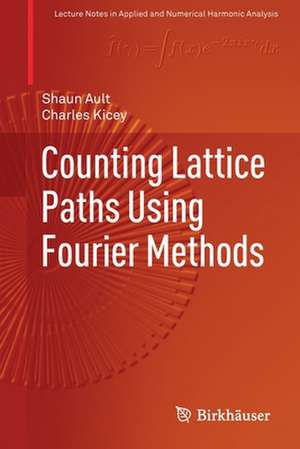
Counting Lattice Paths Using Fourier Methods: Applied and Numerical Harmonic Analysis
Autor Shaun Ault, Charles Kiceyen Limba Engleză Paperback – 31 aug 2019
This monograph introduces a novel and effective approach to counting lattice paths by using the discrete Fourier transform (DFT) as a type of periodic generating function. Utilizing a previously unexplored connection between combinatorics and Fourier analysis, this method will allow readers to move to higher-dimensional lattice path problems with ease. The technique is carefully developed in the first three chapters using the algebraic properties of the DFT, moving from one-dimensional problems to higher dimensions. In the following chapter, the discussion turns to geometric properties of the DFT in order to study the corridor state space. Each chapter poses open-ended questions and exercises to prompt further practice and future research. Two appendices are also provided, which cover complex variables and non-rectangular lattices, thus ensuring the text will be self-contained and serve as a valued reference.
Counting Lattice Paths Using Fourier Methods is ideal for upper-undergraduates and graduate students studying combinatorics or other areas of mathematics, as well as computer science or physics. Instructors will also find this a valuable resource for use in their seminars. Readers should have a firm understanding of calculus, including integration, sequences, and series, as well as a familiarity with proofs and elementary linear algebra.
Din seria Applied and Numerical Harmonic Analysis
-
 Preț: 412.83 lei
 -
 Preț: 422.34 lei
 - 15%
 Preț: 687.12 lei
 - 15%
 Preț: 648.10 lei
 - 15%
 Preț: 670.35 lei
 - 15%
 Preț: 678.37 lei
 -
 Preț: 425.06 lei
 - 17%
 Preț: 490.75 lei
 -
 Preț: 394.98 lei
 -
 Preț: 417.98 lei
 - 15%
 Preț: 668.72 lei
 - 15%
 Preț: 679.46 lei
 - 18%
 Preț: 693.76 lei
 - 15%
 Preț: 680.36 lei
 - 15%
 Preț: 669.27 lei
 - 24%
 Preț: 646.32 lei
 - 32%
 Preț: 589.01 lei
 -
 Preț: 376.97 lei
 - 15%
 Preț: 525.30 lei
 - 15%
 Preț: 672.01 lei
 -
 Preț: 390.25 lei
 - 21%
 Preț: 583.02 lei
 -
 Preț: 424.20 lei
 - 15%
 Preț: 649.75 lei
 -
 Preț: 407.65 lei
 - 24%
 Preț: 594.27 lei
 -
 Preț: 411.45 lei
 -
 Preț: 390.01 lei
 - 5%
 Preț: 1174.50 lei
 - 24%
 Preț: 597.60 lei
 -
 Preț: 401.66 lei
 - 18%
 Preț: 1147.27 lei
 - 18%
 Preț: 991.26 lei
 -
 Preț: 403.77 lei
 - 15%
 Preț: 609.75 lei
 -
 Preț: 393.95 lei
 - 18%
 Preț: 1165.29 lei
 - 18%
 Preț: 1014.41 lei
 - 15%
 Preț: 571.61 lei
 - 15%
 Preț: 555.16 lei
 - 15%
 Preț: 680.81 lei
 - 24%
 Preț: 934.46 lei
Preț: 465.37 lei
Preț vechi: 547.50 lei
-15%
Puncte Express: 698
Carte tipărită la comandă
Livrare economică 26 noiembrie-10 decembrie
Livrare prin curier în România Termenul estimat este afișat lângă disponibilitate.
Transport gratuit pentru acest produs Plată online sau ramburs, în funcție de opțiunile comenzii.
Retur gratuit în 14 zile Comandă securizată și suport în română.
Specificații
ISBN-13: 9783030266950
ISBN-10: 3030266958
Pagini: 136
Ilustrații: XII, 136 p. 60 illus., 1 illus. in color.
Dimensiuni: 155 x 235 mm
Greutate: 0.22 kg
Ediția:1st ed. 2019
Editura: Springer International Publishing
Colecția Birkhäuser
Seriile Applied and Numerical Harmonic Analysis, Lecture Notes in Applied and Numerical Harmonic Analysis
Locul publicării:Cham, Switzerland
ISBN-10: 3030266958
Pagini: 136
Ilustrații: XII, 136 p. 60 illus., 1 illus. in color.
Dimensiuni: 155 x 235 mm
Greutate: 0.22 kg
Ediția:1st ed. 2019
Editura: Springer International Publishing
Colecția Birkhäuser
Seriile Applied and Numerical Harmonic Analysis, Lecture Notes in Applied and Numerical Harmonic Analysis
Locul publicării:Cham, Switzerland
Cuprins
Lattice Paths and Corridors.- One-Dimensional Lattice Walks.- Lattice Walks in Higher Dimensions.- Corridor State Space.- Review: Complex Numbers.- Triangular Lattices.- Selected Solutions.- Index.
Textul de pe ultima copertă
This monograph introduces a novel and effective approach to counting lattice paths by using the discrete Fourier transform (DFT) as a type of periodic generating function. Utilizing a previously unexplored connection between combinatorics and Fourier analysis, this method will allow readers to move to higher-dimensional lattice path problems with ease. The technique is carefully developed in the first three chapters using the algebraic properties of the DFT, moving from one-dimensional problems to higher dimensions. In the following chapter, the discussion turns to geometric properties of the DFT in order to study the corridor state space. Each chapter poses open-ended questions and exercises to prompt further practice and future research. Two appendices are also provided, which cover complex variables and non-rectangular lattices, thus ensuring the text will be self-contained and serve as a valued reference.
Counting Lattice Paths Using Fourier Methods is ideal for upper-undergraduates and graduate students studying combinatorics or other areas of mathematics, as well as computer science or physics. Instructors will also find this a valuable resource for use in their seminars. Readers should have a firm understanding of calculus, including integration, sequences, and series, as well as a familiarity with proofs and elementary linear algebra.
Caracteristici
Introduces a unique technique to count lattice paths by using the discrete Fourier transform Explores the interconnection between combinatorics and Fourier methods Motivates students to move from one-dimensional problems to higher dimensions Presents numerous exercises with selected solutions appearing at the end