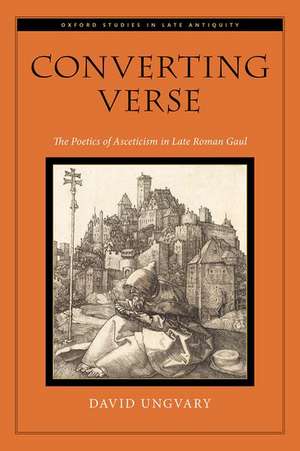
Converting Verse: Oxford Studies in Late Antiquity
Autor David Ungvaryen Limba Engleză Hardback – 23 sep 2024
Din seria Oxford Studies in Late Antiquity
- 23%
 Preț: 800.65 lei
 - 18%
 Preț: 542.66 lei
 -
 Preț: 240.58 lei
 - 34%
 Preț: 604.02 lei
 - 31%
 Preț: 504.03 lei
 - 31%
 Preț: 499.33 lei
 - 33%
 Preț: 534.08 lei
 - 34%
 Preț: 514.06 lei
 - 34%
 Preț: 691.92 lei
 - 11%
 Preț: 409.85 lei
 - 14%
 Preț: 661.93 lei
 - 14%
 Preț: 660.42 lei
 - 14%
 Preț: 597.24 lei
 - 27%
 Preț: 696.79 lei
 - 14%
 Preț: 832.18 lei
 - 8%
 Preț: 682.17 lei
 - 6%
 Preț: 516.04 lei
 - 14%
 Preț: 647.49 lei
 - 9%
 Preț: 652.58 lei
 - 13%
 Preț: 615.71 lei
 - nou
 Preț: 503.84 lei
Preț: 500.20 lei
Preț vechi: 727.06 lei
-31% Nou
Puncte Express: 750
Preț estimativ în valută:
88.54€ • 103.09$ • 77.32£
88.54€ • 103.09$ • 77.32£
Carte disponibilă
Livrare economică 01-07 ianuarie 26
Preluare comenzi: 021 569.72.76
Specificații
ISBN-13: 9780197600740
ISBN-10: 0197600743
Pagini: 288
Dimensiuni: 152 x 226 x 33 mm
Greutate: 0.5 kg
Editura: Oxford University Press
Seria Oxford Studies in Late Antiquity
Locul publicării:New York, United States
ISBN-10: 0197600743
Pagini: 288
Dimensiuni: 152 x 226 x 33 mm
Greutate: 0.5 kg
Editura: Oxford University Press
Seria Oxford Studies in Late Antiquity
Locul publicării:New York, United States
Recenzii
Why write poetry? As David Ungvary shows, this question urgently occupied authors in Late Antique Gaul. Through a brilliant exploration of their answers, using a wide range of texts, Ungvary advances our understanding of the relationship between Late Antique Christianity and classical Latin verse- their fault lines and common ground - and of the practices and poetics of Christian conversion. The book is necessary reading for anyone interested in how poetry became Christian in Late Antiquity.
Converting Verse spotlights a series of daring literary experiments in harmonizing the expressive modes of classical poetry and Late Antiquity's burgeoning monastic discourses. In pages rich with insights, David Ungvary deftly argues that these negotiations between poets and ascetic impresarios spurred the reinvention of poetry's power and legitimized verse composition as an ascetic practice.
"Converting Verse" tackles a difficult historical question through an analysis of textual evidence that is reluctant to divulge clear answers. The book is at its best when Ungvary applies his skills as a Latinist to the analysis of the fifth-century poems that form the basis of his study. Readers will surely benefit from his close reading of the Epigramma Paulini and the poems of Pauli-nus of Pella, Sidonius Apollinaris, and Avitus of Vienne.
The book is at its best when Ungvary applies his skills as a Latinist to the analysis of fifth-century poems that form the basis of his study. Readers will surely benefit from his close reading of the Epigramma Paulini and the poems of Paulinus of Pella, Sidonius Apollinaris, and Avitus of Vienne.
The book should be read by anyone interested in late antique or medieval Latin poetry. All texts are well translated, including a complete translation of Ennodius' Eucharisticon co-authored with one of U.'s students.
Converting Verse spotlights a series of daring literary experiments in harmonizing the expressive modes of classical poetry and Late Antiquity's burgeoning monastic discourses. In pages rich with insights, David Ungvary deftly argues that these negotiations between poets and ascetic impresarios spurred the reinvention of poetry's power and legitimized verse composition as an ascetic practice.
"Converting Verse" tackles a difficult historical question through an analysis of textual evidence that is reluctant to divulge clear answers. The book is at its best when Ungvary applies his skills as a Latinist to the analysis of the fifth-century poems that form the basis of his study. Readers will surely benefit from his close reading of the Epigramma Paulini and the poems of Pauli-nus of Pella, Sidonius Apollinaris, and Avitus of Vienne.
The book is at its best when Ungvary applies his skills as a Latinist to the analysis of fifth-century poems that form the basis of his study. Readers will surely benefit from his close reading of the Epigramma Paulini and the poems of Paulinus of Pella, Sidonius Apollinaris, and Avitus of Vienne.
The book should be read by anyone interested in late antique or medieval Latin poetry. All texts are well translated, including a complete translation of Ennodius' Eucharisticon co-authored with one of U.'s students.
Notă biografică
David Ungvary is Assistant Professor of Classics at Bard College.