
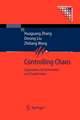
Controlling Chaos: Communications and Control Engineering
Autor Huaguang Zhang, Derong Liu, Zhiliang Wangen Limba Engleză Hardback – 27 iul 2009
This monograph is self-contained with introductory material providing a review of the history of chaos control and the necessary mathematical preliminaries for working with dynamical systems.
Din seria Communications and Control Engineering
- 20%
 Preț: 912.34 lei
 - 18%
 Preț: 992.26 lei
 - 18%
 Preț: 1169.33 lei
 - 18%
 Preț: 1154.10 lei
 - 15%
 Preț: 680.73 lei
 - 18%
 Preț: 929.37 lei
 - 15%
 Preț: 667.91 lei
 - 18%
 Preț: 987.63 lei
 - 18%
 Preț: 1451.74 lei
 - 18%
 Preț: 952.84 lei
 - 18%
 Preț: 983.93 lei
 - 18%
 Preț: 916.16 lei
 - 23%
 Preț: 1004.58 lei
 - 18%
 Preț: 988.90 lei
 - 15%
 Preț: 675.30 lei
 - 18%
 Preț: 991.00 lei
 - 18%
 Preț: 1087.77 lei
 - 18%
 Preț: 925.04 lei
 - 18%
 Preț: 1144.83 lei
 - 18%
 Preț: 1193.65 lei
 - 24%
 Preț: 1061.48 lei
 - 18%
 Preț: 982.79 lei
 - 18%
 Preț: 981.00 lei
 - 18%
 Preț: 1119.01 lei
 - 18%
 Preț: 1431.25 lei
 - 18%
 Preț: 990.53 lei
 - 15%
 Preț: 668.95 lei
 - 18%
 Preț: 980.46 lei
 - 15%
 Preț: 598.26 lei
 - 15%
 Preț: 668.10 lei
 - 20%
 Preț: 1500.71 lei
 - 15%
 Preț: 666.14 lei
 - 18%
 Preț: 1279.56 lei
 - 15%
 Preț: 674.64 lei
 - 18%
 Preț: 821.53 lei
 - 18%
 Preț: 990.77 lei
 - 18%
 Preț: 1079.91 lei
 - 18%
 Preț: 988.26 lei
 - 18%
 Preț: 1270.25 lei
 - 15%
 Preț: 670.23 lei
Preț: 988.65 lei
Preț vechi: 1205.68 lei
-18%
Puncte Express: 1483
Carte tipărită la comandă
Livrare economică 30 noiembrie-14 decembrie
Livrare prin curier în România Termenul estimat este afișat lângă disponibilitate.
Transport gratuit pentru acest produs Plată online sau ramburs, în funcție de opțiunile comenzii.
Retur gratuit în 14 zile Comandă securizată și suport în română.
Specificații
ISBN-13: 9781848825222
ISBN-10: 1848825226
Pagini: 368
Ilustrații: XX, 344 p. 178 illus.
Dimensiuni: 160 x 241 x 25 mm
Greutate: 0.67 kg
Ediția:2009
Editura: Springer
Colecția Communications and Control Engineering
Seria Communications and Control Engineering
Locul publicării:London, United Kingdom
ISBN-10: 1848825226
Pagini: 368
Ilustrații: XX, 344 p. 178 illus.
Dimensiuni: 160 x 241 x 25 mm
Greutate: 0.67 kg
Ediția:2009
Editura: Springer
Colecția Communications and Control Engineering
Seria Communications and Control Engineering
Locul publicării:London, United Kingdom
V-ar putea interesa
-
 -39%Preț: 359.16 lei590.66 lei
 -
 -38%Preț: 160.69 lei260.20 lei
 -
 Handbook of Hybrid Systems ControlJan Lunze-14%Preț: 961.04 lei1117.48 lei
 -
 Fundamentals of Object TrackingSubhash Challa-11%Preț: 730.64 lei820.93 lei
 -
 Arduino Projects For DummiesBrock CraftPreț: 162.53 lei
 -
 Engineering Systems Integration: Theory, Metrics, and MethodsGary O. Langford-20%Preț: 1309.34 lei1636.68 lei
 -
 Make: Arduino Bots and GadgetsTero KarvinenPreț: 210.49 lei
 -
 Geometric Methods and ApplicationsJean Gallier-15%Preț: 552.23 lei649.67 lei
 -
 Model Predictive ControlEduardo F. Camacho-15%Preț: 512.40 lei602.82 lei
 -
 Mechatronic SystemsRolf Isermann-15%Preț: 605.64 lei712.51 lei
 -
 Logistik-Wörterbuch. Dictionary of LogisticsVanessa Scott-Sabic-18%Preț: 838.28 lei1022.30 lei
 -
 Automotive Mechatronics: Operational and Practical IssuesB. T. Fijalkowski-18%Preț: 1194.66 lei1456.91 lei
Public țintă
ResearchCuprins
Overview.- Preliminaries of Nonlinear Dynamics and Chaos.- Entrainment and Migration Control of Chaotic Systems.- Feedback Control of Chaotic Systems.- Synchronizing Chaotic Systems Based on Feedback Control.- Synchronizing Chaotic Systems via Impulsive Control.- Synchronization of Chaotic Systems with Time Delay.- Synchronizing Chaotic Systems Based on Fuzzy Models.- Chaotification of Nonchaotic Systems.
Recenzii
From the reviews:
“In this book the authors present state-of-the-art techniques for active control and synchronization of chaotic systems. … the book is written in a clear and concise fashion and each chapter contains a list of up-to-date references. … The book should be valuable to graduate students and faculty in engineering, or to applied mathematicians and physicists interested in the field of nonlinear dynamics and control theory. … It is recommended for individuals as well as libraries.” (Subhash C. Sinha, International Journal of Acoustics and Vibration, Vol. 16 (1), 2011)
“In this book the authors present state-of-the-art techniques for active control and synchronization of chaotic systems. … the book is written in a clear and concise fashion and each chapter contains a list of up-to-date references. … The book should be valuable to graduate students and faculty in engineering, or to applied mathematicians and physicists interested in the field of nonlinear dynamics and control theory. … It is recommended for individuals as well as libraries.” (Subhash C. Sinha, International Journal of Acoustics and Vibration, Vol. 16 (1), 2011)
Textul de pe ultima copertă
Controlling Chaos offers its reader an extensive selection of techniques to achieve three goals: the suppression, synchronization and generation of chaos, each of which is the focus of a separate part of the book. The text deals with the well-known Lorenz, Rössler and Hénon attractors and the Chua circuit, and with less celebrated novel systems. Modeling of chaos is accomplished using difference equations and ordinary and time-delayed differential equations. The methods directed at controlling chaos benefit from the influence of advanced nonlinear control theory: inverse optimal control is used for stabilization; exact linearization for synchronization; and impulsive control for chaotification. Notably, a fusion of chaos and fuzzy systems theories is employed, with the Takagi–Sugeno model and the authors’ own fuzzy hyperbolic model utilized in the modeling and control of chaotic systems. Time-delayed systems are also studied with many synchronization methods being explored. All the results presented are general for a broad class of chaotic systems.
This monograph is self-contained with introductory material providing a review of the history of chaos control and the necessary mathematical preliminaries for working with dynamical systems.
Controlling Chaos will be of interest to academics from electrical, systems, mechanical and chemical engineering backgrounds working in control theory related to nonlinear dynamical and chaotic systems and to graduate students of chaos control.
The Communications and Control Engineering series reports major technological advances which have potential for great impact in the fields of communication and control. It reflects research in industrial and academic institutions around the world so that the readership can exploit new possibilities as they become available.
This monograph is self-contained with introductory material providing a review of the history of chaos control and the necessary mathematical preliminaries for working with dynamical systems.
Controlling Chaos will be of interest to academics from electrical, systems, mechanical and chemical engineering backgrounds working in control theory related to nonlinear dynamical and chaotic systems and to graduate students of chaos control.
The Communications and Control Engineering series reports major technological advances which have potential for great impact in the fields of communication and control. It reflects research in industrial and academic institutions around the world so that the readership can exploit new possibilities as they become available.
Caracteristici
Unifies chaos theory with fuzzy systems theory for more effective control of chaotic systems Presents the latest results on chaotification of linear systems Presents novel advanced control methods for applications to chaotic and nonlinear systems Includes supplementary material: sn.pub/extras
Notă biografică
Juan Zhang received the B.S. degree in information and computing science from Shanxi Normal University, Linfen, China, in 2016, and the M.S. degree in basic mathematics and the Ph.D. degree in control theory and control engineering from Northeastern University, Shenyang, China, in 2018 and 2023, respectively. She is currently a Lecturer with the School of Information Science and Engineering, Northeastern University, where she is also a Post-Doctoral Fellow. Her current research interests include containment control, event-triggered control, formation control, consensus control, fault-tolerant control, DoS attacks for multi-agent systems, and their applications in boiler systems.
Huaguang Zhang (Fellow, IEEE) received the B.S. and M.S. degrees in control engineering from Northeast Dianli University, Jilin, China, in 1982 and1985, respectively, and the Ph.D. degree in thermal power engineering and automation from Southeast University, Nanjing, China, in 1991. He has authored or coauthored over 280 journals and conference papers, six monographs, and coinvented 90 patents. His current research interests include fuzzy control, stochastic system control, neural networks-based control, nonlinear control, and their applications. He was Recipient of the Outstanding Youth Science Foundation Award from the National Natural Science Foundation Committee of China in 2003 and the IEEE Transactions on Neural Networks and Learning systems Outstanding Paper Award in 2012. He was named the Cheung Kong Scholar by the Education Ministry of China in 2005. He is E-Letter Chair of the IEEE CIS Society and Former Chair of the Adaptive Dynamic Programming and Reinforcement Learning Technical Committee of the IEEE Computational Intelligence Society. He was Associate Editor of the IEEE Transactions on Fuzzy Systems from 2008 to 2013. He is Associate Editor of Automatica, the IEEE Transactions on Neural Networks and Learning Systems, the IEEE Transactions on Cybernetics, and Neurocomputing.
Dongsheng Yang (Senior Member, IEEE) received the B.S. degree in testing technology and instrumentation, the M.S. degree in power electronics and electric drives, and the Ph.D. degree in control theory and control engineering from Northeastern University, Shenyang, China, in 1999, 2004, and 2007, respectively. He is currently Professor with Northeastern University. He was supported by the Program for New Century Excellent Talents in University. He has authored or coauthored more than 70 papers published in academic journals and conference proceedings, three monographs, and coinvented 80 patents. His current research interests include distributed generation, multi-energy power systems, and artificial intelligence-based fault diagnosis and protection. He was a recipient of the Second Prize of National Science and Technology Progress.
Yanhong Luo (Member, IEEE) received the B.S. degree in automation control, the Ph.D. degree in control theory and control engineering from Northeastern University, Shenyang, China, in 2003 and 2009, respectively. From 2016 to 2017, she visited The University of Texas at Arlington as
a Visiting Scholar. She is currently a Professor with Northeastern University. She has published more than 100 SCI/EI indexed papers. Her research interests include renewable energy accommodation, distributed control and optimal operation of energy Internet, adaptive dynamic programming, and data-driven self-learning control and its industrial applications. She is a recipient of Andrew P. Sage Best Transactions Paper Award (2015) with IEEE SMC Society. In addition, she is the Former Vice-Chair of Adaptive Dynamic Programming Reinforcement Learning Technical Committee with IEEE Computational Intelligence Society.She served as the Session Chair or a TPC member for more than 20 international conferences.
Bowen Zhou (Member, IEEE) received the B.Sc. and M.Sc. degrees in electrical engineering from Wuhan University,