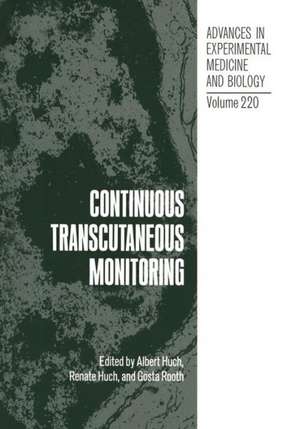
Continuous Transcutaneous Monitoring: Advances in Behavioral Biology, cartea 7
Autor Albert Huch, Renate Huch, Gösta Roothen Limba Engleză Paperback – 4 noi 2011
Din seria Advances in Behavioral Biology
- 20%
 Preț: 626.38 lei
 - 20%
 Preț: 619.00 lei
 - 20%
 Preț: 612.18 lei
 - 5%
 Preț: 1089.80 lei
 - 5%
 Preț: 354.03 lei
 -
 Preț: 386.52 lei
 -
 Preț: 391.16 lei
 - 15%
 Preț: 624.46 lei
 -
 Preț: 372.50 lei
 - 5%
 Preț: 363.70 lei
 -
 Preț: 389.88 lei
 -
 Preț: 366.95 lei
 - 5%
 Preț: 358.61 lei
 - 5%
 Preț: 696.54 lei
 - 5%
 Preț: 642.75 lei
 - 5%
 Preț: 364.56 lei
 - 15%
 Preț: 646.64 lei
 -
 Preț: 370.46 lei
 - 15%
 Preț: 647.26 lei
 -
 Preț: 391.91 lei
 - 5%
 Preț: 772.44 lei
 - 5%
 Preț: 689.18 lei
 - 5%
 Preț: 358.45 lei
 - 15%
 Preț: 654.19 lei
 -
 Preț: 405.03 lei
 - 15%
 Preț: 637.65 lei
 - 5%
 Preț: 386.88 lei
 - 5%
 Preț: 355.28 lei
 -
 Preț: 393.75 lei
 - 15%
 Preț: 634.69 lei
 -
 Preț: 371.37 lei
 - 15%
 Preț: 621.67 lei
 -
 Preț: 387.82 lei
 -
 Preț: 382.49 lei
 -
 Preț: 391.16 lei
 - 5%
 Preț: 726.94 lei
 - 5%
 Preț: 391.10 lei
 - 5%
 Preț: 375.10 lei
 - 5%
 Preț: 377.23 lei
 - 5%
 Preț: 691.96 lei
 -
 Preț: 374.71 lei
 - 5%
 Preț: 2063.53 lei
 - 5%
 Preț: 1369.25 lei
 - 5%
 Preț: 1374.69 lei
 - 5%
 Preț: 2041.22 lei
Preț: 380.82 lei
Nou
Puncte Express: 571
Preț estimativ în valută:
67.40€ • 79.04$ • 59.09£
67.40€ • 79.04$ • 59.09£
Carte tipărită la comandă
Livrare economică 26 ianuarie-09 februarie 26
Preluare comenzi: 021 569.72.76
Specificații
ISBN-13: 9781461290711
ISBN-10: 1461290716
Pagini: 344
Ilustrații: XIII, 328 p.
Dimensiuni: 178 x 254 x 18 mm
Greutate: 0.6 kg
Ediția:Softcover reprint of the original 1st ed. 1987
Editura: Springer Us
Colecția Springer
Seria Advances in Behavioral Biology
Locul publicării:New York, NY, United States
ISBN-10: 1461290716
Pagini: 344
Ilustrații: XIII, 328 p.
Dimensiuni: 178 x 254 x 18 mm
Greutate: 0.6 kg
Ediția:Softcover reprint of the original 1st ed. 1987
Editura: Springer Us
Colecția Springer
Seria Advances in Behavioral Biology
Locul publicării:New York, NY, United States
V-ar putea interesa
-
 Preț: 259.97 lei
 -
 -19%Preț: 484.22 lei597.80 lei
 -
 A User′s Manual to the PMBOK Guide, Fifth EditionCS Stackpole-11%Preț: 523.90 lei588.64 lei
 -
 Patient Safety: A Human Factors ApproachSidney DekkerPreț: 429.56 lei
 -
 Preț: 365.65 lei
 -
 Handbook of Modern Grinding TechnologyRobert I. King-15%Preț: 618.64 lei727.80 lei
 -
 -20%Preț: 613.30 lei766.62 lei
 -
 Quality Control, Robust Design, and the Taguchi MethodKhosrow Dehnad-15%Preț: 619.75 lei729.11 lei
 -
 Statistical Quality Control for the Food IndustryMerton Hubbard-15%Preț: 618.03 lei727.08 lei
 -
 -18%Preț: 704.06 lei858.61 lei
 -
 -5%Preț: 690.39 lei726.72 lei
Public țintă
ResearchCuprins
Reviews of Main Themes.- History, Status and Future of Pulse Oximetry.- Possibilities and Limitations of the Transcutaneous Measuring Technique. A Theoretical Analysis.- Growth and Development of Transcutaneous Monitoring in the U.S.A. — 1978-1986.- Transcutaneous Po2 and Pco2 Monitoring at 37°C. Cutaneous Po2 and Pco2.- Performance of Transcutaneous Electrodes.- The Measurement of tcPo2 and tcPco2 in Newborn Infants at 44°C, 42°C and 37°C after Initial Heating to 44°C.- Drift in Vivo of Transcutaneous Dual Electrodes.- Evaluation of Single Sensor Transcutaneous Measurement of Po2 and Pco2 in the Neonate.- Current Correction Factors Inadequately Predict the Relationship between Transcutaneous (tc) and Arterial Pco2 in Sick Neonates.- Computing the Oxygen Status of the Blood from Heated Skin Po2.- Application in Adults.- Transcutaneous Monitoring of Po2 and Pco2 during Running — A Non-Invasive Determination of Gas Transport.- Transcutaneous Oxygen Tension during Exercise in Patients with Pulmonary Emphysema.- The Effect of Inhaled Bronchoconstrictors on Transcutaneous Gas Tensions in Normal Adult Subjects.- In Vivo Calibration of a Transcutaneous Oxygen Electrode in Adult Patients.- Inflammation and Transcutaneous Measurement of Oxygen Pressure in Dermatology.- Diagnostic Assessment of Diabetic Microangiopathy by tcPo2 Stimulation Tests.- Application in Perinatology.- Transcutaneous Blood Gases and Sleep Apnea Profile in Healthy Preterm Infants during Early Infancy.- Transcutaneous Monitoring as Trigger for Therapy of Hypoxemia during Sleep.- Effectiveness of Combined Transcutaneous Po2/Pco2 Monitoring of Newborns.- Incidence and Severity of Retinopathy in Low Birth Weight Infants Monitored by tcPo2.- Transcutaneous Oxygen Monitoring and Retinopathy ofPrematurity.- Combined Transcutaneous Oxygen, Carbon Dioxide Tensions and End-expired CO2 Levels in Severely Ill Newborns.- Transcutaneous Po2 and Pco2 during Surfactant Therapy in Newborn Infants witn Idiopathic Respiratory Distress Syndrome.- Continuous Fetal Acid-Base Assessment during Labour by tcPco2 Monitoring.- Microvascular Dynamics during Acute Asphyxia in Chronically Prepared Fetal Sheep near Term.- Pulse Oximetry.- Pulse Oximetry: Physical Principles, Technical Realization and Present Limitations.- Pulse Oximetry - an Alternative to Transcutaneous Po2in Sick Newborns.- Application of the Ohmeda Biox 3700 Pulse Oximeter to Neonatal Oxygen Monitoring.- Pulse Oximetry and Transcutaneous Oxygen Tension for Detection of Hypoxemia in Critically Ill Infants and Children.- Is Pulse Oximetry Reliable in Detecting Hyperoxemia in the Neonate?.- Comparison between Transcutaneous Po2 and Pulse Oximetry for Monitoring O2-Treatment in Newborns.- The Accuracy of the Pulse Oximeter in Neonates.- Pulse Oximetry and Transcutaneous Oxygen Tension in Hypoxemic Neonates and Infants with Bronchopulmonary Dysplasia.- Control of Pedicle and Microvascular Tissue Transfer by Photometric Reflection Oximetry.- Comparison of in Vivo Response Times between Pulse Oximetry and Transcutaneous PO2 Monitoring.- Errors in the Measurement of CO-Hemoglobin in Fetal Blood by Automated Multicomponent Analysis.- A Simple Method for HbF Analysis.- Skin Blood Flow.- Capillary Blood Pressure.- Microvasculatory Evaluation of Vasospastic Syndromes.- Infrared Fluorescence Videomicroscopy with Indocyanine Green (Cardiogreen ®).- Measurement of Tissue Blood Flow by High Frequency Doppler Ultrasound.- Laser-Doppler Probes for the Evaluation of Arterial Ischemia.- Skin Reactive Hyperemia Recorded by aCombined tcPo2 and Laser Doppler Sensor.- Comparison of Laser-Doppler-Flux and tcPo2 in Healthy Probands and Patients with Arterial Ischemia.- The Use of the Hellige Oxymonitor to Study Skin Blood Flow Changes.- Calculation of Skin Blood Flow.- Estimated Peripheral Blood FLow in Premature Newborn Infants.- Skin Blood Flow Calculations from Transcutaneous Gas Pressure Measurements.- The Percentual Initial Slope Index of tcPo2 as a Measure of the Peripheral Circulation and its Measurements by different tcPo2 Electrodes.- Examinations on the Blood Flow Dependence of tcPO2 Using the Model of the “Circulatory Hyperbola”.- Estimation of the Determinants of Transcutaneous Oxygen Tension Using a Dynamic Computer Model.- Technical Aspects of Continuous Monitoring.- Quality and Safety Aspects in the Development and Fabrication of Transcutaneous Sensors.- A New System for tcPo2 Long-Term Monitoring Using a Two-Electrode Sensor with Alternating Heating.- A Novel Approach for an ECG Electrode Integrated into a Transcutaneous Sensor.- Microelectronic Sensors for Simultaneous Measurement of Po2and pH.- A Modified Electrode Ring for Use in Transcutaneous Measurement of Po2.- Multichannel Recording and Analysis of Physiological Data Using a Personal Computer.- Continuous Non-Invasive Beat-by-Beat Blood Pressure (B.P.) Measurement in the Newborn.- The Relative Accuracy of Three Transcutaneous Dual Electrodes at 45° in Adults.- Contributors.