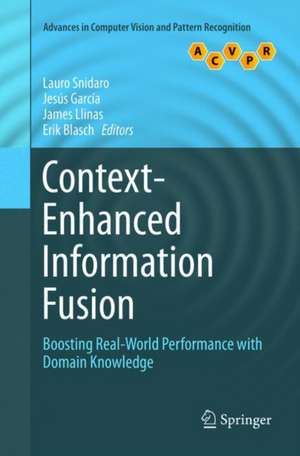
Context-Enhanced Information Fusion: Advances in Computer Vision and Pattern Recognition
Editat de Lauro Snidaro, Jesús García, James Llinas, Erik Blaschen Limba Engleză Paperback – 30 mai 2018
În ecosistemul sistemelor complexe de supraveghere și analiză, Context-Enhanced Information Fusion reprezintă o resursă tehnică de anvergură ce integrează framework-uri de fuziune a datelor cu modele de context pentru optimizarea proceselor decizionale. Remarcăm modul în care volumul trece dincolo de procesarea simplă a semnalelor, abordând arhitecturi middleware pentru schimbul și validarea informațiilor, precum și instrumente matematice pentru modelarea influențelor contextuale. Pe linia practică a lucrării Multisensor Data Fusion, dar cu focus pe integrarea cercetării din comunități diferite pentru a depăși limitările unei perspective unice, această lucrare analizează riguros atât problemele de nivel înalt, cât și cele de nivel scăzut în fuziunea informației. Structura volumului este organizată progresiv pentru a ghida cercetătorul de la teorie la implementare. Primele secțiuni definesc terminologia și formalizarea contextului ca sursă incertă, în timp ce partea a treia se concentrează pe filozofia sistemelor, explorând aspectele arhitecturale și modelarea comportamentului utilizatorului pentru suport decizional proactiv. Ultima parte, dedicată caracterizării matematice, oferă algoritmi specifici pentru urmărirea țintelor (tracking) și exploatarea relevanței contextuale în analiza de text. Suntem de părere că abordarea hibridă, care combină datele „hard” (senzori) cu cele „soft” (text, informații umane), este esențială pentru sistemele moderne de gestionare a crizelor sau evaluarea amenințărilor, oferind o bază solidă pentru designul sistemelor context-aware.
Din seria Advances in Computer Vision and Pattern Recognition
- 20%
 Preț: 1006.22 lei
 - 20%
 Preț: 775.73 lei
 - 20%
 Preț: 655.30 lei
 - 20%
 Preț: 663.46 lei
 - 20%
 Preț: 1081.78 lei
 - 20%
 Preț: 330.76 lei
 - 20%
 Preț: 1028.42 lei
 - 20%
 Preț: 1654.36 lei
 - 20%
 Preț: 1093.71 lei
 - 20%
 Preț: 671.16 lei
 - 20%
 Preț: 627.29 lei
 - 20%
 Preț: 676.02 lei
 - 20%
 Preț: 630.57 lei
 - 20%
 Preț: 996.14 lei
 - 20%
 Preț: 628.13 lei
 - 20%
 Preț: 618.83 lei
 - 20%
 Preț: 747.42 lei
 - 20%
 Preț: 924.34 lei
 - 20%
 Preț: 675.57 lei
 - 18%
 Preț: 934.61 lei
 - 20%
 Preț: 345.78 lei
 - 20%
 Preț: 676.11 lei
 - 18%
 Preț: 958.57 lei
 - 20%
 Preț: 1038.21 lei
 - 20%
 Preț: 674.48 lei
 - 20%
 Preț: 668.10 lei
 - 20%
 Preț: 629.71 lei
 - 20%
 Preț: 669.32 lei
 - 20%
 Preț: 1211.57 lei
 - 20%
 Preț: 997.59 lei
 - 20%
 Preț: 687.30 lei
 - 20%
 Preț: 968.11 lei
 - 20%
 Preț: 850.69 lei
 - 20%
 Preț: 683.29 lei
 - 20%
 Preț: 670.53 lei
 - 20%
 Preț: 979.76 lei
 - 20%
 Preț: 1031.38 lei
Preț: 817.47 lei
Preț vechi: 1021.83 lei
-20%
Carte tipărită la comandă
Livrare economică 19-25 noiembrie
Specificații
ISBN-10: 3319804642
Pagini: 724
Ilustrații: XVIII, 703 p. 242 illus., 229 illus. in color.
Dimensiuni: 155 x 235 x 37 mm
Greutate: 1.21 kg
Ediția:Softcover reprint of the original 1st edition 2016
Editura: Springer
Colecția Advances in Computer Vision and Pattern Recognition
Seria Advances in Computer Vision and Pattern Recognition
Locul publicării:Cham, Switzerland
V-ar putea interesa
-
 Sabiston Textbook of Surgery: The Biological Basis of Modern Surgical PracticeDouglas Scott Tyler-29%Preț: 1167.99 lei1644.95 leiRecomandat
 -
 Computer Architecture: A Quantitative ApproachJohn L. Hennessy-39%Preț: 536.81 lei884.58 lei
 -
 -14%Preț: 738.12 lei858.27 lei
 -
 Remote Sensing and Image InterpretationThomas Lillesand-18%Preț: 1378.18 lei1680.71 lei
 -
 Kalman Filtering: Theory and Practice with MATLABMohinder S. Grewal-5%Preț: 662.84 lei697.72 lei
 -
 Visualize ThisNathan Yau-20%Preț: 233.34 lei291.67 lei
 -
 Multimodal Data Fusion for Bioinformatics AIAbhishek Kumar-23%Preț: 1298.27 lei1686.06 lei
 -
 -20%Preț: 134.29 lei167.85 lei
 -
 Preț: 123.51 lei
 -
 -36%Preț: 154.45 lei242.67 lei
 -
 Research Methods in InformationAlison Jane Pickard-19%Preț: 558.33 lei689.30 lei
 -
 Running the RiskDavid Burrett ReidPreț: 140.40 lei
 -
 Statistics for ScientistsUmberto Michelucci-20%Preț: 275.88 lei344.84 lei
 -
 -20%Preț: 458.54 lei573.18 lei
 -
 Recent Advances in Artificial Intelligence and Smart ApplicationsJyotsna K. Mandal-18%Preț: 1017.19 lei1240.48 lei
 -
 Data-Driven Cyber Physical SystemsFangyu Li-18%Preț: 1046.51 lei1276.23 lei
De ce să citești această carte
Recomandăm această carte cercetătorilor și inginerilor din domeniul inteligenței artificiale și vederii artificiale care proiectează sisteme de fuziune a datelor. Cititorul câștigă acces la metodologii matematice avansate pentru modelarea contextului, esențiale în reducerea incertitudinii în medii dinamice. Este un volum de referință pentru înțelegerea modului în care informația contextuală poate transforma un algoritm de tracking într-un sistem robust de suport decizional.
Despre autor
Volumul este editat de o echipă de experți recunoscuți în domeniul fuziunii informației. Lauro Snidaro este specialist în vederea artificială și sisteme de recunoaștere a formelor. James Llinas și Erik Blasch sunt figuri centrale în comunitatea de fuziune a datelor, cu o experiență vastă în dezvoltarea modelelor de tracking și evaluare a situației, contribuind constant la publicații academice de prestigiu și la standardizarea terminologiei în cadrul organizațiilor internaționale de profil.
Descriere scurtă
Cuprins
Notă biografică
Textul de pe ultima copertă
Topics andfeatures:
· Introduces the essential terminology and core elementsin information fusion and context, conveyed with the support of the JDL/DFIGdata fusion model
· Presents key themes for context-enhanced informationfusion, including topics derived from target tracking, decision support andthreat assessment
· Discusses design issues in developing context-awarefusion systems, proposing several architectures optimized for context accessand discovery
· Provides mathematical grounds for modeling thecontextual influences in representative fusion problems, such as sensor qualityassessment, target tracking, robotics, and text analysis
· Describes the fusion of device-generated (hard) datawith human-generated (soft) data
· Reviews a diverse range of applications where theexploitation of contextual information in the fusion process boosts systemperformance
This authoritative volume will be of great use toresearchers, academics, and practitioners pursuing applications whereinformation fusion offers a solution. The broad coverage will appeal to thoseinvolved in a variety of disciplines, from machine learning and data mining, tomachine vision, decision support systems, and systems engineering.
Dr. Lauro Snidaro is an Assistant Professorin the Department of Mathematics and Computer Science at the University ofUdine, Italy. Dr. Jesús García is an AssociateProfessor in the Computer Science and Engineering Department at the Carlos IIIUniversity of Madrid, Spain. Dr. JamesLlinas is an Emeritus Professor in the Department of Industrial and SystemsEngineering, and in the Department of Electrical Engineering, at the StateUniversity of New York at Buffalo, NY, USA. Dr. Erik Blasch is a Principal Scientistat the Air Force Research Laboratory Information Directorate (AFRL/RIEA) inRome, NY, USA. The editors and contributors have all been leading expertswithin the international society of information fusion (www.isif.org).