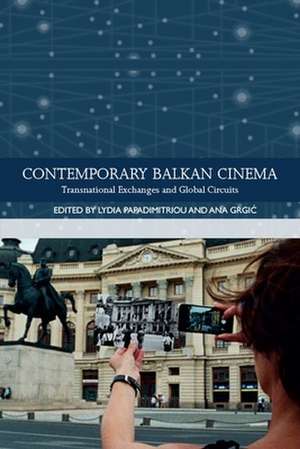
Contemporary Balkan Cinema
Editat de Lydia Papadimitriou, Ana Grgicen Limba Engleză Hardback – 19 noi 2020
The first inclusive collection to examine post-2008 developments in Balkan cinema, this book brings together a number of international scholars to explore its industrial contexts and textual dimensions. With a focus on transnational links, global networks and cross-cultural exchanges, the book addresses the role of national and supranational institutions as well as film festival networks in supporting film production, distribution and reception. It also identifies key characteristics in the subject matter and aesthetics of Balkan films made since the global economic crisis. Through critical and comprehensive country profiles, and with a focus on smaller and underrepresented cinemas from Montenegro, Kosovo, North Macedonia and Albania, the collection argues for the continuing relevance of the concept of 'Balkan cinema'.
Preț: 600.20 lei
Preț vechi: 798.94 lei
-25%
Carte disponibilă
Livrare economică 30 octombrie-13 noiembrie
Specificații
ISBN-10: 1474458432
Pagini: 328
Ilustrații: 17 Tables, black and white; 49 Illustrations, black and white
Dimensiuni: 160 x 239 x 24 mm
Greutate: 0.65 kg
Editura: EDINBURGH UNIVERSITY PRESS
V-ar putea interesa
-
 André BazinDudley AndrewPreț: 350.94 lei
 -
 Film and Television Acting: From stage to screenIan BernardPreț: 427.43 lei
 -
 The Art of Film Acting: A Guide For Actors and DirectorsJeremiah ComeyPreț: 310.61 lei
 -
 The Michael Chekhov Handbook: For the ActorLenard PetitPreț: 336.37 lei
 -
 Sanford Meisner on ActingSanford MeisnerPreț: 122.71 lei
 -
 Auditioning On Camera: An Actor's GuideJoseph HackerPreț: 278.79 lei
 -
 -8%Preț: 428.67 lei465.94 lei
 -
 The Politics of American Actor TrainingEllen Margolis-5%Preț: 442.39 lei465.68 lei
 -
 Andre Bazin's New MediaAndré BazinPreț: 238.37 lei
 -
 AuditionMichael ShurtleffPreț: 60.47 lei
 -
 The Intent to LiveLarry Moss-27%Preț: 99.64 lei137.12 lei
 -
 Challenge for the ActorUta HagenPreț: 172.16 lei
 -
 Small Cinemas in Global Markets: Genres, Identities, NarrativesJosé Cláudio Siqueira Castanheira-33%Preț: 710.87 lei1054.21 lei
 -
 How To Be A Working ActorMarilyn HenryPreț: 141.82 lei
 -
 The BFI Companion to Eastern European and Russian CinemaProfessor Richard Taylor-23%Preț: 253.17 lei328.15 lei
 -
 Preț: 356.79 lei
 -
 Self-Management for ActorsBonnie GillespiePreț: 175.04 lei
 -
 The Hollywood Survival Guide for ActorsKym JacksonPreț: 120.97 lei
 -
 Acting for the ScreenMary Lou BelliPreț: 309.37 lei
 -
 Intercultural Acting and Performer TrainingPhillip B. ZarrilliPreț: 397.89 lei
 -
 National Identity in Global CinemaC. CelliPreț: 367.97 lei
 -
 Preț: 395.46 lei
 -
 Acting in Film: An Actor's Take on Movie MakingSir Michael Caine-17%Preț: 131.99 lei158.11 lei
 -
 Stella Adler: The Art of ActingHoward Kissel-35%Preț: 143.87 lei222.46 lei
 -
 The Hero with a Thousand FacesJoseph CampbellPreț: 159.00 lei
 -
 ActingRichard BoleslavskyPreț: 54.55 lei
Descriere
The first inclusive collection to examine post-2008 developments in Balkan cinema, this book brings together a number of international scholars to explore its industrial contexts and textual dimensions. With a focus on transnational links, global networks and cross-cultural exchanges, the book addresses the role of national and supranational institutions as well as film festival networks in supporting film production, distribution and reception. It also identifies key characteristics in the subject matter and aesthetics of Balkan films made since the global economic crisis. Through critical and comprehensive country profiles, and with a focus on smaller and underrepresented cinemas from Montenegro, Kosovo, North Macedonia and Albania, the collection argues for the continuing relevance of the concept of 'Balkan cinema'.
Notă biografică
Ana Grgic, PhD (University of St Andrews) is a Lecturer in Screen Studies at Monash University Malaysia. She has published on questions of identity, memory and archives in Balkan cinema. Her publications appeared in Studies in Eastern European Cinema, Short Film Studies, Film Quarterly, The Film Festival Yearbook and Cinemas of Paris. She co-edited two special issues: on Albanian cinema (KinoKultura) and on Central and Eastern European women editors (Apparatus). Her monograph on early cinema in the Balkans is forthcoming with Amsterdam University Press.