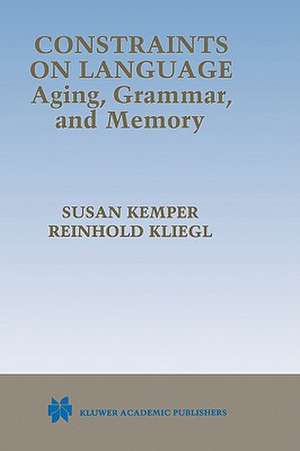
Constraints on Language: Aging, Grammar, and Memory
Editat de Susan Kemper, Reinhold Klieglen Limba Engleză Hardback – 30 mai 1999
| Toate formatele și edițiile | Preț | Express |
|---|---|---|
| Paperback (1) | 909.98 lei 6-8 săpt. | |
| Springer Us – 7 mar 2013 | 909.98 lei 6-8 săpt. | |
| Hardback (1) | 883.85 lei 3-5 săpt. | +29.47 lei 4-10 zile |
| Springer Us – 30 mai 1999 | 883.85 lei 3-5 săpt. | +29.47 lei 4-10 zile |
Preț: 883.85 lei
Preț vechi: 1104.82 lei
-20% Nou
Puncte Express: 1326
Preț estimativ în valută:
156.40€ • 183.40$ • 137.35£
156.40€ • 183.40$ • 137.35£
Carte disponibilă
Livrare economică 19 ianuarie-02 februarie 26
Livrare express 02-08 ianuarie 26 pentru 39.46 lei
Preluare comenzi: 021 569.72.76
Specificații
ISBN-13: 9780792385264
ISBN-10: 0792385268
Pagini: 324
Ilustrații: XVI, 324 p.
Dimensiuni: 155 x 235 x 21 mm
Greutate: 0.66 kg
Ediția:1999
Editura: Springer Us
Colecția Springer
Locul publicării:New York, NY, United States
ISBN-10: 0792385268
Pagini: 324
Ilustrații: XVI, 324 p.
Dimensiuni: 155 x 235 x 21 mm
Greutate: 0.66 kg
Ediția:1999
Editura: Springer Us
Colecția Springer
Locul publicării:New York, NY, United States
V-ar putea interesa
-
 Language Contact in AmazoniaAlexandra Aikhenvald-19%Preț: 409.25 lei502.15 lei
 -
 The Linguistic Cycle: Language Change and the Language FacultyElly van Gelderen-14%Preț: 433.87 lei501.98 lei
 -
 The Routledge Handbook of Second Language AcquisitionSusan M. Gass-32%Preț: 1289.89 lei1896.79 lei
 -
 -18%Preț: 1063.81 lei1297.33 lei
 -
 Jokes and the Linguistic MindDebra AaronsPreț: 448.71 lei
 -
 The Cambridge Handbook of Linguistic Code-switchingBarbara E. BullockPreț: 422.49 lei
 -
 Preț: 362.14 lei
 -
 A Spanish Learning GrammarMike ThackerPreț: 356.63 lei
 -
 Language DevelopmentPP Brooks-19%Preț: 409.48 lei505.53 lei
 -
 Research Methods in Second Language AcquisitionAlison MackeyPreț: 318.61 lei
 -
 -9%Preț: 1343.48 lei1476.34 lei
 -
 The Multiliteracies Classroom. Kathy A. MillsKathy A. MillsPreț: 255.32 lei
 -
 Preț: 310.90 lei
 -
 Being and Becoming a Speaker of Japanese: An Autoethnographic AccountAndrea Simon-MaedaPreț: 260.87 lei
 -
 Learning to Read and Write in the Multilingual FamilyXiao-lei WangPreț: 184.72 lei
 -
 -31%Preț: 848.88 lei1237.24 lei
 -
 Language and Bilingual CognitionVivian Cook-18%Preț: 1038.01 lei1265.87 lei
Public țintă
ResearchDescriere
Susan Kemper A debate about the role of working memory in language processing has become center-most in psycholinguistics (Caplan & Waters, in press; Just & Carpenter, 1992; Just, Carpenter, & Keller, 1996; Waters & Caplan, 1996). This debate concerns which aspects of language processing are vulnerable to working memory limitations, how working memory is best measured, and whether compensatory processes can offset working memory limitations. Age-comparative studies are particularly relevant to this debate for several reasons: difficulties with language and communication are frequently mentioned by older adults and signal the onset of Alzheimer's dementia and other pathologies associated with age; older adults commonly experience working memory limitations that affect their ability to perform everyday activities; the rapid aging of the United States population has forced psychologists and gerontologists to examine the effects of aging on cognition, drawing many investigators to the study of cognitive aging. Older adults constitute ideal population for studying how working memory limitations affect cognitive performance, particularly language and communication. Age-comparative studies of cognitive processes have advanced our understanding of the temporal dynamics of cognition as well as the working memory demands of many types of tasks (Kliegl, Mayr, & Krampe, 1994; Mayr & Kliegl, 1993). The research findings reviewed in this volume have clear implications - for addressing the practical problems of older adults as consumers of leisure ti- reading, radio and television broadcasts, as targets of medical, legal, and financial documents, and as participants in a web of service agencies and volunteer activities.
Cuprins
List of Contributors. Preface; S. Kemper. Part 1: Constraints on Language: Aging. 1. Language Production and Aging; D.M. Burke. 2. Working Memory and Spoken Language Comprehension: The Case for Age Stability in Conceptual Short-Term Memory; A. Wingfield, P.A. Tun. 3. Discourse Processing and Aging: Resource Allocation as a Limiting Factor; E.A.L. Stine-Morrow, L.M. Soederberg Miller. Part 2: Constraints on Language: Memory. 4. Limitations on Syntactic Processing; S. Kemper, K.A. Kemtes. 5. Verbal Working Memory Capacity and On-Line Sentence Processing Efficiency in the Elderly; G. Waters, D. Caplan. 6. Testing Age Invariance in Language Processes; R. Kliegl, et al. Part 3: Constraints on Language: Grammar. 7. Processing Difficulty and Principles of Grammar; G. Fanselow, et al. 8. Parsing and Memory; L. Frazier. Part 4: Constraints on Language: Neuroscience. 9. Working with Limited Memory: Sentence Comprehension in Alzheimer's Disease; D. Kempler, et al. 10. Memory or Aging? That's the Question: An Electrophysiological Perspective on Language; T.C. Gunter, et al. 11. Age Effects on the Functional Neuroanatomy of Syntactic Processing in Sentence Comprehension; D. Caplan, G. Waters. Concluding Observations; R. Kliegl, S. Kemper. Index.