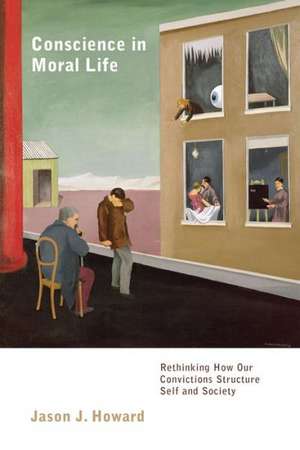
Conscience in Moral Life: Rethinking How Our Convictions Structure Self and Society
Autor Jason J. Howarden Limba Engleză Paperback – 19 mar 2014
Jason Howard provides a comprehensive reassessment of the function of conscience in moral life, detailing along the way the manifold problems that arise when we believe our conscience is more reliable than is actually warranted.
The result is a step-by-step evaluation of our most accepted assumptions. Howard goes on to argue, from a phenomenological perspective, that conscience is indispensable for understanding moral experience. He capitalizes on a dialectical perspective developed by Hegel and Ricoeur, in which conscience is seen as the recognition of the other, and integrates this with work in the philosophy of emotion, arguing that conscience is best seen in terms of the function it serves in moderating the moral emotions of shame, guilt and pride.
Preț: 321.53 lei
Preț vechi: 416.66 lei
-23%
Puncte Express: 482
Carte tipărită la comandă
Livrare economică 30 noiembrie-14 decembrie
Livrare prin curier în România Termenul estimat este afișat lângă disponibilitate.
Transport gratuit de la 400.00 lei Plată online sau ramburs, în funcție de opțiunile comenzii.
Retur gratuit în 14 zile Comandă securizată și suport în română.
Specificații
ISBN-13: 9781783480111
ISBN-10: 1783480114
Pagini: 213
Dimensiuni: 152 x 228 x 17 mm
Greutate: 0.34 kg
Editura: Bloomsbury Publishing
Colecția Rowman & Littlefield
Locul publicării:New York, United States
ISBN-10: 1783480114
Pagini: 213
Dimensiuni: 152 x 228 x 17 mm
Greutate: 0.34 kg
Editura: Bloomsbury Publishing
Colecția Rowman & Littlefield
Locul publicării:New York, United States
V-ar putea interesa
-
 A Metaphysics for FreedomHelen Steward-19%Preț: 323.35 lei400.68 lei
 -
 Shaping the Normative LandscapeDavid Owens-20%Preț: 295.50 lei371.39 lei
 -
 A Sentimentalist Theory of the MindMichael Slote-29%Preț: 503.44 lei704.94 lei
 -
 Contractualism and the Foundations of MoralityNicholas Southwood-12%Preț: 356.50 lei404.22 lei
 -
 How We Fight: Ethics in WarHelen Frowe-28%Preț: 505.57 lei706.15 lei
 -
 Human Interests: or Ethics for PhysicalistsJoseph Mendola-31%Preț: 746.38 lei1079.76 lei
 -
 The Morality of Defensive WarCécile Fabre-28%Preț: 525.77 lei734.33 lei
 -
 Knowing What To Do: Imagination, Virtue, and Platonism in EthicsSophie Grace Chappell-31%Preț: 636.67 lei920.93 lei
 -
 Oxford Studies in Normative Ethics, Volume 3Mark Timmons-13%Preț: 355.47 lei406.78 lei
 -
 The Human ConditionJohn Kekes-12%Preț: 336.25 lei380.24 lei
 -
 From Normativity to ResponsibilityJoseph Raz-13%Preț: 295.68 lei338.67 lei
 -
 Oxford Studies in Agency and Responsibility, Volume 1David Shoemaker-11%Preț: 345.61 lei387.28 lei
 -
 From Individual to Collective Intentionality: New EssaysSara Rachel Chant-35%Preț: 626.06 lei960.03 lei
 -
 Environmental EthicsRobin AttfieldPreț: 226.05 lei
 -
 Ethics for OCR Religious StudiesMark CoffeyPreț: 396.64 lei
 -
 EthicsPeter CavePreț: 70.81 lei
Cuprins
Dedication and Acknowledgments / Introduction: Considering the Place of Conscience / 1. A Quick History of Conscience and the Rise of the Faculty View / 2. Problems with the Faculty View of Conscience / 3. Moral Emotions and the Connection to Conscience / 4. Conscience and Our Convictions / 5. Conscience as a Right and its Reification in the Law / 6. Living with our Convictions / Works Cited / Index
Recenzii
This is a smart, timely, compelling book. Howard persuasively argues that the convoluted history of conscience is responsible for some of our thorniest moral puzzles: both theoretical puzzles (for instance about moral emotions) and extremely concrete puzzles about US constitutional law and universal health care. Both historically illuminating and genuinely relevant to contemporary ethical thought.
This is an impressive study of conscience as both a thought-provoking and indispensable moral concept. It brings scholarly weight and philosophical intelligence to bear on conscience as a somewhat neglected theme in moral philosophy ... Very thoughtful, philosophically provocative, and warmly recommended.
This very well-written and timely book focuses on a concept that is central to our day-to-day moral thinking: 'conscience'. Drawing on the work of thinkers such as Hegel, Ricoeur and Rawls, the author offers an original and carefully-reasoned account of the nature, history and functions of conscience ... The result is a work of deep scholarship, which forms the basis of a much-need applied philosophy and which has relevance across academic disciplines.
In this masterful work, Jason J. Howard argues that conscience is necessary for comprehending moral experience ... [his] text will become the point of departure for all future work on conscience.
This is an impressive study of conscience as both a thought-provoking and indispensable moral concept. It brings scholarly weight and philosophical intelligence to bear on conscience as a somewhat neglected theme in moral philosophy ... Very thoughtful, philosophically provocative, and warmly recommended.
This very well-written and timely book focuses on a concept that is central to our day-to-day moral thinking: 'conscience'. Drawing on the work of thinkers such as Hegel, Ricoeur and Rawls, the author offers an original and carefully-reasoned account of the nature, history and functions of conscience ... The result is a work of deep scholarship, which forms the basis of a much-need applied philosophy and which has relevance across academic disciplines.
In this masterful work, Jason J. Howard argues that conscience is necessary for comprehending moral experience ... [his] text will become the point of departure for all future work on conscience.