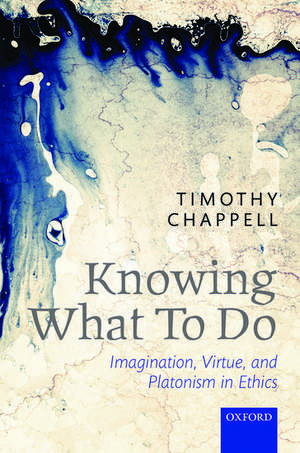
Knowing What To Do: Imagination, Virtue, and Platonism in Ethics
Autor Sophie Grace Chappellen Limba Engleză Hardback – 27 mar 2014
Preț: 636.67 lei
Preț vechi: 920.93 lei
-31%
Puncte Express: 955
Carte tipărită la comandă
Livrare economică 04-15 decembrie
Livrare prin curier în România Termenul estimat este afișat lângă disponibilitate.
Transport gratuit pentru acest produs Plată online sau ramburs, în funcție de opțiunile comenzii.
Retur gratuit în 14 zile Comandă securizată și suport în română.
Specificații
ISBN-13: 9780199684854
ISBN-10: 0199684855
Pagini: 350
Dimensiuni: 162 x 240 x 28 mm
Greutate: 0.67 kg
Editura: OUP OXFORD
Colecția OUP Oxford
Locul publicării:Oxford, United Kingdom
ISBN-10: 0199684855
Pagini: 350
Dimensiuni: 162 x 240 x 28 mm
Greutate: 0.67 kg
Editura: OUP OXFORD
Colecția OUP Oxford
Locul publicării:Oxford, United Kingdom
V-ar putea interesa
-
 Persons, Rights, and the Moral CommunityLoren E. Lomasky-10%Preț: 385.64 lei429.47 lei
 -
 The De Malo of Thomas AquinasThomas Aquinas-26%Preț: 365.39 lei495.33 lei
 -
 From Morality to VirtueMichael Slote-20%Preț: 525.65 lei660.83 lei
 -
 Scripture and Ethics: Twentieth-Century PortraitsJeffrey S. Siker-20%Preț: 385.23 lei481.76 lei
 -
 Can God Be Trusted?: Faith and the Challenge of EvilJohn G. Stackhouse-15%Preț: 221.91 lei261.58 lei
 -
 Finite and Infinite Goods: A Framework for EthicsRobert Merrihew Adams-27%Preț: 517.40 lei710.13 lei
 -
 Kant's Impure Ethics: From Rational Beings to Human BeingsRobert B. Louden-10%Preț: 387.02 lei430.19 lei
 -
 The Foundations of Ethics: The Gifford Lectures 1935-6W. David Ross-32%Preț: 815.86 lei1193.03 lei
 -
 Selected Papers: Volume II: Persons and ValuesJ. L. Mackie-32%Preț: 1074.77 lei1577.23 lei
 -
 Intuition, Theory, and Anti-Theory in EthicsSophie Grace Chappell-31%Preț: 564.07 lei817.17 lei
 -
 Passions and Projections: Themes from the Philosophy of Simon BlackburnRobert N. Johnson-30%Preț: 624.24 lei889.34 lei
 -
 Preț: 101.31 lei
 -
 The Aim of BeliefTimothy Chan-31%Preț: 727.11 lei1048.64 lei
 -
 -30%Preț: 650.77 lei935.95 lei
 -
 Preț: 113.70 lei
 -
 Worldly Virtue: Moral Ideals and Contemporary LifeJudith Andre-33%Preț: 581.03 lei862.67 lei
 -
 Abolition of Nuclear Weapons as a Moral ImperativeJohn Kultgen-34%Preț: 584.17 lei882.52 lei
 -
 Preț: 372.01 lei
 -
 -15%Preț: 477.18 lei561.38 lei
 -
 -15%Preț: 432.98 lei509.38 lei
 -
 Civic Virtue and the Sovereignty of EvilDerek EdyvanePreț: 475.58 lei
 -
 -33%Preț: 481.31 lei723.05 lei
 -
 The Challenges of Modern Sport to Ethics: From Doping to CyborgsJose Luis Perez Trivino-25%Preț: 304.27 lei405.84 lei
 -
 Exploring the Illusion of Free Will and Moral ResponsibilityGregg D. Caruso-24%Preț: 368.85 lei484.65 lei
 -
 Autonomy and the Situated Self: A Challenge to BioethicsRachel Haliburton-24%Preț: 368.86 lei484.66 lei
 -
 Rationality, Control, and Freedom: Making Sense of Human FreedomCurran F. Douglass-34%Preț: 634.19 lei958.98 lei
 -
 Applied Ethics: A Multicultural ApproachLarry May-15%Preț: 727.27 lei855.61 lei
 -
 Responsible Innovation 2Bert-Jaap Koops-15%Preț: 671.15 lei789.59 lei
Recenzii
The book must be praised as an inspiring expression of an ethical vision with deep historical roots and urgent contemporary relevance ... Sophie Grace Chappell's book is itself an ethical exemplar, a study in the contemplation of value, a testament to ordinary goodness. Event hose who disagree must contemplate his arguments; since "if we can't see individual specific things, we can't see anything at all"
Knowing What to Do is an excellent book: the clear prose and application of literature, philosophy, and history make it an enjoyable read. This book appeals to nonspecialists and specialists alike. The focus of this book is mostly on metaethics and normative ethics, but it also concerns areas in applied ethics, such as environmental ethics and biomedical ethics, as well as epistemology. Additionally, anyone interested in issues concerning philosophical methodology will find this book useful.
A book that frequently challenges the conventional expectations of a philosophy research monograph ... his non-conventional approach not only serves to illuminate important aspects of moral thought that normally receive little or no attention in systematic moral theory, but also helps to support the claim that these are aspects of moral thought that moral philosophers may want to say more about
[M]akes available in the context of contemporary debates a version of ethics which could deliver the discipline from the tyranny of theory... Imagination plays a large role in Chappell's own presentation, and this is one of the many delights for the reader.... If knowing what to do, knowing what is required to live well, is a real concern of yours, then this book is a valuable asset for your search. It should lead to a revision of the teaching of ethics in higher education.
Knowing What to Do is an excellent book: the clear prose and application of literature, philosophy, and history make it an enjoyable read. This book appeals to nonspecialists and specialists alike. The focus of this book is mostly on metaethics and normative ethics, but it also concerns areas in applied ethics, such as environmental ethics and biomedical ethics, as well as epistemology. Additionally, anyone interested in issues concerning philosophical methodology will find this book useful.
A book that frequently challenges the conventional expectations of a philosophy research monograph ... his non-conventional approach not only serves to illuminate important aspects of moral thought that normally receive little or no attention in systematic moral theory, but also helps to support the claim that these are aspects of moral thought that moral philosophers may want to say more about
[M]akes available in the context of contemporary debates a version of ethics which could deliver the discipline from the tyranny of theory... Imagination plays a large role in Chappell's own presentation, and this is one of the many delights for the reader.... If knowing what to do, knowing what is required to live well, is a real concern of yours, then this book is a valuable asset for your search. It should lead to a revision of the teaching of ethics in higher education.
Notă biografică
Sophie Grace Chappell is the author of numerous books and articles on ethics, ancient philosophy, epistemology, and philosophy of religion. He has taught at universities including the University of Oxford, the University of British Columbia, the University of East Anglia, and the University of Manchester. Since 2006 he has been Professor of Philosophy at The Open University.