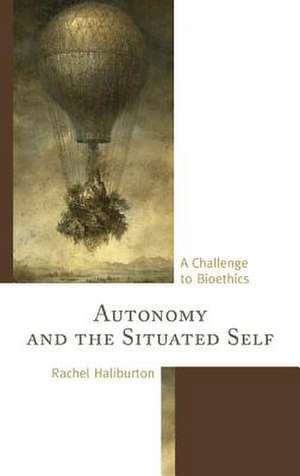
Autonomy and the Situated Self: A Challenge to Bioethics
Autor Rachel Haliburtonen Limba Engleză Paperback – 24 aug 2015
In addition to providing a critique, this book offers an alternative framework that is designed to allow bioethicists to address the concerns that led to the creation of bioethics in the first place. This alternative framework is oriented around a conception of autonomy that works within the ethical guidelines provided by a contemporary form of virtue ethics, and which connects the value of autonomous choice to a conception of human flourishing.
Preț: 368.86 lei
Preț vechi: 484.66 lei
-24%
Puncte Express: 553
Carte tipărită la comandă
Livrare economică 19 noiembrie-03 decembrie
Livrare prin curier în România Termenul estimat este afișat lângă disponibilitate.
Transport gratuit de la 400.00 lei Plată online sau ramburs, în funcție de opțiunile comenzii.
Retur gratuit în 14 zile Comandă securizată și suport în română.
Specificații
ISBN-13: 9781498520966
ISBN-10: 1498520960
Pagini: 322
Dimensiuni: 149 x 229 x 24 mm
Greutate: 0.5 kg
Editura: Bloomsbury Publishing
Colecția Lexington Books
Locul publicării:New York, United States
ISBN-10: 1498520960
Pagini: 322
Dimensiuni: 149 x 229 x 24 mm
Greutate: 0.5 kg
Editura: Bloomsbury Publishing
Colecția Lexington Books
Locul publicării:New York, United States
V-ar putea interesa
-
 Moral Status: Obligations to Persons and Other Living ThingsMary Anne Warren-29%Preț: 437.15 lei611.80 lei
 -
 Philosophical Perspectives on Technology and PsychiatryJames Phillips-28%Preț: 407.36 lei567.18 lei
 -
 Why Evolution is TrueJerry A. Coyne-19%Preț: 75.26 lei93.24 lei
 -
 Evolution and Genetics for PsychologyDaniel Nettle-21%Preț: 358.51 lei452.13 lei
 -
 Big Questions in Ecology and EvolutionThomas N. Sherratt-21%Preț: 408.72 lei517.48 lei
 -
 -31%Preț: 745.28 lei1079.10 lei
 -
 Choosing Tomorrow's Children: The Ethics of Selective ReproductionStephen Wilkinson-11%Preț: 330.16 lei372.12 lei
 -
 Oxford Handbook of NeuroethicsJudy Illes-15%Preț: 745.93 lei880.17 lei
 -
 The Ethics of ParenthoodNorvin Richards-31%Preț: 694.68 lei1007.72 lei
 -
 Evolution, the Extended SynthesisMassimo PigliucciPreț: 409.98 lei
 -
 The Cambridge Companion to DarwinJonathan HodgePreț: 351.85 lei
 -
 BioethicsMarianne Talbot-5%Preț: 469.84 lei494.57 lei
 -
 The Greatest Show on EarthRichard Dawkins-23%Preț: 68.58 lei88.76 lei
 -
 The Ethics of SpeciesRonald L. SandlerPreț: 252.24 lei
 -
 BiocentrismRobert LanzaPreț: 96.39 lei
 -
 Ethics in MedicineShabih H. Zaidi-5%Preț: 356.57 lei375.34 lei
 -
 Equitable Access to Human Biological Resources in Developing CountriesRoger Scarlin Chennells-15%Preț: 620.95 lei730.52 lei
Cuprins
Introduction
Chapter 1: The Chimeric Self: Exploring the Landscape of Bioethics
Chapter 2: The Troubled Self of Bioethics: The Unhappy Offspring of Immanuel Kant and J.S. Mill
Chapter 3: The Divided Self: Liberal Politics and the Rise of Autonomy in Bioethics
Chapter 4: The Choosing Self: Bioethics and the Paradox of Autonomy
Chapter 5: The Gendered Self: Bioethics and the Feminist Critique
Chapter 6: The Virtuous Self: Autonomy and Value
Chapter 7: The Suffering Self: Illness Narratives and the Postmodern Divide
Chapter 8: The Storytelling Self: The Place of Case Studies in Bioethics
Chapter 9: The Situated Self: Freedom and Virtue
Notes
Chapter 1: The Chimeric Self: Exploring the Landscape of Bioethics
Chapter 2: The Troubled Self of Bioethics: The Unhappy Offspring of Immanuel Kant and J.S. Mill
Chapter 3: The Divided Self: Liberal Politics and the Rise of Autonomy in Bioethics
Chapter 4: The Choosing Self: Bioethics and the Paradox of Autonomy
Chapter 5: The Gendered Self: Bioethics and the Feminist Critique
Chapter 6: The Virtuous Self: Autonomy and Value
Chapter 7: The Suffering Self: Illness Narratives and the Postmodern Divide
Chapter 8: The Storytelling Self: The Place of Case Studies in Bioethics
Chapter 9: The Situated Self: Freedom and Virtue
Notes
Recenzii
Haliburton here criticizes bioethics for relinquishing its critical stance for the 'status of a respected insider, whose primary role is to defend both existing institutional arrangements and its own privileged position.' She warns that 'if mainstream bioethics doesn't change its ideological ways, [and] refuses to risk its insider status ..., then it increasingly won't matter whether it exists at all.' . . . .This volume analyzes the situated self primarily through gender, given the author's feminist inspirations, but considers the implications such a self has for virtue ethics; narratives as culturally informing selfhood; the ethics of suffering; and bioethical practice that must consider political, economic, and social structures. Overall, Haliburton offers a refreshing, critical outlook on bioethics and its politicization. Summing Up: Recommended. Upper-division undergraduates and above; general readers.