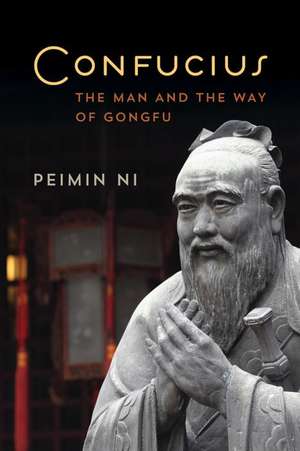
Confucius: The Man and the Way of Gongfu
Autor Peimin Nien Limba Engleză Paperback – 18 feb 2016
Preț: 255.10 lei
Preț vechi: 333.95 lei
-24%
Puncte Express: 383
Carte tipărită la comandă
Livrare economică 03-17 decembrie
Livrare prin curier în România Termenul estimat este afișat lângă disponibilitate.
Transport gratuit de la 400.00 lei Plată online sau ramburs, în funcție de opțiunile comenzii.
Retur gratuit în 14 zile Comandă securizată și suport în română.
Specificații
ISBN-13: 9781442257429
ISBN-10: 1442257423
Pagini: 190
Dimensiuni: 151 x 228 x 13 mm
Greutate: 0.28 kg
Editura: Bloomsbury Publishing
Colecția Rowman & Littlefield
Locul publicării:New York, United States
ISBN-10: 1442257423
Pagini: 190
Dimensiuni: 151 x 228 x 13 mm
Greutate: 0.28 kg
Editura: Bloomsbury Publishing
Colecția Rowman & Littlefield
Locul publicării:New York, United States
V-ar putea interesa
-
 Bringing Yoga to LifeDonna FarhiPreț: 99.00 lei
 -
 Zhuangzi - Basic WritingsZhuangziPreț: 174.23 lei
 -
 A History of Islamic Philosophy 3eMajid FakhryPreț: 357.80 lei
 -
 An Inquiry into the GoodKitaro NishidaPreț: 183.62 lei
 -
 -18%Preț: 65.18 lei79.50 lei
 -
 The Heart of Yoga: Developing a Personal PracticeT. K. V. Desikachar-21%Preț: 107.07 lei135.41 lei
 -
 Preț: 125.00 lei
 -
 -31%Preț: 79.59 lei114.61 lei
 -
 The Heart of AwarenessThomas Byrom-31%Preț: 99.78 lei145.17 lei
 -
 Psychotherapy East and WestAlan Watts-20%Preț: 90.89 lei113.46 lei
 -
 Deep AwakeTim FrekePreț: 71.15 lei
 -
 -16%Preț: 97.04 lei115.01 lei
 -
 -24%Preț: 185.58 lei244.54 lei
 -
 The Yoga TraditionGeorg FeuersteinPreț: 237.83 lei
Cuprins
Preface
Chronology
Chapter I. Confucius as a Historical Figure
Long, Long Ago, There Was a Time
A Man from a Humble Background
The Life Story Continues .
The Second Epoch
New Challenges and the Third Epoch
Chapter II. Confucius as a Spiritual Leader
A Wooden Bell-Clapper
Humans are Part of Heaven
Mandate and Destiny
Immortality and the Meaning of Life
Inter-religiosity
Chapter III. Confucius as a Philosopher
One Cannot Be Fully a Human in Solitude
Born to Become a Human
What Makes A Vessel Sacred?
Naming Means Illuminating
Hit the Mark Constantly
Chapter IV. Confucius as a Political Reformer
Ideal Society-Harmony and Holism
Sageliness Within and Kingliness Without
Names and Rituals as Political Devices
The Freedom of Needing No Choice
Uprightness and Justice
Chapter V. Confucius as an Educator
The Kind of Education
Six Arts
Learning, Thinking, and Embodiment
Method of Education
Chapter VI. Confucius as a Person
The "ZENG Dian Spirit"
Elitist?
Sexist?
Honesty and Sincerity
After All, the Master Is a Human
Bibliography
Index of Quotes from the Analects
Index of Names and Subjects
Chronology
Chapter I. Confucius as a Historical Figure
Long, Long Ago, There Was a Time
A Man from a Humble Background
The Life Story Continues .
The Second Epoch
New Challenges and the Third Epoch
Chapter II. Confucius as a Spiritual Leader
A Wooden Bell-Clapper
Humans are Part of Heaven
Mandate and Destiny
Immortality and the Meaning of Life
Inter-religiosity
Chapter III. Confucius as a Philosopher
One Cannot Be Fully a Human in Solitude
Born to Become a Human
What Makes A Vessel Sacred?
Naming Means Illuminating
Hit the Mark Constantly
Chapter IV. Confucius as a Political Reformer
Ideal Society-Harmony and Holism
Sageliness Within and Kingliness Without
Names and Rituals as Political Devices
The Freedom of Needing No Choice
Uprightness and Justice
Chapter V. Confucius as an Educator
The Kind of Education
Six Arts
Learning, Thinking, and Embodiment
Method of Education
Chapter VI. Confucius as a Person
The "ZENG Dian Spirit"
Elitist?
Sexist?
Honesty and Sincerity
After All, the Master Is a Human
Bibliography
Index of Quotes from the Analects
Index of Names and Subjects
Recenzii
In this thematic, well-written portrait, Confucius is less an authoritarian, ultra-stern traditionalist concerned with squeezing everything into a rigid theoretical role and ritual structure and more a thoughtful guide to each individual's unique spiritual and ethical life, a life in which ritual and role mostly set the table for a life ending in mastery, or gongfu. Ni's emphasis on a truly important side of Confucius's philosophy is interesting, and he offers some thoughtful, innovative takes on Confucius's philosophy. This approach also allows the author to defend Confucius from common criticisms and even allows opposing later Confucians Mencius and Xunzi. Focusing on gongfu helps keep individuals from reducing Confucian thought into their own deontological/consequentialist principle-oriented frameworks.. [T]his is an interesting text with insightful passages and challenging interpretations worth pondering.
Summing Up: Recommended. Upper-division undergraduates through faculty and professionals.
"The book is a thoughtful and inspiring presentation of Confucianism as arguably the longest and most influential ethical and spiritual traditions in human history. It is highly readable with many insightful observations. Especially noteworthy is its emphasis on self-cultivation, spiritual exercises, and learning of the heart-and-mind as essential features of Confucian humanism in the 21st century."
"Peimin Ni has provided a portrait of Confucius that makes him more complex and also more human than he generally is presented as being."
Ni Peimin's book shifts attention from considering Confucius as a theorist to reading him as a guide to the art of living, or to life as an aesthetic endeavor. Confucius is masterfully constructed as an interrelated whole, while at the same time, parts can be selected for discussion or a short read, without a need to link them to other parts. The sections are accurate in their biographical and historical details, while teaching that art of living. In both music and society, harmony works longer if it is a blend of differing voices than if it is the conformity of all instruments or voices sounding (thinking) the same. There is harmony in variety. In the section on secular immortality, Confucius and Ni ask us to consider one kind of immortality as the lasting impact of virtuous exemplars, whom they describe, on their communities and larger social groups. Throughout the book there are insightful comparisons with relevant Western figures. For example, the goal of the Jesuit missionary Matteo Ricci (1552-1610) was to learn 'What should I believe is true?' The Confucian goal was to learn 'how to live one's life in this world.'
In this remarkable book, Peimin Ni presents a systematic interpretation of Confucius from a gongfu perspective and invites readers to appreciate the Confucian ethical life in artistic, rather than theoretical, terms. Thus understood, Confucius's teachings ultimately are aimed not at setting up moral principles and rules to constrain people, but at providing guidance to enable people to lead the good life. This book provides readers a refreshing view of Confucius and his philosophy. It makes an excellent reading for scholarly exploration as well as in the classroom.
Peimin Ni's eloquent new book is an ideal introduction to Confucius and Confucianism. The book ranges from early stories to modern history, but is centered throughout on the Analects, our best source for Confucius's teachings. Professor Ni gives us a sympathetic and engaging treatment of Confucius as person, thinker, and teacher, and makes clear why Confucius's values, life story, and ideas have been so inspiring.
There is no shortage of introductory books on Confucius. What makes Ni's book outstanding is, as its subtitle shows, that it takes a gongfu approach, not in the sense that it presents Confucius as a martial artists with wonderful skills of fighting. Rather, it pictures Confucius as one of the greatest Chinese philosophers, if not the greatest one, who, instead of interested in solving profound intellectual riddles, is good at teaching his students the simple art of living a life that is authentically human. Confucius: The Man and the Way of Gongfu is simply the best of the kind.
Summing Up: Recommended. Upper-division undergraduates through faculty and professionals.
"The book is a thoughtful and inspiring presentation of Confucianism as arguably the longest and most influential ethical and spiritual traditions in human history. It is highly readable with many insightful observations. Especially noteworthy is its emphasis on self-cultivation, spiritual exercises, and learning of the heart-and-mind as essential features of Confucian humanism in the 21st century."
"Peimin Ni has provided a portrait of Confucius that makes him more complex and also more human than he generally is presented as being."
Ni Peimin's book shifts attention from considering Confucius as a theorist to reading him as a guide to the art of living, or to life as an aesthetic endeavor. Confucius is masterfully constructed as an interrelated whole, while at the same time, parts can be selected for discussion or a short read, without a need to link them to other parts. The sections are accurate in their biographical and historical details, while teaching that art of living. In both music and society, harmony works longer if it is a blend of differing voices than if it is the conformity of all instruments or voices sounding (thinking) the same. There is harmony in variety. In the section on secular immortality, Confucius and Ni ask us to consider one kind of immortality as the lasting impact of virtuous exemplars, whom they describe, on their communities and larger social groups. Throughout the book there are insightful comparisons with relevant Western figures. For example, the goal of the Jesuit missionary Matteo Ricci (1552-1610) was to learn 'What should I believe is true?' The Confucian goal was to learn 'how to live one's life in this world.'
In this remarkable book, Peimin Ni presents a systematic interpretation of Confucius from a gongfu perspective and invites readers to appreciate the Confucian ethical life in artistic, rather than theoretical, terms. Thus understood, Confucius's teachings ultimately are aimed not at setting up moral principles and rules to constrain people, but at providing guidance to enable people to lead the good life. This book provides readers a refreshing view of Confucius and his philosophy. It makes an excellent reading for scholarly exploration as well as in the classroom.
Peimin Ni's eloquent new book is an ideal introduction to Confucius and Confucianism. The book ranges from early stories to modern history, but is centered throughout on the Analects, our best source for Confucius's teachings. Professor Ni gives us a sympathetic and engaging treatment of Confucius as person, thinker, and teacher, and makes clear why Confucius's values, life story, and ideas have been so inspiring.
There is no shortage of introductory books on Confucius. What makes Ni's book outstanding is, as its subtitle shows, that it takes a gongfu approach, not in the sense that it presents Confucius as a martial artists with wonderful skills of fighting. Rather, it pictures Confucius as one of the greatest Chinese philosophers, if not the greatest one, who, instead of interested in solving profound intellectual riddles, is good at teaching his students the simple art of living a life that is authentically human. Confucius: The Man and the Way of Gongfu is simply the best of the kind.