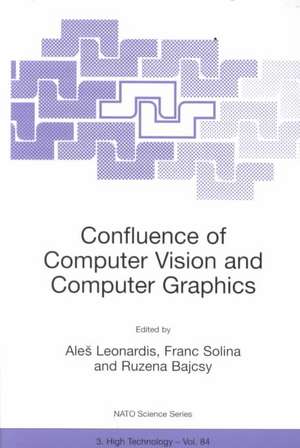
Confluence of Computer Vision and Computer Graphics: NATO Science Partnership Subseries: 3, cartea 84
Editat de Ales Leonardis, F. Solina, Ruzena Bajcsyen Limba Engleză Paperback – 30 sep 2000
| Toate formatele și edițiile | Preț | Express |
|---|---|---|
| Paperback (1) | 324.50 lei 6-8 săpt. | |
| SPRINGER NETHERLANDS – 30 sep 2000 | 324.50 lei 6-8 săpt. | |
| Hardback (1) | 328.98 lei 6-8 săpt. | |
| Springer – 30 sep 2000 | 328.98 lei 6-8 săpt. |
Din seria NATO Science Partnership Subseries: 3
- 18%
 Preț: 1914.28 lei
 -
 Preț: 378.21 lei
 -
 Preț: 375.81 lei
 - 18%
 Preț: 1777.22 lei
 -
 Preț: 396.68 lei
 - 18%
 Preț: 1181.14 lei
 - 18%
 Preț: 1771.77 lei
 - 15%
 Preț: 617.72 lei
 -
 Preț: 387.47 lei
 - 18%
 Preț: 1758.43 lei
 -
 Preț: 365.09 lei
 - 18%
 Preț: 1176.89 lei
 -
 Preț: 386.16 lei
 - 18%
 Preț: 1769.80 lei
 -
 Preț: 377.12 lei
 - 18%
 Preț: 1186.41 lei
 -
 Preț: 389.88 lei
 -
 Preț: 381.55 lei
 - 18%
 Preț: 1178.99 lei
 - 18%
 Preț: 1185.51 lei
 - 18%
 Preț: 1180.81 lei
 - 5%
 Preț: 363.18 lei
 - 18%
 Preț: 1759.04 lei
 - 20%
 Preț: 323.41 lei
 - 18%
 Preț: 1177.80 lei
 -
 Preț: 382.30 lei
 - 18%
 Preț: 1759.19 lei
 - 15%
 Preț: 625.44 lei
 - 5%
 Preț: 1361.54 lei
 - 18%
 Preț: 1184.61 lei
 - 18%
 Preț: 1180.20 lei
 - 18%
 Preț: 918.59 lei
 -
 Preț: 383.75 lei
 -
 Preț: 373.76 lei
 - 18%
 Preț: 1753.72 lei
Preț: 324.50 lei
Preț vechi: 405.63 lei
-20%
Puncte Express: 487
Preț estimativ în valută:
57.37€ • 66.74$ • 49.90£
57.37€ • 66.74$ • 49.90£
Carte tipărită la comandă
Livrare economică 17 aprilie-01 mai
Specificații
ISBN-13: 9780792366126
ISBN-10: 0792366123
Pagini: 352
Ilustrații: XL, 352 p.
Dimensiuni: 160 x 240 x 21 mm
Greutate: 0.55 kg
Ediția:Softcover reprint of the original 1st ed. 2000
Editura: SPRINGER NETHERLANDS
Colecția Springer
Seria NATO Science Partnership Subseries: 3
Locul publicării:Dordrecht, Netherlands
ISBN-10: 0792366123
Pagini: 352
Ilustrații: XL, 352 p.
Dimensiuni: 160 x 240 x 21 mm
Greutate: 0.55 kg
Ediția:Softcover reprint of the original 1st ed. 2000
Editura: SPRINGER NETHERLANDS
Colecția Springer
Seria NATO Science Partnership Subseries: 3
Locul publicării:Dordrecht, Netherlands
V-ar putea interesa
-
 Segmentation and Recovery of SuperquadricsAles Jaklic-20%Preț: 622.82 lei778.53 lei
 -
 Human Face Recognition Using Third-Order Synthetic Neural NetworksOkechukwu A Uwechue-20%Preț: 939.93 lei1174.90 lei
 -
 Computer Vision: Models, Learning, and InferenceSimon J. D. Prince-20%Preț: 528.19 lei660.24 lei
 -
 A Practical Introduction to Computer Vision with OpenCV3K Dawson–Howe-23%Preț: 433.80 lei563.37 lei
 -
 Beginning Design for 3D PrintingJoe Micallef-20%Preț: 325.55 lei406.94 lei
 -
 Theoretical Foundations of Computer VisionWalter Kropatsch-20%Preț: 322.61 lei403.26 lei
 -
 Advances in Computer VisionFranc Solina-20%Preț: 320.86 lei401.08 lei
 -
 The NexStar Evolution and SkyPortal User's GuideJames L. ChenPreț: 303.41 lei
 -
 -20%Preț: 325.79 lei407.24 lei
 -
 Preț: 368.23 lei
 -
 -20%Preț: 337.66 lei422.08 lei
 -
 -20%Preț: 651.14 lei813.92 lei
 -
 Hybrid Soft Computing for Image SegmentationSiddhartha Bhattacharyya-20%Preț: 628.77 lei785.96 lei
 -
 -20%Preț: 638.14 lei797.67 lei
 -
 -5%Preț: 870.32 lei916.13 lei
 -
 -20%Preț: 328.94 lei411.17 lei
 -
 -20%Preț: 646.38 lei807.97 lei
 -
 -20%Preț: 642.40 lei803.00 lei
 -
 -20%Preț: 645.58 lei806.97 lei
 -
 -20%Preț: 645.58 lei806.97 lei
 -
 -20%Preț: 315.16 lei393.95 lei
 -
 -20%Preț: 399.09 lei498.86 lei
 -
 Augmented Environments for Computer-Assisted InterventionsCristian A. Linte-20%Preț: 286.49 lei358.12 lei
 -
 -20%Preț: 407.87 lei509.83 lei
 -
 Computational Collective Intelligence. Technologies and ApplicationsNgoc Thanh Nguyen-20%Preț: 336.09 lei420.11 lei
 -
 -20%Preț: 292.81 lei366.01 lei
 -
 -20%Preț: 484.35 lei605.44 lei
 -
 Computer Vision in Robotics and Industrial ApplicationsDominik Sankowski-20%Preț: 1192.51 lei1490.63 lei
Public țintă
ResearchCuprins
1 From images to virtual and augmented reality.- 1. Introduction.- 2. Review: the correspondence problem over multiple views.- 3. Results.- 4. Construction of virtual-reality models for polyhedral scenes.- 5. Augmented reality.- 6. Future developments.- 2 Surface reconstruction from multiple views using apparent contours and surface texture.- 1. Introduction.- 2. Reconstruction from apparent contours.- 3. Computing the surface from texture information.- 4. Minimising reprojection errors using a surface representation.- 5. Summary.- 3 Consistent projective reconstruction from multiple views.- 1. Introduction.- 2. Problem of joining two independent projective reconstructions.- 3. Projective reconstruction from three views.- 4. Projective reconstruction from n views based on concatenation of trifocal constraints.- 5. Experiments.- 6. Summary.- Appendix A: Trifocal constraints.- Appendix B: The structure of matrix G.- 4 Accurate natural surface reconstruction from polynocular stereo.- 1. Introduction.- 2. The point-set model reconstruction.- 3. The fish-scale model reconstruction.- 4. The discrete manifold model reconstruction.- 5. Human face 3D model reconstruction.- 6. Summary.- 5 Building models from sensor data: An application shared by the computer vision and the computer graphics community.- 1. Introduction.- 2. Model building pipeline.- 3. Research themes.- 4. Conclusion.- 6 Acquiring range images of objects with non-uniform reflectance using high dynamic scale radiance maps.- 1. Introduction.- 2. Acquisition technique.- 3. Problem description.- 4. Our approach.- 5. Experimental results.- 6. Conclusion.- 7 Dynamic view interpolation without affine reconstruction.- 1. Introduction.- 2. Dynamic view morphing.- 3. Notation and preliminary concepts.- 4. View interpolation for a single moving object.- 5. Interpolation without H?.- 6. Interpolation with H?.- 7. Experimental results.- 8. Summary.- 8 Facial motion capturing using an explanation-based approach.- 1. Introduction.- 2. PBVD model.- 3. PBVD model-based tracking algorithm.- 4. Explanation-based motion tracking.- 5. Implementation and experimental results.- 6. Discussion.- 9 Image-based 3D modeling: Modeling from reality.- 1. Introduction.- 2. Two image-based 3D acquisition systems.- 3. Image-based texture synthesis.- 4. Face animation for speech.- 5. Conclusions and future work.- 10 Computer vision and graphics techniques for modeling dressed humans.- 1. Introduction.- 2. Human body reconstruction.- 3. Modeling and analysis of cloth draping.- 4. Experimental results.- 5. Conclusions.- 11 Urban site models: Accurate, detailed, rapid and inexpensive.- 1. Introduction.- 2. Source data.- 3. Work flow issues.- 4. The use of image matching.- 5. Setting up large blocks of imagery.- 6. Extracting details of building facades.- 7. Where will this lead?.- 12 Medical visualisation, biomechanics, figure animation and robot teleoperation: Themes and links.- 1. Introduction.- 2. Medical visualisation and biomechanics.- 3. Figure animation.- 4. Telecontrol of robots.- 5. Summary.- 13 Can virtual look real? A review of virtual studio techniques.- 1. Introduction.- 2. Real-time performance.- 3. Realism of computer-generated scenes.- 4. Lighting and chroma keying.- 5. Shadows.- 6. Camera tracking.- 7. Simulation of lens behavior.- 8. Distance keying.- 9. Conclusions.- 14 Real-time 3D-teleimmersion.- 1. Introduction.- 2. Related work.- 3. System description and scenario.- 4. Binocular stereo reconstruction.- 5. A novel trinocular stereo algorithm.- 6. Performance.- 7. Conclusions and thefuture.- 15 Augmented reality: A problem in need of many computer vision—based solutions.- 1. Introduction.- 2. Typical AR configurations.- 3. User tracking.- 4. 3D scene modeling for occlusion and reflection handling.- 5. Diminished reality.- 6. Mobile object tracking.- 7. Virtual user motion and telepresence.- 8. Summary.- 16 Registration methods for harmonious integration of real world and computer generated objects.- 1. Introduction.- 2. Contributions.- 3. Overview.- 4. Robust pose computation from various features (RPC algorithm).- 5. Improving the viewpoint computation.- 6. Results.- 7. Conclusion.- Appendix: The fundamental matrix.- 17 3D object tracking using analysis/synthesis techniques.- 1. Introduction.- 2. Models.- 3. Camera calibration.- 4. Definition of the object tracking parameters.- 5. Matching process.- 6. Optimization.- 7. Dynamic tracking.- 8. Experiments and results.- 9. Conclusion and future work.- 10. Summary.- 18 Augmented reality by integrating multiple sensory modalities for underwater scene understanding.- 1. Introduction.- 2. Segmentation.- 3. Extraction of cylinders.- 4. Augmented reality.- 5. Experimental results.- 6. Summary.