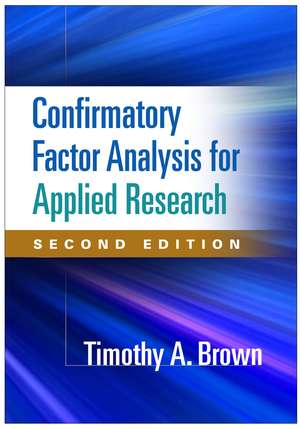
Confirmatory Factor Analysis for Applied Research, Second Edition: Methodology in the Social Sciences
Autor Timothy A. Brownen Limba Engleză Paperback – 29 ian 2015
Recomandăm Confirmatory Factor Analysis for Applied Research, Second Edition ca resursă fundamentală pentru cercetătorii care urmăresc validarea constructelor și rigoarea metodologică necesară în publicațiile academice și procesele de acreditare profesională. Această a doua ediție, publicată de Guilford Press în seria Methodology in the Social Sciences, extinde cadrul propus de Confirmatory Factor Analysis de J. Scott Long prin integrarea unor evoluții recente în modelarea variabilelor latente și utilizarea versiunilor actualizate ale pachetelor software precum Mplus și LISREL.
Considerăm că punctul forte al lucrării rezidă în abordarea conceptuală și practică, Timothy A. Brown reușind să explice mecanismele CFA fără a suprasolicita cititorul cu demonstrații matematice. Structura cărții facilitează o progresie logică: primele capitole clarifică distincția dintre analiza factorială exploratorie (EFA) și cea confirmatorie (CFA), în timp ce secțiunile ulterioare introduc teme complexe precum modelarea structurală exploratorie (ESEM) și analiza bifactorială. Această ediție aduce un plus de actualitate prin capitolul dedicat metodelor Bayesiene, oferind o perspectivă complementară celei din Bayesian Structural Equation Modeling de Sarah Depaoli, dar menținând focusul pe aplicabilitatea imediată în cercetarea socială.
În contextul operei sale, această lucrare reprezintă fundamentul metodologic pentru instrumentele clinice dezvoltate de autor, precum Anxiety and Related Disorders Interview Schedule for DSM-5 (ADIS-5). Dacă în ghidurile clinice Brown aplică standardele de diagnostic, aici el oferă „motorul” statistic din spatele validării acestor instrumente. Textul este echilibrat, oferind atât fișiere de sintaxă pentru programare, cât și îndrumări despre raportarea corectă a rezultatelor, fiind un instrument indispensabil pentru o analiză de date riguroasă.
Din seria Methodology in the Social Sciences
-
 Preț: 418.14 lei
 - 15%
 Preț: 599.22 lei
 - 9%
 Preț: 656.34 lei
 - 8%
 Preț: 597.36 lei
 -
 Preț: 433.18 lei
 - 8%
 Preț: 503.97 lei
 - 8%
 Preț: 476.09 lei
 - 15%
 Preț: 477.33 lei
 - 8%
 Preț: 429.44 lei
 - 15%
 Preț: 566.09 lei
 -
 Preț: 332.70 lei
 -
 Preț: 377.43 lei
 -
 Preț: 501.86 lei
 -
 Preț: 421.32 lei
 - 25%
 Preț: 350.88 lei
 - 11%
 Preț: 358.37 lei
 - 25%
 Preț: 386.49 lei
 - 11%
 Preț: 347.66 lei
 - 9%
 Preț: 506.26 lei
Preț: 502.75 lei
Preț vechi: 546.46 lei
-8%
Carte disponibilă
Livrare economică 26 august-09 septembrie
Livrare express 12-18 august pentru 47.54 lei
Specificații
ISBN-10: 1462515363
Pagini: 462
Dimensiuni: 178 x 254 x 27 mm
Greutate: 0.82 kg
Ediția:2. Auflage
Editura: Guilford Publications
Colecția Guilford Press
Seria Methodology in the Social Sciences
V-ar putea interesa
-
 -5%Preț: 404.42 lei425.71 lei
 -
 -29%Preț: 667.50 lei942.10 lei
 -
 The Annual of Psychoanalysis, V. 32: Psychoanalysis and WomenJerome A. WinerPreț: 367.15 lei
 -
 Casebook in Abnormal PsychologyTimothy Brown-23%Preț: 430.94 lei557.14 lei
 -
 -5%Preț: 341.69 lei359.67 lei
 -
 -5%Preț: 393.36 lei414.06 lei
 -
 -5%Preț: 299.39 lei315.15 lei
 -
 Rumination-Focused Cognitive-Behavioral Therapy for DepressionEdward R. Watkins-5%Preț: 308.00 lei324.21 lei
 -
 Preț: 430.15 lei
 -
 Handbook of Pediatric Psychology, Fifth EditionMichael C. Roberts-5%Preț: 522.37 lei549.86 lei
 -
 -5%Preț: 244.77 lei257.65 lei
 -
 -5%Preț: 618.19 lei650.73 lei
 -
 Die Schattenseite des MondesRenate KlöppelPreț: 105.28 lei
 -
 Mutig werden mit Til Tiger. CDSabine Ahrens-EipperPreț: 100.27 lei
 -
 Den Mann zur Sprache bringenWolfgang NeumannPreț: 182.05 lei
 -
 HerzneuroseHorst-Eberhard RichterPreț: 166.21 lei
Public țintă
Professional Practice & DevelopmentDe ce să citești această carte
Această carte este esențială pentru doctoranzi și cercetători în științe sociale care doresc să stăpânească analiza factorială confirmatorie fără a se pierde în formalism matematic. Câștigați acces la tehnici moderne (Bayesian CFA, ESEM) și soluții practice pentru erori comune în modelare. Este ghidul care transformă analiza datelor dintr-o barieră tehnică într-un avantaj competitiv în publicarea studiilor de validare.
Despre autor
Timothy A. Brown este profesor la Departamentul de Psihologie al Universității din Boston și Director de Cercetare la Centrul pentru Anxietate și Afecțiuni Corelate. Expertiza sa vastă în psihometrie și metodologie de cercetare este recunoscută la nivel internațional, fiind un consultant frecvent pentru proiecte finanțate federal. Activitatea sa academică îmbină rigoarea statistică cu aplicația clinică, fiind autorul principal al interviurilor structurate Anxiety and Related Disorders Interview Schedule for DSM-5 (ADIS-5). Contribuțiile sale în jurnalele de specialitate au modelat standardele actuale de raportare și interpretare a modelelor de variabile latente în psihologie.
Descriere scurtă
New to This Edition
*Updated throughout to incorporate important developments in latent variable modeling.
*Chapter on Bayesian CFA and multilevel measurement models.
*Addresses new topics (with examples): exploratory structural equation modeling, bifactor analysis, measurement invariance evaluation with categorical indicators, and a new method for scaling latent variables.
*Utilizes the latest versions of major latent variable software packages.
Notă biografică
Cuprins
Recenzii
"I am a big fan of this book. When something goes wrong in SEM, it is almost always due to a faulty measurement model, so students need to have a thorough understanding of latent trait measurement models before learning how to evaluate structural models. That is why this book is so important. My students regularly comment on how accessible the text is. I very much like the examples of study results, which students can use as templates for their own reports. The numerically worked examples throughout are extremely helpful at demystifying the process."--Lesa Hoffman, PhD, Institute for Lifespan Studies, University of Kansas
"This book occupies a unique and important position in the field. It describes the use of CFA to address a wide range of important social science research questions that are too often ignored or underdeveloped in books on structural equation modeling. The text helps readers understand the nuances of CFA in a way that is deep yet incredibly accessible. I highly recommend this book to students and experienced social scientists interested in applying this powerful approach in their research."--Noel A. Card, PhD, Department of Educational Psychology, University of Connecticut
"The most comprehensive reference text on CFA for experienced researchers. Other texts typically devote a chapter or two to the subject, but Brown’s coverage is wide and deep. Frankly, what gives this book value to me is that it is a reference text that can be used for instruction. Aided by clear examples, simplified tables, and helpful visual depictions, readers easily gain an understanding of how to run popular modeling software and correctly interpret the output. Perhaps one of the finest jewels in this book is the explanation of non-positive definite matrices, the bane of LISREL users. I also find the thread throughout the book on explaining equivalent models very important."--Randall MacIntosh, PhD, Professor of Sociology, California State University, Sacramento
"I highly recommend this book to colleagues and students who teach and apply structural equation modeling. The book provides an invaluable resource for applied researchers concerning concepts, procedures, and problems in CFA, as well as how to interpret and report analysis results. An especially valuable feature is the many detailed examples that are worked out in detail and presented along with syntax and output from leading software packages. The Appendices at the end of several chapters expand on many technical points the reader might fail to grasp otherwise."--James G. Anderson, PhD, Department of Sociology, Purdue University
"The book does an excellent job of walking through the steps in an analysis. It is wonderfully user friendly in the way it presents each step, discusses major decisions to be made, and presents code and output. Not only do I think this is the best book out there for learning CFA, but I also think it is a fantastic way to learn introductory structural equation modeling methods."--Scott J. Peters, PhD, Department of Educational Foundations, University of Wisconsin-Whitewater
"A strength of this book is the style of the author's presentation. Many important concepts are explained in plain language, rather than by mathematical formula. The book reads as though you were listening to a lecture. It provides the learner with an extensive understanding of the theory and applications of CFA. I also strongly recommend this book to practitioners who are in need of a comprehensive reference for better applications of CFA."--Akihito Kamata, PhD, Department of Education Policy and Leadership and Department of Psychology, Southern Methodist University