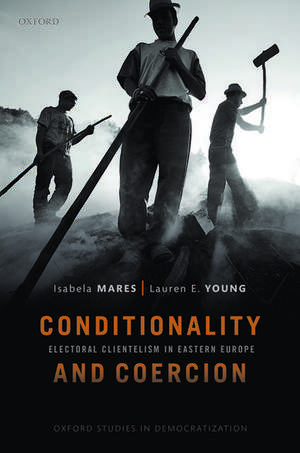
Conditionality & Coercion: Electoral clientelism in Eastern Europe: Oxford Studies in Democratization
Autor Isabela Mares, Lauren E. Youngen Limba Engleză Hardback – 17 oct 2019
Din seria Oxford Studies in Democratization
- 17%
 Preț: 280.86 lei
 - 32%
 Preț: 710.73 lei
 - 32%
 Preț: 786.76 lei
 - 31%
 Preț: 792.76 lei
 - 32%
 Preț: 799.18 lei
 - 22%
 Preț: 179.15 lei
 - 32%
 Preț: 1157.23 lei
 - 32%
 Preț: 1048.84 lei
 - 17%
 Preț: 298.39 lei
 - 30%
 Preț: 730.67 lei
 - 30%
 Preț: 422.50 lei
 - 17%
 Preț: 386.39 lei
 - 30%
 Preț: 950.14 lei
 - 27%
 Preț: 358.96 lei
 - 31%
 Preț: 744.42 lei
 - 25%
 Preț: 618.10 lei
 - 30%
 Preț: 768.96 lei
 - 15%
 Preț: 250.63 lei
 - 32%
 Preț: 1232.84 lei
 - 32%
 Preț: 964.37 lei
 - 31%
 Preț: 720.93 lei
 - 27%
 Preț: 440.13 lei
 - 17%
 Preț: 280.80 lei
 - 30%
 Preț: 932.50 lei
 - 19%
 Preț: 352.85 lei
 - 10%
 Preț: 351.68 lei
 - 31%
 Preț: 741.39 lei
 - 33%
 Preț: 744.47 lei
 - 31%
 Preț: 695.48 lei
 - 32%
 Preț: 733.53 lei
 - 16%
 Preț: 341.67 lei
 - 32%
 Preț: 1290.96 lei
 - 31%
 Preț: 695.02 lei
 - 14%
 Preț: 678.83 lei
 - 32%
 Preț: 1324.35 lei
 - 18%
 Preț: 341.64 lei
 - 33%
 Preț: 896.28 lei
 - 20%
 Preț: 425.55 lei
 - 32%
 Preț: 1031.25 lei
 - 27%
 Preț: 467.47 lei
Preț: 753.57 lei
Preț vechi: 1074.35 lei
-30%
Puncte Express: 1130
Carte tipărită la comandă
Livrare economică 10-15 decembrie
Livrare prin curier în România Termenul estimat este afișat lângă disponibilitate.
Transport gratuit pentru acest produs Plată online sau ramburs, în funcție de opțiunile comenzii.
Retur gratuit în 14 zile Comandă securizată și suport în română.
Specificații
ISBN-13: 9780198832775
ISBN-10: 019883277X
Pagini: 338
Dimensiuni: 162 x 240 x 27 mm
Greutate: 0.71 kg
Editura: OUP OXFORD
Colecția OUP Oxford
Seria Oxford Studies in Democratization
Locul publicării:Oxford, United Kingdom
ISBN-10: 019883277X
Pagini: 338
Dimensiuni: 162 x 240 x 27 mm
Greutate: 0.71 kg
Editura: OUP OXFORD
Colecția OUP Oxford
Seria Oxford Studies in Democratization
Locul publicării:Oxford, United Kingdom
Recenzii
[The book] represents a huge contribution both theoretically and empirically. The latter is not only to be commended because of its methodological inventiveness, but also due to the demanding original data collection strategy focusing on actual individuals—putting the 'social' into social scientific research.
Mares and Young use both ethnographic and survey evidence to analyze everyday politics in poor rural regions of Hungary and Romania. Local politicians use their discretion in allocating state resources to buy votes; they also exploit political differences within the community by applying welfare programs in a coercive manner, thus attracting support from the working poor. This signaling blurs the distinction between clientilistic and programmatic appeals. Threats seem to be more effective than gifts, and employers or moneylenders are often used as intermediaries. Such tactics are used by parties on both the Right and the Left. A flawed electoral system combines with such factors as corruption and poverty to lead to widespread disillusionment with the efficacy of democracy. Exemplary in its use of both qualitative and quantitative methods, this book will be of interest to students and scholars of electoral politics around the world.
Mares and Young deliver a theoretically incisive and methodologically innovative analysis of clientelistic practices in postcommunist polities that is obligatory reading for any student of electoral politics. It vividly demonstrates that different forms of clientelism, and particularly the prevalence of coercive modes of targeted political exchange, are embedded in distinctive social and political settings. Empirically, the authors base their analysis on some of the highestquality data ever collected in the study of clientelism, both through systematic surveys as well as through ethnographic work with hundreds of qualitative interviews yielding empirically and theoretically pertinent-if not shocking-insights.
Conditionality and Coercion fills an important gap in the study of clientelism by explaining when and why politicians use different strategies at their disposal, and particularly how they balance positive and negative inducements. Mares and Young's most novel theoretical intuition is that the choice of strategies sends informational signals to voters, extending the reach of any clientelistic exchange beyond its recipient. Policymakers and students of democracy have much to learn from this innovative book about the often subtle ways coercion is deployed for electoral gain.
Combining evidence from largescale surveys and intensive fieldwork, Isabela Mares and Lauren Young show how and why politicians mix different clientelistic strategies-including crucially both persuasion and coercion-to signal their policy preferences. Scholars of clientelism and Eastern European politics will benefit equally from reading this outstanding book.
This sophisticated, rigorous, and meticulously documented analysis demonstrates that clientelism takes a surprising variety of forms-and that coercion and voter intimidation, rather than voluntary exchange and favors, can fundamentally characterize these relationships. This fascinating and compelling study redefines our understanding of clientelism, coercion, and class politics.
Mares and Young use both ethnographic and survey evidence to analyze everyday politics in poor rural regions of Hungary and Romania. Local politicians use their discretion in allocating state resources to buy votes; they also exploit political differences within the community by applying welfare programs in a coercive manner, thus attracting support from the working poor. This signaling blurs the distinction between clientilistic and programmatic appeals. Threats seem to be more effective than gifts, and employers or moneylenders are often used as intermediaries. Such tactics are used by parties on both the Right and the Left. A flawed electoral system combines with such factors as corruption and poverty to lead to widespread disillusionment with the efficacy of democracy. Exemplary in its use of both qualitative and quantitative methods, this book will be of interest to students and scholars of electoral politics around the world.
Mares and Young deliver a theoretically incisive and methodologically innovative analysis of clientelistic practices in postcommunist polities that is obligatory reading for any student of electoral politics. It vividly demonstrates that different forms of clientelism, and particularly the prevalence of coercive modes of targeted political exchange, are embedded in distinctive social and political settings. Empirically, the authors base their analysis on some of the highestquality data ever collected in the study of clientelism, both through systematic surveys as well as through ethnographic work with hundreds of qualitative interviews yielding empirically and theoretically pertinent-if not shocking-insights.
Conditionality and Coercion fills an important gap in the study of clientelism by explaining when and why politicians use different strategies at their disposal, and particularly how they balance positive and negative inducements. Mares and Young's most novel theoretical intuition is that the choice of strategies sends informational signals to voters, extending the reach of any clientelistic exchange beyond its recipient. Policymakers and students of democracy have much to learn from this innovative book about the often subtle ways coercion is deployed for electoral gain.
Combining evidence from largescale surveys and intensive fieldwork, Isabela Mares and Lauren Young show how and why politicians mix different clientelistic strategies-including crucially both persuasion and coercion-to signal their policy preferences. Scholars of clientelism and Eastern European politics will benefit equally from reading this outstanding book.
This sophisticated, rigorous, and meticulously documented analysis demonstrates that clientelism takes a surprising variety of forms-and that coercion and voter intimidation, rather than voluntary exchange and favors, can fundamentally characterize these relationships. This fascinating and compelling study redefines our understanding of clientelism, coercion, and class politics.
Notă biografică
Isabela Mares is Professor of Political Science at Yale University. She has written extensively on a range of topics in comparative politics and political economy, including democratization, clientelism and corruption, taxation and fiscal capacity development, social policy reforms in both developed and developing countries. She is the author of The Politics of Social Risk: Business and Welfare State Development (New York: Cambridge University Press), for which she won the Gregory Luebbert Award for best book in Comparative Politics (awarded by the American Political Science Assciation, 2004), she also won the First Best Book in European Studies award (Council for European Studies, 2004) and received an Honorable Mention from the American Political Science Association.At Yale, Isabela Mares is teaching courses in political economy, welfare state development, democratization and democratic erosion, and an interdisciplinary graduate course on Micro-historical Analysis in Comparative Research.Lauren E. Young is Assistant Professor in the Department of Political Science at UC Davis. She received her Ph.D. in political science with distinction from Columbia University and was a postdoctoral scholar at the Center for Democracy, Development and the Rule of Law (CDDRL) at Stanford, and the Center for Global Development (CGD) (non-resident). She is a member of the Evidence in Governance and Politics (EGAP) network and a co-organizer of the California Workshop on Empirical Political Science and the 2019 WPSA Autocratic Politics pre-conference.Her research aims to understand how individuals make decisions when faced with the threat of violence. She has been published in the American Political Science Review, Annual Review of Political Science, the Journal of Peace Research, and Comparative Political Studies.