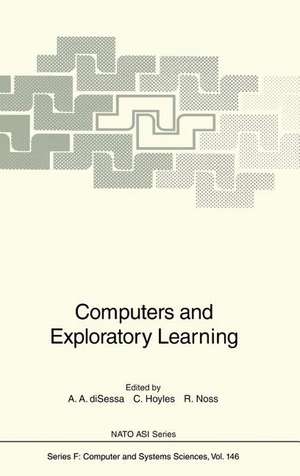
Computers and Exploratory Learning: NATO ASI Subseries F:, cartea 146
L.D. Edwards Editat de Andrea A. DiSessa, Celia Hoyles, Richard Nossen Limba Engleză Hardback – 20 iun 1995
Din seria NATO ASI Subseries F:
- 20%
 Preț: 642.70 lei
 - 20%
 Preț: 953.88 lei
 - 18%
 Preț: 1190.96 lei
 - 20%
 Preț: 1847.73 lei
 - 20%
 Preț: 631.95 lei
 - 18%
 Preț: 1185.98 lei
 - 20%
 Preț: 682.34 lei
 - 20%
 Preț: 630.68 lei
 - 18%
 Preț: 1782.54 lei
 - 20%
 Preț: 360.65 lei
 - 20%
 Preț: 953.40 lei
 - 20%
 Preț: 645.09 lei
 - 20%
 Preț: 1850.75 lei
 - 20%
 Preț: 956.09 lei
 -
 Preț: 374.71 lei
 - 20%
 Preț: 632.58 lei
 - 20%
 Preț: 629.88 lei
 - 18%
 Preț: 1177.62 lei
 - 18%
 Preț: 915.13 lei
 - 20%
 Preț: 319.42 lei
 - 20%
 Preț: 1234.45 lei
 - 20%
 Preț: 619.89 lei
 -
 Preț: 380.82 lei
 - 18%
 Preț: 1173.54 lei
 - 20%
 Preț: 620.52 lei
 - 20%
 Preț: 1233.02 lei
 - 20%
 Preț: 631.00 lei
 - 20%
 Preț: 1233.33 lei
 - 20%
 Preț: 1849.02 lei
 - 20%
 Preț: 348.43 lei
 - 20%
 Preț: 621.81 lei
 - 20%
 Preț: 322.93 lei
 - 20%
 Preț: 634.14 lei
 - 20%
 Preț: 331.17 lei
Preț: 923.02 lei
Preț vechi: 1125.63 lei
-18%
Puncte Express: 1385
Carte tipărită la comandă
Livrare economică 27 iulie-10 august
Livrare prin curier în România Termenul estimat este afișat lângă disponibilitate.
Transport gratuit pentru acest produs Plată online sau ramburs, în funcție de opțiunile comenzii.
Retur gratuit în 14 zile Comandă securizată și suport în română.
Specificații
ISBN-13: 9783540592020
ISBN-10: 3540592024
Pagini: 500
Ilustrații: VIII, 482 p.
Dimensiuni: 155 x 235 x 30 mm
Greutate: 0.87 kg
Ediția:1995
Editura: Springer Berlin, Heidelberg
Colecția Springer
Seria NATO ASI Subseries F:
Locul publicării:Berlin, Heidelberg, Germany
ISBN-10: 3540592024
Pagini: 500
Ilustrații: VIII, 482 p.
Dimensiuni: 155 x 235 x 30 mm
Greutate: 0.87 kg
Ediția:1995
Editura: Springer Berlin, Heidelberg
Colecția Springer
Seria NATO ASI Subseries F:
Locul publicării:Berlin, Heidelberg, Germany
V-ar putea interesa
-
 The Psychology of EducationMartyn LongPreț: 428.26 lei
 -
 Psychology for the Classroom: BehaviourismJohn WoollardPreț: 279.14 lei
 -
 Preț: 397.71 lei
 -
 Educational Psychology: Concepts, Research and ChallengesChristine M. Rubie-DaviesPreț: 446.76 lei
 -
 -15%Preț: 420.89 lei495.16 lei
 -
 -15%Preț: 470.03 lei552.98 lei
 -
 Preț: 124.25 lei
 -
 Making Thinking VisibleRon RitchhartPreț: 157.91 lei
 -
 Using Psychology in the ClassroomStephen James MintonPreț: 355.81 lei
 -
 Theory of Mind: Beyond the Preschool YearsScott A. Miller-15%Preț: 400.73 lei471.45 lei
 -
 The Anti-Bullying HandbookKeith SullivanPreț: 397.19 lei
Public țintă
ResearchCuprins
1. Computers and Exploratory Learning: Setting the Scene.- Section I: Computers and Knowledge.- 2. Thematic Chapter: Epistemology and Systems Design.- 3. New Paradigms for Computing, New Paradigms for Thinking.- 4. From Local to Global: Programming and the Unfolding of Local Models in the Exploratory Learning of Mathematics and Science.- 5. East or West—GEOMLAND is Best, or Does the Answer Depend on the Angle?.- 6. Computational Media to Support the Learning and Use of Functions.- 7. Knowledge Representation in a Learning Environment for Euclidean Geometry.- 8. Microworlds as Representations.- 9. Visualizing Formal and Structural Relationships with Spreadsheets.- 10. Creating Software Applications for Children: Some Thoughts About Design.- Section II: Computers and Learning.- 11. Thematic Chapter: Exploratory Software, Exploratory Cultures?.- 12. The Medium and the Curriculum: Reflections on Transparent Tools and Tacit Mathematics.- 13. What About a Learning Environment Where Euclidean Concepts are Manipulated with a Mouse?.- 14. Four Steps to the Right.- 15. Learning Dynamic Geometry: Implementing Rotations.- 16. Sketching a Multidisciplinary Microworld: A Collaborative Exploration in Boxer.- 17. Design of Computer-Based Cognitive Tools.- 18. The Spreadsheet as a Tool for Mathematical Modeling: A Case Study.- 19. The Many Faces of a Computational Medium: Teaching the Mathematics of Motion.- Section III: Computers and Cultures.- 20. Thematic Chapter: Computers as Commodities.- 21. Exploring the Sketch Metaphor for Presenting Mathematics Using Boxer.- 22. Programming as a Means of Expressing and Exploring Ideas: Three Case Studies Situated in a Directive Educational System.- 23. Do Users Inhabit Or Build Their Boxer Environment?.- 24. Designing, Exploring andInteracting: Novice Activities in the Boxer Computational Medium.- 25. Learning Opportunities Provided by Domain-Oriented Design Environments.