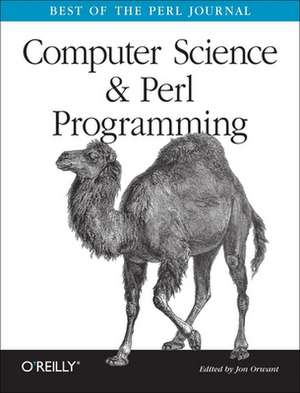
Computer Science & Perl Programming
Autor Jon Orwanten Limba Engleză Paperback – 10 dec 2002
Remarcăm de la bun început că Computer Science & Perl Programming se distinge de documentația oficială sau de manualele standard prin natura sa antologică și aplicată. În timp ce un manual tehnic se concentrează pe sintaxă, această lucrare editată de Jon Orwant documentează „epoca de aur” a limbajului prin 70 de articole de referință extrase din The Perl Journal. Nu este doar un ghid de utilizare, ci o explorare a posibilităților practice în domenii diverse, de la inteligență artificială la biologie. Considerăm că valoarea acestui volum rezidă în profunzimea tehnică a contributorilor săi. Ca și David Schwartz în Randal Schwartz's Perls of Wisdom, autorul distilează experiență reală în principii acționabile, oferind perspective pe care doar practicienii veterani le pot furniza. Veți găsi aici analize detaliate despre optimizarea programelor prin memoizare semnate de Mark Jason Dominus sau mecanisme de parsing explicate de Damian Conway. Această lucrare completează organic opera anterioară a lui Jon Orwant. Dacă în Mastering Algorithms with Perl accentul era pus pe implementarea structurilor de date clasice, volumul de față extinde orizontul către aplicații neconvenționale și filozofia culturii Perl, temă centrală și în Programming Perl. Structura este una densă, orientată spre rezolvarea problemelor complexe de informatică (hard-core computer science), păstrând totodată tonul pragmatic specific comunității de la începutul anilor 2000. Este o resursă esențială pentru cei care vor să înțeleagă nu doar cum funcționează codul, ci și raționamentul din spatele designului acestuia.
Preț: 278.90 lei
Preț vechi: 348.62 lei
-20%
Carte disponibilă
Livrare economică 06-20 noiembrie
Specificații
ISBN-10: 0596003102
Pagini: 758
Dimensiuni: 177 x 235 x 45 mm
Greutate: 1.2 kg
Ediția:0002
Editura: O'Reilly
V-ar putea interesa
-
 -20%Preț: 225.84 lei282.30 lei
 -
 -20%Preț: 304.38 lei380.49 lei
 -
 -20%Preț: 2116.13 lei2645.16 lei
 -
 Concrete MathematicsRonald Graham-20%Preț: 560.73 lei700.91 lei
 -
 The Practice of ProgrammingBrian Kernighan-20%Preț: 304.16 lei380.20 lei
 -
 -20%Preț: 151.07 lei188.84 lei
 -
 The Art of Computer ProgrammingDonald Knuth-20%Preț: 499.23 lei624.04 lei
 -
 Programming ChallengesSteven S Skiena-20%Preț: 484.25 lei605.31 lei
 -
 Computer Architecture: A Quantitative ApproachJohn L. Hennessy-39%Preț: 534.37 lei882.55 lei
 -
 Practical Computing for BiologistsSteven H. D. Haddock-27%Preț: 797.38 lei1092.30 lei
 -
 -20%Preț: 134.29 lei167.85 lei
 -
 FaikPerry Carpenter-20%Preț: 139.24 lei174.05 lei
 -
 Science Stories: Coding and ComputersLisa ReganPreț: 74.89 lei
 -
 The Art of R ProgrammingNorman Matloff-35%Preț: 253.50 lei392.87 lei
 -
 PoC || GTFOManul Laphroaig-36%Preț: 200.94 lei314.97 lei
 -
 -34%Preț: 293.51 lei447.85 lei
 -
 -36%Preț: 236.32 lei367.47 lei
 -
 Perl Programming in easy stepsMike Mcgrath-20%Preț: 117.32 lei146.64 lei
 -
 Statistics for ScientistsUmberto Michelucci-20%Preț: 275.88 lei344.84 lei
 -
 .NET 10 RevealedKajetan Duszy¿ski-20%Preț: 240.60 lei300.75 lei
De ce să citești această carte
Recomandăm această carte programatorilor care doresc să treacă dincolo de bazele limbajului și să exploreze tehnici avansate de inginerie software. Veți câștiga acces la expertiza colectivă a 41 de lideri ai comunității Perl, învățând soluții ingenioase pentru optimizarea performanței și manipularea datelor complexe. Este o investiție în gândirea algoritmică aplicată, utilă oricărui dezvoltator care apreciază robustețea și flexibilitatea acestui limbaj.
Despre autor
Jon Orwant este o figură centrală în ecosistemul Perl, fiind fondatorul publicației The Perl Journal și laureat al premiului White Camel pentru întreaga activitate în 2004. Cu un doctorat obținut la MIT, Orwant a ocupat funcții de conducere tehnica de prestigiu, inclusiv cea de CTO la O'Reilly și Engineering Manager la Google. La Google, a coordonat proiecte majore precum Patent Search și Google Books Ngram Viewer. Expertiza sa vastă în algoritmi și procesarea limbajului natural se reflectă în calitatea editorială a acestui volum, consolidându-i statutul de autoritate în domeniu.
Descriere scurtă
- Jeffrey Friedl on Understanding Regexes
- Mark Jason Dominus on optimizing your Perl programs with Memoization
- Damian Conway on Parsing
- Tim Meadowcroft on integrating Perl with Microsoft Office
- Larry Wall on the culture of Perl
Cuprins
- Foreword
- Preface
- Chapter 1: Introduction
- Beginner Concepts
- Chapter 2: All About Arrays
- Chapter 3: Perfect Programming
- Chapter 4: Precedence
- Chapter 5: The Birth of a One-Liner
- Chapter 6: Comparators, Sorting, and Hashes
- Chapter 7: What Is Truth?
- Chapter 8: Using Object-Oriented Modules
- Chapter 9: Unreal Numbers
- Chapter 10: CryptoContext
- Chapter 11: References
- Chapter 12: Perl Heresies
- Regular Expressions
- Chapter 13: Understanding Regular Expressions, Part I
- Chapter 14: Understanding Regular Expressions, Part II
- Chapter 15: Understanding Regular Expressions, Part III
- Chapter 16: Nibbling Strings
- Chapter 17: How Regexes Work
- Computer Science
- Chapter 18: Infinite Lists
- Chapter 19: Compression
- Chapter 20: Memoization
- Chapter 21: Parsing
- Chapter 22: Trees and Game Trees
- Chapter 23: B_Trees
- Chapter 24: Making Life and Death Decisions with Perl
- Chapter 25: Information Retrieval
- Chapter 26: Randomness
- Chapter 27: Random Number Generators and XS
- Programming Techniques
- Chapter 28: Suffering from Buffering
- Chapter 29: Scoping
- Chapter 30: Seven Useful Uses of local
- Chapter 31: Parsing Command-Line Options
- Chapter 32: Building a Better Hash with tie
- Chapter 33: Source Filters
- Chapter 34: Overloading
- Chapter 35: Building Objects Out of Arrays
- Chapter 36: Hiding Objects with Closures
- Chapter 37: Multiple Dispatch in Perl
- Software Development
- Chapter 38: Using Other Languages from Perl
- Chapter 39: SWIG
- Chapter 40: Benchmarking
- Chapter 41: Building Software with Cons
- Chapter 42: MakeMaker
- Chapter 43: Autoloading Perl Code
- Chapter 44: Debugging and Devel::
- Networking
- Chapter 45: Email with Attachments
- Chapter 46: Sending Mail Without sendmail
- Chapter 47: Filtering Mail
- Chapter 48: Net::Telnet
- Chapter 49: Microsoft Office
- Chapter 50: Client-Server Applications
- Chapter 51: Managing Streaming Audio
- Chapter 52: A 74-Line Ip Telephone
- Chapter 53: Controlling Modems
- Chapter 54: Using Usenet from Perl
- Chapter 55: Transferring Files with FTP
- Chapter 56: Spidering an FTP Site
- Chapter 57: DNS Updates with Perl
- Databases
- Chapter 58: DBI
- Chapter 59: Using DBI with Microsoft Access
- Chapter 60: DBI Caveats
- Chapter 61: Beyond Hardcoded Database Applications with DBIx::Recordset
- Chapter 62: Win32::ODBC
- Chapter 63: Net::LDAP
- Chapter 64: Web Databases the Genome Project Way
- Chapter 65: Spreadsheet::WriteExcel
- Internals
- Chapter 66: How to Improve Perl
- Chapter 67: Components of the Perl Distribution
- Chapter 68: Basic Perl Anatomy
- Chapter 69: Lexical Analysis
- Chapter 70: Debugging Perl Programs with -D
- Chapter 71: Microperl
- Colophon