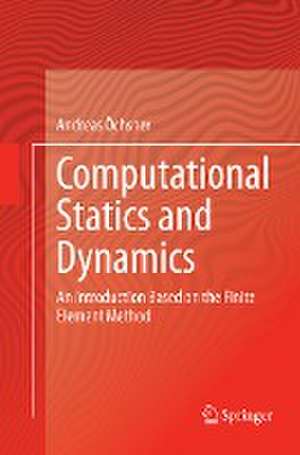
Computational Statics and Dynamics
Autor Andreas Öchsneren Limba Engleză Paperback – 25 apr 2018
In order to deepen readers’ understanding of the derived equations and theories, each chapter also includes supplementary problems. These problems start with fundamental knowledge questions on the theory presented in the chapter, followed by calculation problems. In total over 80 such calculation problems are provided, along with brief solutions for each.
This book is especially designed to meet the needs of Australian students, reviewing the mathematics covered in their first two years at university. The 13-week course comprises three hours of lectures and two hours of tutorials per week.
Preț: 654.86 lei
Preț vechi: 770.42 lei
-15%
Puncte Express: 982
Carte tipărită la comandă
Livrare economică 19 octombrie-02 noiembrie
Livrare prin curier în România Termenul estimat este afișat lângă disponibilitate.
Transport gratuit pentru acest produs Plată online sau ramburs, în funcție de opțiunile comenzii.
Retur gratuit în 14 zile Comandă securizată și suport în română.
Specificații
ISBN-13: 9789811092404
ISBN-10: 9811092400
Pagini: 508
Ilustrații: XX, 485 p. 225 illus.
Dimensiuni: 155 x 235 x 28 mm
Greutate: 0.76 kg
Ediția:Softcover reprint of the original 1st ed. 2016
Editura: Springer Nature B.V.
Locul publicării:Singapore, Singapore
ISBN-10: 9811092400
Pagini: 508
Ilustrații: XX, 485 p. 225 illus.
Dimensiuni: 155 x 235 x 28 mm
Greutate: 0.76 kg
Ediția:Softcover reprint of the original 1st ed. 2016
Editura: Springer Nature B.V.
Locul publicării:Singapore, Singapore
V-ar putea interesa
-
 Mechanical Engineering PrinciplesJohn BirdPreț: 438.85 lei
 -
 A First Course in Finite ElementsJacob Fish-19%Preț: 419.86 lei518.35 lei
 -
 Concepts and Applications of Finite Element AnalysisRobert D. Cook-18%Preț: 1345.31 lei1640.62 lei
 -
 Applied Mechanics of SolidsAllan F. Bower-14%Preț: 766.28 lei891.02 lei
 -
 -19%Preț: 633.60 lei782.22 lei
 -
 Introduction to Finite Elements in EngineeringTirupathi Chandrupatla-19%Preț: 648.01 lei800.01 lei
 -
 Design of Mechanical ElementsBart Raeymaekers-19%Preț: 591.87 lei730.71 lei
 -
 VECTOR MECHANICS FOR ENGINEERS: STATICS, SI EDITIONFerdinand Beer-26%Preț: 383.32 lei516.35 lei
 -
 Vector Mechanics for Engineers: Dynamics, SI EditionFerdinand Beer-25%Preț: 393.07 lei521.64 lei
 -
 -20%Preț: 513.47 lei641.85 lei
 -
 -20%Preț: 557.86 lei697.32 lei
 -
 -20%Preț: 434.19 lei542.73 lei
 -
 -20%Preț: 503.92 lei629.89 lei
 -
 -20%Preț: 558.06 lei697.58 lei
 -
 Structural EngineeringAdnan Ibrahimbegovic-19%Preț: 456.85 lei564.01 lei
 -
 -15%Preț: 424.11 lei498.95 lei
 -
 General Physics IMehdi Rahmani-AndebiliPreț: 377.42 lei
 -
 Engineering Mechanics 1Dietmar GrossPreț: 270.16 lei
 -
 -25%Preț: 511.38 lei680.54 lei
Cuprins
Introduction to the Finite Element Method.- Rods and Trusses.- Euler-Bernoulli Beams and Frames.- Timoshenko Beams.- Plane Elements.- Classical Plate Elements.- Three-Dimensional Elements.- Principles of Linear Dynamics.- Integration Methods for Transient Problems.- Appendix A: Mathematics.- Appendix B: Mechanics.- Appendix C: Units and Conversion.- Appendix D: Summary of Stiffness Matrices.
Notă biografică
Andreas Öchsner is a Full Professor at the School of Engineering, Griffith University, Australia and Leader of the Mechanical Engineering Program (Head of Discipline and Program Director). Having obtained a Dipl.-Ing. degree in Aeronautical Engineering at the University of Stuttgart (1997), Germany, he served as a research and teaching assistant at the University of Erlangen-Nuremberg from 1997 to 2003 while working to complete his Doctor of Engineering Sciences (Dr.-Ing.) degree. From 2003 to 2006, he was an Assistant Professor at the Department of Mechanical Engineering and Head of the Cellular Metals Group affiliated with the University of Aveiro, Portugal. He spent seven years (2007–2013) as a Full Professor at the Department of Applied Mechanics, Technical University of Malaysia, where he was also Head of the Advanced Materials and Structure Lab.
Textul de pe ultima copertă
This book introduces readers to modern computational mechanics based on the finite element method. It helps students succeed in mechanics courses by showing them how to apply the fundamental knowledge they gained in the first years of their engineering education to more advanced topics.
In order to deepen readers’ understanding of the derived equations and theories, each chapter also includes supplementary problems. These problems start with fundamental knowledge questions on the theory presented in the chapter, followed by calculation problems. In total over 80 such calculation problems are provided, along with brief solutions for each.
This book is especially designed to meet the needs of Australian students, reviewing the mathematics covered in their first two years at university. The 13-week course comprises three hours of lectures and two hours of tutorials per week.
In order to deepen readers’ understanding of the derived equations and theories, each chapter also includes supplementary problems. These problems start with fundamental knowledge questions on the theory presented in the chapter, followed by calculation problems. In total over 80 such calculation problems are provided, along with brief solutions for each.
This book is especially designed to meet the needs of Australian students, reviewing the mathematics covered in their first two years at university. The 13-week course comprises three hours of lectures and two hours of tutorials per week.
Caracteristici
Provides essential guidance to ensure students’ success in mechanics courses Shows students how to apply their fundamental knowledge Includes over 80 calculation exercises with brief solutions for each Includes supplementary material: sn.pub/extras