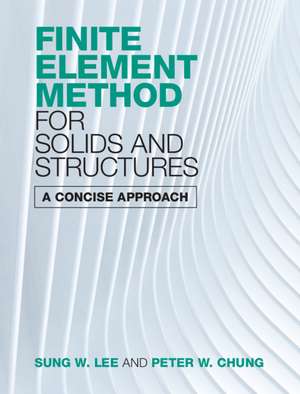
Finite Element Method for Solids and Structures
Autor Sung W Lee, Peter W Chungen Limba Engleză Hardback – 17 iun 2021
În ingineria mecanică și civilă, tranziția de la ecuațiile diferențiale teoretice la simulările complexe din mediul industrial reprezintă adesea o barieră majoră pentru studenți și inginerii debutanți. Finite Element Method for Solids and Structures propune o metodologie hibridă inovatoare, concepută să elimine acest decalaj prin utilizarea resurselor video și a tutorialelor software detaliate. Reținem că volumul nu se limitează la expunerea teoretică a metodei elementului finit (MEF), ci ghidează utilizatorul prin fluxuri de lucru reale în platforme precum ANSYS, SolidWorks sau PTC Creo. Structura narativă a cursului este riguros organizată pentru a asigura o progresie logică. Primele capitole pun bazele prin studiul barelor, torsiunii și efectelor de temperatură, avansând rapid către dinamica structurală și deplasarea virtuală. Observăm o atenție deosebită acordată în capitolul 10 fenomenului de „element locking”, o problemă tehnică frecventă în modelare, și extinderea analizei către transferul de căldură în capitolul 11. Complementar volumului Essentials of the Finite Element Method de Dimitrios G. Pavlou, care oferă o perspectivă concisă asupra fundamentelor, lucrarea semnată de Sung W Lee și Peter W Chung pune un accent mult mai pronunțat pe implementarea practică și pe utilizarea software-ului comercial. De asemenea, dacă Introduction to the Finite Element Method and Implementation with Matlab(r) se concentrează masiv pe codare, acest titlu de la Cambridge University Press oferă un echilibru între modelarea matematică și interfețele grafice ale uneltelor de analiză industrială, fiind susținut de peste 200 de ilustrații tehnice și 120 de exerciții aplicate.
Preț: 623.03 lei
Preț vechi: 778.79 lei
-20%
Carte disponibilă
Livrare economică 16-30 iunie
Specificații
ISBN-10: 1108497098
Pagini: 366
Dimensiuni: 196 x 249 x 20 mm
Greutate: 0.91 kg
Editura: Cambridge University Press
Locul publicării:New York, United States
De ce să citești această carte
Recomandăm această lucrare studenților de nivel licență terminală și masteranzilor care doresc să stăpânească metoda elementului finit dincolo de teorie. Cititorul câștigă experiență practică directă în utilizarea pachetelor software standard (ANSYS, SolidWorks), facilitând integrarea rapidă într-un departament de proiectare sau analiză structurală. Este un instrument esențial pentru transformarea modelelor matematice abstracte în soluții de inginerie viabile.
Descriere scurtă
Cuprins
Recenzii
'The perfect material for people who want to learn about or teach the theoretical background of the FEM. It explains key concepts with plenty of examples, MATLAB® codes and practice problems. The book also provides theories of element locking and mixed formulation, and detailed formulations for structural dynamics and heat transfer, showing how the FEM can be applied to various engineering problems.' Hoon Cheol Park, Konkuk University
'I strongly recommend this book to students who want to learn about the fundamentals of the finite element method. Professors Lee and Chung are well known for their contribution to the FEM field. The book focuses on the FEM using linear structural analysis, and Chapter 11 applies FEM to heat transfer problems, an excellent addition which opens the concept of FEM to solve partial differential equations.' Sameer Mulani, University of Alabama