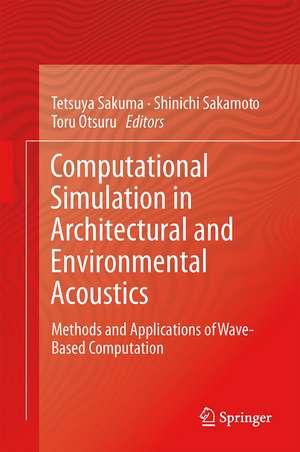
Computational Simulation in Architectural and Environmental Acoustics
Editat de Tetsuya Sakuma, Shinichi Sakamoto, Toru Otsuruen Limba Engleză Hardback – 13 aug 2014
Following an introduction providing an overview of computational simulation of sound environment, the book is in two parts: four chapters on methods and four chapters on applications. The first part explains the fundamentals and advanced techniques for three popular methods, namely, the finite-difference time-domain method, the finite element method, and the boundary element method, as well as alternative time-domain methods. The second part demonstrates various applications to room acoustics simulation, noise propagation simulation, acoustic property simulation for building components, and auralization.
This book is a valuable reference that covers the state of the art in computational simulation for architectural and environmental acoustics.
Preț: 925.88 lei
Preț vechi: 1129.13 lei
-18%
Puncte Express: 1389
Carte tipărită la comandă
Livrare economică 14-28 noiembrie
Livrare prin curier în România Termenul estimat este afișat lângă disponibilitate.
Transport gratuit pentru acest produs Plată online sau ramburs, în funcție de opțiunile comenzii.
Retur gratuit în 14 zile Comandă securizată și suport în română.
Specificații
ISBN-13: 9784431544531
ISBN-10: 4431544534
Pagini: 340
Ilustrații: XIV, 324 p. 237 illus., 38 illus. in color.
Dimensiuni: 160 x 241 x 24 mm
Greutate: 0.68 kg
Ediția:2014
Editura: Springer
Locul publicării:Tokyo, Japan
ISBN-10: 4431544534
Pagini: 340
Ilustrații: XIV, 324 p. 237 illus., 38 illus. in color.
Dimensiuni: 160 x 241 x 24 mm
Greutate: 0.68 kg
Ediția:2014
Editura: Springer
Locul publicării:Tokyo, Japan
V-ar putea interesa
-
 -12%Preț: 377.59 lei427.68 lei
 -
 Designing SoundAndy Part time lecturer (School of Audio Engineering/ Middlesex Un) Farnell-25%Preț: 509.47 lei682.15 lei
 -
 Engineering Noise ControlDavid A. Bies-8%Preț: 537.44 lei584.17 lei
 -
 -9%Preț: 739.08 lei812.18 lei
 -
 Architectural Research MethodsDavid Wang-8%Preț: 478.18 lei519.76 lei
 -
 Music, Physics and EngineeringHarry F. OlsonPreț: 98.19 lei
 -
 -24%Preț: 143.13 lei189.40 lei
 -
 The Routledge Companion to the Sound of SpaceEmma-Kate Matthews-9%Preț: 2013.07 lei2212.16 lei
 -
 Design-Tech: Building Science for ArchitectsJason Alread-8%Preț: 465.32 lei505.78 leiRecomandat
 -
 Funicular Structures: The Art of Building EfficientlyDamon BolhassaniPreț: 384.80 leiRecomandat
 -
 Practising Wood in Architecture: Connecting Design, Construction and SustainabilityJames Benedict BrownPreț: 346.04 leiRecomandat
 -
 -11%Preț: 497.37 lei558.84 lei
 -
 Master Handbook of Acoustics, Seventh EditionF. Alton Everest-28%Preț: 282.37 lei389.90 lei
 -
 Fundamentals of Acoustic Waves and ApplicationsSanichiro YoshidaPreț: 451.41 lei
 -
 -19%Preț: 512.51 lei632.72 lei
 -
 Nonlinear AcousticsMark F. HamiltonPreț: 396.05 lei
 -
 -18%Preț: 1119.50 lei1365.24 lei
 -
 -18%Preț: 748.99 lei913.41 lei
Public țintă
GraduateCuprins
Introduction.- Finite-Difference Time-Domain Method.- Finite Element Method.- Boundary Element Method.- Alternative Time-Domain Methods.- Room Acoustics Simulation.- Noise Propagation Simulation.- Acoustic Property Simulation for Building Components.- Auralization.
Textul de pe ultima copertă
This book reviews a variety of methods for wave-based acoustic simulation and recent applications to architectural and environmental acoustic problems.
Following an introduction providing an overview of computational simulation of sound environment, the book is in two parts: four chapters on methods and four chapters on applications. The first part explains the fundamentals and advanced techniques for three popular methods, namely, the finite-difference time-domain method, the finite element method, and the boundary element method, as well as alternative time-domain methods. The second part demonstrates various applications to room acoustics simulation, noise propagation simulation, acoustic property simulation for building components, and auralization.
This book is a valuable reference that covers the state of the art in computational simulation for architectural and environmental acoustics.
Following an introduction providing an overview of computational simulation of sound environment, the book is in two parts: four chapters on methods and four chapters on applications. The first part explains the fundamentals and advanced techniques for three popular methods, namely, the finite-difference time-domain method, the finite element method, and the boundary element method, as well as alternative time-domain methods. The second part demonstrates various applications to room acoustics simulation, noise propagation simulation, acoustic property simulation for building components, and auralization.
This book is a valuable reference that covers the state of the art in computational simulation for architectural and environmental acoustics.
Caracteristici
Presents reports from the forefront of computational acoustics research
Is a comprehensive handbook on wave-based acoustic simulation
Provides substantial applications of architectural and environmental acoustics
Includes supplementary material: sn.pub/extras
Is a comprehensive handbook on wave-based acoustic simulation
Provides substantial applications of architectural and environmental acoustics
Includes supplementary material: sn.pub/extras