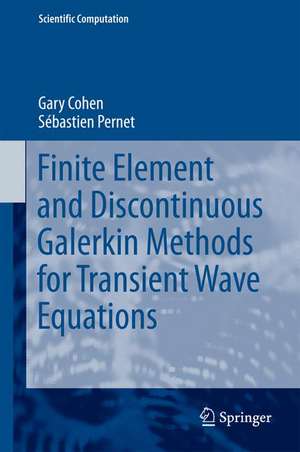
Finite Element and Discontinuous Galerkin Methods for Transient Wave Equations: Scientific Computation
Autor Gary Cohen, Sébastien Perneten Limba Engleză Hardback – 18 aug 2016
Descoperim în această lucrare o abordare riguroasă a metodelor numerice destinate rezolvării ecuațiilor undelor tranziente, sub semnătura lui Gary Cohen și Sébastien Pernet. Autorii își bazează expunerea pe o vastă experiență în modelarea fenomenelor fizice, concentrându-se pe eficiența computațională a algoritmilor în domenii precum acustica, elastodinamica liniară și electromagnetismul. Suntem de părere că volumul reușește să pună în echilibru fundamentele teoretice cu necesitățile practice ale ingineriei moderne. Ca și Gary Cohen în Higher-Order Numerical Methods for Transient Wave Equations, autorul distilează experiență reală în principii acționabile, extinzând aici analiza către metodele de tip Galerkin discontinuu (DG). Această lucrare rafinează conceptele prezentate în volumele anterioare din seria Scientific Computation, oferind o perspectivă integrată asupra simulării numerice a undelor. Notăm cu interes progresia logică a materialului: după stabilirea modelelor variaționale clasice, autorii detaliază o varietate impresionantă de elemente finite (prisme, piramide, hexadri), trecând apoi la studiul preciziei prin tehnici de unde plane și estimări de eroare a priori. Structura cărții este concepută pentru a ghida cititorul de la elemente de bază, precum 1D mass-lumping, către subiecte avansate de cercetare. Un capitol esențial este dedicat sistemului Maxwell, abordând problema critică a aproximărilor fără soluții parazite, urmat de soluții tehnice pentru domenii nemărginite prin ABC și PML. Ultimele secțiuni introduc algoritmi de local time-stepping, esențiali pentru optimizarea resurselor în simulări complexe. Este o resursă tehnică ce transformă analiza matematică într-un instrument de lucru pentru simulări fizice de înaltă fidelitate.
Din seria Scientific Computation
- 18%
 Preț: 905.73 lei
 - 18%
 Preț: 985.62 lei
 - 15%
 Preț: 602.26 lei
 - 18%
 Preț: 954.50 lei
 - 18%
 Preț: 847.00 lei
 - 18%
 Preț: 969.26 lei
 -
 Preț: 375.74 lei
 - 15%
 Preț: 673.39 lei
 -
 Preț: 377.20 lei
 -
 Preț: 376.47 lei
 - 20%
 Preț: 1014.97 lei
 -
 Preț: 389.14 lei
 - 15%
 Preț: 704.49 lei
 - 18%
 Preț: 946.55 lei
 - 18%
 Preț: 1013.23 lei
 -
 Preț: 377.64 lei
 - 15%
 Preț: 508.50 lei
 -
 Preț: 371.76 lei
 - 15%
 Preț: 548.21 lei
 - 18%
 Preț: 987.42 lei
 - 18%
 Preț: 1146.94 lei
 - 15%
 Preț: 674.85 lei
 - 15%
 Preț: 647.44 lei
 - 18%
 Preț: 963.47 lei
 - 15%
 Preț: 672.87 lei
 - 18%
 Preț: 893.57 lei
 -
 Preț: 415.34 lei
 -
 Preț: 388.30 lei
 -
 Preț: 392.13 lei
 -
 Preț: 372.86 lei
 - 15%
 Preț: 657.90 lei
 - 15%
 Preț: 507.41 lei
 - 18%
 Preț: 768.28 lei
 -
 Preț: 367.88 lei
 - 18%
 Preț: 1110.95 lei
 -
 Preț: 383.38 lei
 -
 Preț: 370.25 lei
 - 15%
 Preț: 625.56 lei
 - 15%
 Preț: 598.26 lei
Preț: 748.99 lei
Preț vechi: 913.41 lei
-18%
Carte disponibilă
Livrare economică 28 octombrie-11 noiembrie
Specificații
ISBN-10: 9401777594
Pagini: 400
Ilustrații: XVII, 381 p. 79 illus., 39 illus. in color.
Dimensiuni: 160 x 241 x 26 mm
Greutate: 0.84 kg
Ediția:1st edition 2017
Editura: Springer
Colecția Scientific Computation
Seria Scientific Computation
Locul publicării:Dordrecht, Netherlands
V-ar putea interesa
-
 -12%Preț: 377.59 lei427.68 lei
 -
 -32%Preț: 684.58 lei1013.83 lei
 -
 A First Course in Finite ElementsJacob Fish-19%Preț: 419.84 lei518.31 lei
 -
 Concepts and Applications of Finite Element AnalysisRobert D. Cook-18%Preț: 1345.31 lei1640.62 lei
 -
 -19%Preț: 94.27 lei115.68 lei
 -
 Partial Differential Equations for Scientists and EngineersStanley J FarlowPreț: 147.84 lei
 -
 Finite Element Methods and Their ApplicationsMahboub Baccouch-20%Preț: 1007.26 lei1259.07 lei
 -
 -15%Preț: 424.11 lei498.95 lei
 -
 Partial Differential Equations IMichael E. TaylorPreț: 545.32 lei
 -
 Preț: 208.61 lei
 -
 Fundamentals of Acoustic Waves and ApplicationsSanichiro YoshidaPreț: 451.41 lei
 -
 -19%Preț: 512.51 lei632.72 lei
 -
 Select Ideas in Partial Differential EquationsPeter J. Costa-15%Preț: 566.78 lei666.80 lei
 -
 Applied Numerical Methods for Partial Differential EquationsCarl L. Gardner-15%Preț: 404.99 lei476.47 lei
 -
 Model Reduction of Parametrized SystemsPeter Benner-18%Preț: 865.96 lei1056.04 lei
 -
 -24%Preț: 729.90 lei960.39 lei
 -
 Preț: 307.89 lei
De ce să citești această carte
Această monografie este esențială pentru inginerii și cercetătorii care dezvoltă simulări numerice pentru propagarea undelor. Cititorul câștigă o înțelegere profundă a metodelor Galerkin discontinue și a implementării acestora pe geometrii complexe (2D și 3D). Este o investiție valoroasă pentru cei care au nevoie de soluții concrete pentru eliminarea erorilor numerice în electromagnetism și acustică, oferind metode verificate de optimizare a timpului de calcul.
Despre autor
Gary Cohen este un specialist recunoscut în domeniul matematicii aplicate și al calculului științific, cu o contribuție semnificativă în dezvoltarea metodelor numerice de ordin înalt. Activitatea sa de cercetare s-a concentrat pe rezolvarea eficientă a ecuațiilor undelor, fiind autorul unor lucrări de referință în seria Scientific Computation de la Springer. Expertiza sa acoperă atât fundamentarea teoretică a metodelor de element finit, cât și optimizarea algoritmilor pentru aplicații industriale în geofizică și electromagnetism. (Notă: Datele biografice furnizate conțin confuzii între mai multe persoane cu același nume; prezentarea de față se concentrează strict pe profilul academic relevant pentru domeniul ingineriei și matematicii.)
Descriere scurtă
Cuprins
Recenzii
“This monograph presents much of the progress made during the last two decades in the numerical solution of hyperbolic equations like the acoustics and Maxwell's equation as well as in linear elastodynamic systems. … the book is full of mathematical analysis, but also manypractical aspects and a lot of numerical results are given. … the book may be also quite useful for practitioners.” (Rolf Dieter Grigorieff, zbMATH 1360.65233, 2017)