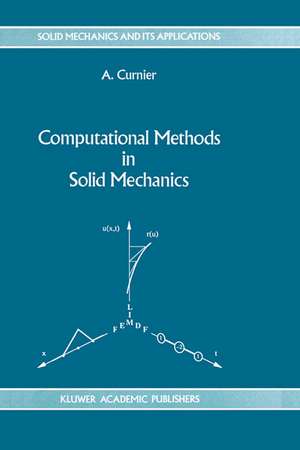
Computational Methods in Solid Mechanics: Solid Mechanics and Its Applications, cartea 29
Autor A. Curnieren Limba Engleză Hardback – 31 mai 1994
| Toate formatele și edițiile | Preț | Express |
|---|---|---|
| Paperback (1) | 1167.39 lei 6-8 săpt. | |
| Springer – 8 oct 2012 | 1167.39 lei 6-8 săpt. | |
| Hardback (1) | 1180.96 lei 6-8 săpt. | |
| SPRINGER NETHERLANDS – 31 mai 1994 | 1180.96 lei 6-8 săpt. |
Din seria Solid Mechanics and Its Applications
- 18%
 Preț: 1189.62 lei
 - 18%
 Preț: 1081.17 lei
 - 15%
 Preț: 618.99 lei
 - 15%
 Preț: 424.11 lei
 -
 Preț: 390.81 lei
 - 18%
 Preț: 913.16 lei
 - 18%
 Preț: 920.88 lei
 - 18%
 Preț: 1185.07 lei
 - 18%
 Preț: 1188.09 lei
 - 18%
 Preț: 906.34 lei
 - 18%
 Preț: 927.09 lei
 - 18%
 Preț: 1191.43 lei
 - 18%
 Preț: 927.09 lei
 - 18%
 Preț: 915.58 lei
 - 18%
 Preț: 959.82 lei
 - 18%
 Preț: 927.86 lei
 - 18%
 Preț: 1183.12 lei
 - 18%
 Preț: 1193.23 lei
 - 18%
 Preț: 924.22 lei
 - 15%
 Preț: 624.14 lei
 - 18%
 Preț: 1214.93 lei
 - 15%
 Preț: 625.88 lei
 - 18%
 Preț: 913.62 lei
 - 18%
 Preț: 1755.40 lei
 - 18%
 Preț: 914.35 lei
 - 24%
 Preț: 1768.13 lei
 - 15%
 Preț: 636.10 lei
 - 18%
 Preț: 1757.37 lei
 - 18%
 Preț: 1178.09 lei
 - 23%
 Preț: 782.65 lei
 - 18%
 Preț: 1189.93 lei
 - 15%
 Preț: 577.30 lei
 - 15%
 Preț: 582.36 lei
 - 18%
 Preț: 2025.46 lei
 -
 Preț: 386.89 lei
 - 18%
 Preț: 925.12 lei
 - 18%
 Preț: 1347.31 lei
 - 18%
 Preț: 912.09 lei
 - 15%
 Preț: 612.55 lei
 - 18%
 Preț: 929.84 lei
 - 18%
 Preț: 919.67 lei
 - 18%
 Preț: 915.29 lei
 - 18%
 Preț: 722.80 lei
 -
 Preț: 378.73 lei
Preț: 1180.96 lei
Preț vechi: 1440.20 lei
-18%
Puncte Express: 1771
Preț estimativ în valută:
208.87€ • 241.37$ • 180.26£
208.87€ • 241.37$ • 180.26£
Carte tipărită la comandă
Livrare economică 25 aprilie-09 mai
Specificații
ISBN-13: 9780792327615
ISBN-10: 0792327616
Pagini: 404
Ilustrații: XII, 404 p.
Dimensiuni: 170 x 244 x 24 mm
Greutate: 0.76 kg
Ediția:1994
Editura: SPRINGER NETHERLANDS
Colecția Springer
Seria Solid Mechanics and Its Applications
Locul publicării:Dordrecht, Netherlands
ISBN-10: 0792327616
Pagini: 404
Ilustrații: XII, 404 p.
Dimensiuni: 170 x 244 x 24 mm
Greutate: 0.76 kg
Ediția:1994
Editura: SPRINGER NETHERLANDS
Colecția Springer
Seria Solid Mechanics and Its Applications
Locul publicării:Dordrecht, Netherlands
V-ar putea interesa
-
 Introduction to Coupled Theories in Solid MechanicsLallit Anand-24%Preț: 546.32 lei716.03 lei
 -
 A First Course in Finite ElementsJacob Fish-19%Preț: 385.75 lei476.23 lei
 -
 Computational Methods for PlasticityDavid R. J. Owen-23%Preț: 928.29 lei1205.57 lei
 -
 -18%Preț: 1280.70 lei1561.83 lei
 -
 Non-Linear Elastic DeformationsR. W. OgdenPreț: 151.35 lei
 -
 Computational Science and EngineeringGilbert Strang-8%Preț: 605.99 lei658.69 lei
 -
 Applied Mechanics of SolidsAllan F. Bower-14%Preț: 729.90 lei848.73 lei
 -
 -20%Preț: 535.29 lei669.11 lei
 -
 -20%Preț: 496.99 lei621.23 lei
 -
 -20%Preț: 421.05 lei526.31 lei
 -
 -20%Preț: 488.43 lei610.54 lei
 -
 -20%Preț: 540.89 lei676.11 lei
 -
 Finite Element Methods and Their ApplicationsMahboub Baccouch-20%Preț: 964.43 lei1205.55 lei
 -
 -19%Preț: 637.43 lei786.95 lei
 -
 Structural Engineering: Models and Methods for Statics, Instability and InelasticityAdnan Ibrahimbegovic-19%Preț: 457.33 lei564.61 lei
 -
 -15%Preț: 424.11 lei498.95 lei
 -
 Select Ideas in Partial Differential EquationsPeter J. Costa-15%Preț: 531.79 lei625.64 lei
 -
 Nonlinear Dynamics of StructuresSergio OllerPreț: 389.55 lei
 -
 -22%Preț: 514.50 lei657.93 lei
Public țintă
ResearchCuprins
1 One-Dimensional Bar Model Problem (Principle of Virtual Work).- 1.1 Kinematics : material description.- 1.2 Dynamics: equilibrium of forces.- 1.3 Mechanics : principle of virtual work.- 1.4 Geometric and material non-linearities.- 1.5 Constitutive laws for solid materials.- 1.6 Discontinuities in space.- 1.7 Thermics : heat equation.- 1.8 Mathematics : functional analysis notions.- 1.9 Summary.- 2 Spatial Discretisation by the Finite Element Method.- 2.1 Global overview : Galerkin method.- 2.2 Nodal FEM : piecewise polynomial basis functions.- 2.3 Localisation of mesh nodal displacements.- 2.4 Interpolation of element nodal displacements.- 2.5 Integration of element nodal forces.- 2.6 Assembly of mesh nodal forces.- 2.7 Properties of force vectors.- 2.8 Automation: isoparametric maps and numerical integration.- 2.9 Boundary conditions condensation.- 2.10 Algorithm: element loop.- 2.11 Practice : heat equation discretisation.- 2.12 Accuracy : error norms and estimates.- 2.13 Summary.- 3 Solution of Non-Linearities by the Linear Iteration Method.- 3.1 Linearisation : classical and directional derivative.- 3.2 Nominal stress linearisation : nominal tangent modulus.- 3.3 Linearized equations of motion : mass and stiffness matrices.- 3.4 Finite element mass and stiffness matrices.- 3.5 Assembly of the mass and stiffness matrices.- 3.6 Properties of the mass and stiffness matrices.- 3.7 Linearized heat equation.- 3.8 Condensation of boundary conditions after linearisation.- 3.9 Linear iteration method : algorithm and variants.- 3.10 Standard and modified Newton methods.- 3.11 Secant or conjugate gradient methods.- 3.12 Gradient and Jacobi methods.- 3.13 Local and global convergence of iterative methods.- 3.14 Local convergence of the LIM : consistency and stability.- 3.15 Glocal convergence of the LIM : damping and continuation.- 3.16 Summary.- 4 Time Integration by the Finite Difference Method.- 4.1 Generalised trapezoidal rule or Euler scheme (applied to the linear heat equation).- 4.2 Modal analysis of the heat equation.- 4.3 General error analysis : summary and glossary.- 4.4 Stability of the heat-trapezoid algorithm.- 4.5 Consistency of the heat-trapezoid algorithm.- 4.6 Convergence of the heat-trapezoid algorithm.- 4.7 Generalized trapezoidal rale or Newmark scheme (applied to the linear wave equation).- 4.8 Modal analysis of the wave equation.- 4.9 Stability of the wave-trapezoid algorithm.- 4.10 Consistency of the wave-trapezoid algorithm.- 4.11 Convergence of the wave-trapezoid algorithm.- 4.12 Summary.- 5 Compact Combination of the Finite Element, Linear Iteration and Finite Difference Methods.- 5.1 Problem statement review.- 5.2 Galerkin-FE algorithm review.- 5.3 Newton-LI algorithm review.- 5.4 Newmark-FD algorithm review.- 5.5 Combining the FE, LI and FD algorithms.- 5.6 Nonlinear thermics algorithm.- 5.7 Nonlinear dynamics algorithm.- 5.8 Nonlinear thermodynamics synthesis.- 5.9 Convergence review.- 5.10 Programming guidelines (TACT example).- 5.11 FD and LI methods programming.- 5.12 FE and algebraic methods programming.- 5.13 Summary.- 6 Two- and Three-Dimensional Deformable Solids.- 6.1 Kinematics : material description.- 6.2 Dynamics: balance of forces.- 6.3 Mechanics : principle of virtual work.- 6.4 Objective constitutive laws.- 6.5 Nominal stress linearisation.- 6.6 Constitutive laws for solid materials.- 6.7 Spatial discretisation in three dimensions.- 6.8 Linearized discrete mechanics.- 6.9 Isoparametric solid finite elements.- 6.10 Finite difference time integration.- 6.11 Final algorithm.- 6.12 Summary.- Conclusion.- Appendix A : List of Symbols.- 1.- 2.- 3.- 4.- 5.- 6.- Appendix B : Exercises.- 1.- 2.- 3.- 4.- 5.- 6.