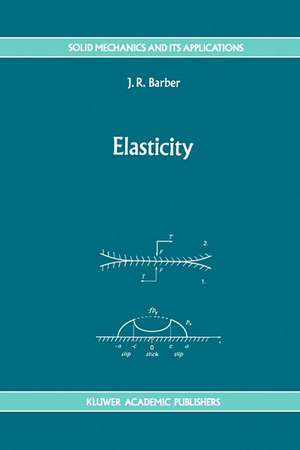
Elasticity: Solid Mechanics and Its Applications, cartea 12
Autor J. R. Barberen Limba Engleză Hardback – 31 ian 1992
Din seria Solid Mechanics and Its Applications
- 18%
 Preț: 1353.76 lei
 -
 Preț: 628.16 lei
 - 18%
 Preț: 1242.60 lei
 - 15%
 Preț: 661.76 lei
 - 15%
 Preț: 731.65 lei
 - 18%
 Preț: 1166.95 lei
 - 15%
 Preț: 666.92 lei
 - 18%
 Preț: 1156.92 lei
 - 18%
 Preț: 647.44 lei
 - 18%
 Preț: 1784.98 lei
 - 15%
 Preț: 424.11 lei
 - 18%
 Preț: 978.42 lei
 - 18%
 Preț: 1238.90 lei
 - 15%
 Preț: 673.19 lei
 - 15%
 Preț: 642.19 lei
 - 18%
 Preț: 984.21 lei
 - 20%
 Preț: 636.75 lei
 - 18%
 Preț: 988.03 lei
 - 18%
 Preț: 914.83 lei
 - 18%
 Preț: 763.70 lei
 - 18%
 Preț: 1271.93 lei
 - 18%
 Preț: 1278.08 lei
 - 18%
 Preț: 934.80 lei
 - 18%
 Preț: 990.14 lei
 - 20%
 Preț: 1031.80 lei
 - 18%
 Preț: 1285.90 lei
 - 18%
 Preț: 993.09 lei
 - 18%
 Preț: 994.79 lei
 - 18%
 Preț: 909.21 lei
 -
 Preț: 418.39 lei
 - 18%
 Preț: 1040.97 lei
 - 18%
 Preț: 990.58 lei
 - 15%
 Preț: 671.79 lei
 - 18%
 Preț: 1155.14 lei
 - 18%
 Preț: 960.16 lei
 - 18%
 Preț: 1269.85 lei
 - 18%
 Preț: 1285.25 lei
 - 18%
 Preț: 989.31 lei
 - 24%
 Preț: 1867.10 lei
 - 18%
 Preț: 993.52 lei
 - 24%
 Preț: 690.04 lei
 - 18%
 Preț: 1238.74 lei
 - 15%
 Preț: 675.76 lei
Preț: 981.22 lei
Preț vechi: 1196.60 lei
-18%
Puncte Express: 1472
Carte tipărită la comandă
Livrare economică 26 noiembrie-10 decembrie
Livrare prin curier în România Termenul estimat este afișat lângă disponibilitate.
Transport gratuit pentru acest produs Plată online sau ramburs, în funcție de opțiunile comenzii.
Retur gratuit în 14 zile Comandă securizată și suport în română.
Specificații
ISBN-13: 9780792316091
ISBN-10: 0792316096
Pagini: 322
Ilustrații: XV, 301 p.
Dimensiuni: 160 x 241 x 22 mm
Greutate: 0.6 kg
Ediția:1992
Editura: Springer
Colecția Solid Mechanics and Its Applications
Seria Solid Mechanics and Its Applications
Locul publicării:Dordrecht, Netherlands
ISBN-10: 0792316096
Pagini: 322
Ilustrații: XV, 301 p.
Dimensiuni: 160 x 241 x 22 mm
Greutate: 0.6 kg
Ediția:1992
Editura: Springer
Colecția Solid Mechanics and Its Applications
Seria Solid Mechanics and Its Applications
Locul publicării:Dordrecht, Netherlands
V-ar putea interesa
-
 The Cartoon Guide to AlgebraLarry GonickPreț: 109.32 lei
 -
 A Taste of Jordan AlgebrasKevin MccrimmonPreț: 427.89 lei
 -
 -18%Preț: 985.08 lei1201.32 lei
 -
 Abstract AlgebraIsrael N. Herstein-27%Preț: 822.25 lei1126.38 lei
 -
 Algebra and Analysis for Engineers and ScientistsAnthony N. MichelPreț: 403.65 lei
 -
 -23%Preț: 784.04 lei1018.23 lei
 -
 Preț: 257.12 lei
 -
 -8%Preț: 643.09 lei699.01 lei
 -
 Algebra I for DummiesMary Jane SterlingPreț: 115.71 lei
 -
 Nondestructive Evaluation of Materials by Infrared ThermographyXavier P. V. MaldaguePreț: 373.16 lei
 -
 Preț: 368.42 lei
 -
 Time-Dependent Fracture MechanicsDominique P. MiannayPreț: 390.21 lei
 -
 Abstract Algebra: An Interactive Approach, Second EditionWilliam Paulsen-15%Preț: 721.69 lei849.05 lei
 -
 Perturbations of Positive Semigroups with ApplicationsJacek BanasiakPreț: 406.62 lei
 -
 Introduction to Noncommutative AlgebraMatej BrešarPreț: 487.86 lei
 -
 Quiver RepresentationsRalf Schiffler-43%Preț: 225.60 lei397.66 lei
 -
 Algebra, Arithmetic and Geometry with ApplicationsChris Christensen-15%Preț: 638.92 lei751.67 lei
 -
 The Geometry of Jordan and Lie StructuresWolfgang BertramPreț: 372.34 lei
 -
 Matrix InequalitiesXingzhi ZhanPreț: 357.06 lei
 -
 Preț: 376.75 lei
 -
 Preț: 470.35 lei
 -
 -15%Preț: 452.65 lei532.52 lei
 -
 Regelung der KraftmaschinenMax TollePreț: 465.55 lei
 -
 -15%Preț: 614.60 lei723.05 lei
 -
 Bernoulli Numbers and Zeta FunctionsTsuneo Arakawa-18%Preț: 927.97 lei1131.67 lei
 -
 Intermediate Mechanics of MaterialsJ. R. Barber-15%Preț: 605.02 lei711.79 lei
 -
 Preț: 227.56 lei
Public țintă
ResearchCuprins
I General Considerations.- 1 Introduction.- 2 Equilibrium and Compatibility.- II Two-Dimensional Problems.- 3 Plane Strain and Plane Stress.- 4 Stress Function Formulation.- 5 Problems in Rectangular Coördinates.- 6 End Effects.- 7 Body Forces.- 8 Problems in Polar Coördinates.- 9 Calculation of Displacements.- 10 Curved Beam Problems.- 11 Wedge Problems.- 12 Plane Contact Problems.- 13 Forces, Dislocations and Cracks.- 14 Thermoelasticity.- III Three Dimensional Problems.- 15 Displacement Function Solutions.- 16 The Boussinesq Potentials.- 17 Thermoelastic Displacement Potentials.- 18 Singular Solutions.- 19 Spherical Harmonics.- 20 Axisymmetric Problems.- 21 Frictionless Contact.- 22 The Boundary-Value Problem.- 23 The Penny-Shaped Crack.- 24 The Interface Crack.- 25 The Reciprocal Theorem.
Recenzii
'...this book is a very good addition to the available literature on elasticity and can be used as a textbook for the first year graduate course on linear elasticity.' Applied Mechanics Reviews, 45:12 (1992)
Notă biografică
James Richard Barber graduated in Mechanical Sciences from the University of Cambridge in 1963. He then joined British Rail, who later sponsored his research at Cambridge between 1965 and 1968 on the subject of thermal effects in braking systems. In 1969 he became a Lecturer and later Reader in Solid Mechanics at the University of Newcastle upon Tyne, U.K. He moved to the University of Michigan, Department of Mechanical Engineering in 1981. His current research interests are in solid mechanics with particular reference to thermoelasticity, contact mechanics and tribology. He is a Chartered Engineer in the U.K., a Fellow of the Institution of Mechanical Engineers and has engaged extensively in consulting work in the field of stress analysis for engineering design. Dr. Barber is author of two books and numerous articles in the fields of Elasticity, Thermoelasticity, Contact Mechanics, Tribology, Heat Conduction and Elastodynamics and he is a member of the editorial boards of the International Journal of Mechanical Sciences and the Journal of Thermal Stresses.
Textul de pe ultima copertă
This is a first year graduate textbook in Linear Elasticity. It is written with the practical engineering reader in mind, dependence on previous knowledge of solid mechanics, continuum mechanics or mathematics being minimized. Emphasis is placed on engineering applications of elasticity and examples are generally worked through to final expressions for the stress and displacement fields in order to explore the engineering consequences of the results.
The topics covered are chosen with a view to modern research applications in fracture mechanics, composite materials, tribology and numerical methods. Thus, significant attention is given to crack and contact problems, problems involving interfaces between dissimilar media, thermoelasticity, singular asymptotic stress fields and three-dimensional problems.
This third edition includes new chapters on complex variable methods, variational methods and three-dimensional solutions for the prismatic bar. Other detailed changes have been made throughout the work, many suggested by users of earlier editions.
The new edition includes over 300 end-of-chapter problems, expressed wherever possible in the form they would arise in engineering - i.e. as a body of a given geometry subjected to prescribed loading - instead of inviting the student to 'verify' that a given candidate stress function is appropriate to the problem. Solution of these problems is considerably facilitated by the use of modern symbolic mathematical languages such as Maple and Mathematica. Electronic files and hints on this method of solution, as well as further supplementary software are available for download via the webpage for this volume on www.springer.com.
The topics covered are chosen with a view to modern research applications in fracture mechanics, composite materials, tribology and numerical methods. Thus, significant attention is given to crack and contact problems, problems involving interfaces between dissimilar media, thermoelasticity, singular asymptotic stress fields and three-dimensional problems.
This third edition includes new chapters on complex variable methods, variational methods and three-dimensional solutions for the prismatic bar. Other detailed changes have been made throughout the work, many suggested by users of earlier editions.
The new edition includes over 300 end-of-chapter problems, expressed wherever possible in the form they would arise in engineering - i.e. as a body of a given geometry subjected to prescribed loading - instead of inviting the student to 'verify' that a given candidate stress function is appropriate to the problem. Solution of these problems is considerably facilitated by the use of modern symbolic mathematical languages such as Maple and Mathematica. Electronic files and hints on this method of solution, as well as further supplementary software are available for download via the webpage for this volume on www.springer.com.
Caracteristici
Expansion of topics to include more on complex variable methods, variational methods and three-dimensional plate and beam solutions Additional end-of-chapter problems Detailed improvements elsewhere, some suggested by users of the earlier editions Modern treatment of the subject Clarity of presentation Supplementary electronic files in Mathematica and Maple available for download Includes supplementary material: sn.pub/extras