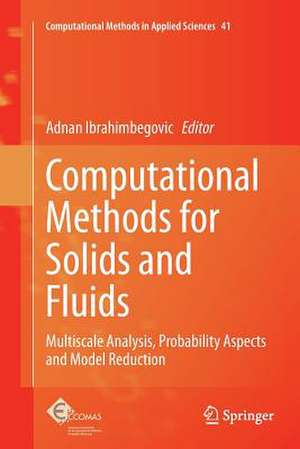
Computational Methods for Solids and Fluids: Computational Methods in Applied Sciences, cartea 41
Editat de Adnan Ibrahimbegovicen Limba Engleză Paperback – 14 mar 2019
Topics dealt with include multiscale strategy for efficient development of scientific software for large-scale computations, coupled probability-nonlinear-mechanics problems and solution methods, and modern mathematical and computational setting for multi-phase flows and fluid-structure interaction.
The papers consist of contributions by six experts who taught short courses prior to the conference, along with several selected articles from other participants dealing with complementary issues, covering both solid mechanics and applied mathematics.
Din seria Computational Methods in Applied Sciences
- 15%
 Preț: 675.08 lei
 - 18%
 Preț: 643.84 lei
 - 15%
 Preț: 678.41 lei
 - 15%
 Preț: 659.28 lei
 - 18%
 Preț: 1156.95 lei
 - 18%
 Preț: 987.29 lei
 - 18%
 Preț: 1262.67 lei
 - 18%
 Preț: 985.87 lei
 - 18%
 Preț: 978.15 lei
 - 20%
 Preț: 639.94 lei
 - 18%
 Preț: 952.65 lei
 - 15%
 Preț: 617.66 lei
 - 18%
 Preț: 1003.81 lei
 - 20%
 Preț: 632.19 lei
 - 18%
 Preț: 986.53 lei
 - 20%
 Preț: 635.65 lei
 - 18%
 Preț: 1197.60 lei
 - 24%
 Preț: 836.98 lei
 - 18%
 Preț: 920.32 lei
 - 47%
 Preț: 564.35 lei
 - 15%
 Preț: 618.47 lei
 - 18%
 Preț: 926.64 lei
 - 15%
 Preț: 615.62 lei
 - 15%
 Preț: 669.40 lei
 - 18%
 Preț: 977.88 lei
 - 18%
 Preț: 1286.08 lei
 - 15%
 Preț: 663.68 lei
 - 15%
 Preț: 673.77 lei
 - 15%
 Preț: 677.06 lei
 - 15%
 Preț: 667.64 lei
 - 15%
 Preț: 673.99 lei
 - 18%
 Preț: 997.53 lei
 - 15%
 Preț: 680.99 lei
Preț: 630.06 lei
Preț vechi: 741.25 lei
-15%
Puncte Express: 945
Carte tipărită la comandă
Livrare economică 30 noiembrie-14 decembrie
Livrare prin curier în România Termenul estimat este afișat lângă disponibilitate.
Transport gratuit pentru acest produs Plată online sau ramburs, în funcție de opțiunile comenzii.
Retur gratuit în 14 zile Comandă securizată și suport în română.
Specificații
ISBN-13: 9783319802541
ISBN-10: 3319802542
Pagini: 508
Ilustrații: XII, 493 p. 224 illus. in color.
Dimensiuni: 155 x 235 x 28 mm
Greutate: 0.76 kg
Ediția:Softcover reprint of the original 1st edition 2016
Editura: Springer
Colecția Computational Methods in Applied Sciences
Seria Computational Methods in Applied Sciences
Locul publicării:Cham, Switzerland
ISBN-10: 3319802542
Pagini: 508
Ilustrații: XII, 493 p. 224 illus. in color.
Dimensiuni: 155 x 235 x 28 mm
Greutate: 0.76 kg
Ediția:Softcover reprint of the original 1st edition 2016
Editura: Springer
Colecția Computational Methods in Applied Sciences
Seria Computational Methods in Applied Sciences
Locul publicării:Cham, Switzerland
V-ar putea interesa
-
 Mechanics of Materials for DummiesJames H AllenPreț: 139.46 lei
 -
 Preț: 170.46 lei
 -
 General Continuum MechanicsT. J. Chung-23%Preț: 901.02 lei1170.15 lei
 -
 Pipe Stress EngineeringAsme Press-23%Preț: 831.60 lei1080.01 lei
 -
 Applied Mechanics of SolidsAllan F. Bower-18%Preț: 856.95 lei1045.07 lei
 -
 Movement Equations 2Michel Borel-9%Preț: 1015.42 lei1115.84 lei
 -
 Experimental Mechanics of Solids and StructuresJer Me Molimard-9%Preț: 1014.13 lei1114.43 lei
 -
 Introduction to Analytical DynamicsNicholas WoodhousePreț: 348.85 lei
 -
 -18%Preț: 914.83 lei1115.64 lei
 -
 Nonlinear Solid MechanicsAdnan IbrahimbegovicPreț: 427.88 lei
 -
 Finite Elements in Fracture MechanicsMeinhard Kuna-8%Preț: 533.14 lei579.51 lei
Cuprins
Preface.- Multiscale analysis as a central component of urbanphysics modeling, by Benoit Beckers.- A path-following method based on plastic dissipationcontrol, by Bostjan Brank et al..- Improved implicit immersed boundary method via operatorsplitting, by Cai Shang-Gui et al..- Modelling wave energy conversion of asemi-submerged heavy cylinder, by Cai Shang-Gui et al..- Multi-scale modelingof imperfect interfaces and applications, by Serge Dumont et al..- A stochasticmulti-scale approach for numerical modeling of complex materials – applicationto uniaxial cyclic response of concrete, by Jehel Pierre and George Deodatis.- Relatingstructure and model, by Ivica Kozar.- Fat Latin hypercube sampling andefficient sparse polynomial chaos expansion for uncertainty propagation onfinite precision models - application to 2D deep drawing process, by Jeremy Lebonet al..- Multiscale atomistic-to-continuum reduced models for micromechanicalsystems, by Eduard Marenic and AdnanIbrahimbegovic.- Inverse Problems in a Bayesian Setting, by Hermann Matthies etal..- Heterogeneous materials models, coupled mechanics-probability problemsand energetically optimal model reduction, by Rainer Niekamp et al..- Modellingof fluid-structure interaction for internal fluid flow in cracks by using embeddedstrong discontinuities, by Mijo Nikolic et al..- Reliability calculus on crackpropagation problem with a Markov renewal process, by Chrysanthi Papamichail etal..- Multi-scale simulation of Newtonian and non-Newtonian multi-phase flows,by Juan Luis Prieto.- Numerical modeling of flow-driven piezoelectricenergyharvesting devices, by Ravi Srivathsan and Andreas Zilian.- Comparison ofnumerical approaches to Bayesian updating, by Rosic Bojana et al..- Two modelsfor hydraulic cylinders in flexible multibody simulations, by Antti Ylinen etal.
Textul de pe ultima copertă
This volume contains the best papers presented at the 2nd ECCOMAS International Conference on Multiscale Computations for Solids and Fluids, held June 10-12, 2015.
Topics dealt with include multiscale strategy for efficient development of scientific software for large-scale computations, coupled probability-nonlinear-mechanics problems and solution methods, and modern mathematical and computational setting for multi-phase flows and fluid-structure interaction.
The papers consist of contributions by six experts who taught short courses prior to the conference, along with several selected articles from other participants dealing with complementary issues, covering both solid mechanics and applied mathematics.
Caracteristici
Presents contributions from both solid mechanics and applied mathematics experts Gives code-coupling strategy for efficient development of scientific software for large-scale computations Treats coupled probability-nonlinear-mechanics problems and solution methods Provides a modern mathematical and computational setting for multi-phase flows and fluid-structure interaction Includes supplementary material: sn.pub/extras