
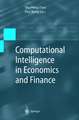
Computational Intelligence in Economics and Finance: Advanced Information Processing
Editat de Paul P. Wangen Limba Engleză Paperback – 6 dec 2010
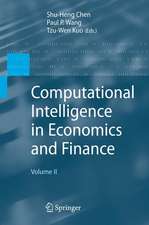
In this volume, Chen and Wang collected not just works on traditional computational intelligence approaches like fuzzy logic, neural networks, and genetic algorithms, but also examples for more recent technologies like e.g. rough sets, support vector machines, wavelets, or ant algorithms. After an introductory chapter with a structural description of all the methodologies, the subsequent parts describe novel applications of these to typical economics and finance problems like business forecasting, currency crisis discrimination, foreign exchange markets, or stock markets behavior.
| Toate formatele și edițiile | Preț | Express |
|---|---|---|
| Paperback (1) | 1178.86 lei 6-8 săpt. | |
| Springer Berlin, Heidelberg – 6 dec 2010 | 1178.86 lei 6-8 săpt. | |
| Hardback (1) | 1185.07 lei 6-8 săpt. | |
| Springer Berlin, Heidelberg – 16 sep 2003 | 1185.07 lei 6-8 săpt. |





Preț: 1178.86 lei
Preț vechi: 1437.64 lei
-18% Nou
Puncte Express: 1768
Preț estimativ în valută:
208.61€ • 244.61$ • 183.20£
208.61€ • 244.61$ • 183.20£
Carte tipărită la comandă
Livrare economică 02-16 februarie 26
Preluare comenzi: 021 569.72.76
Specificații
ISBN-13: 9783642079023
ISBN-10: 3642079024
Pagini: 504
Ilustrații: XXII, 480 p.
Dimensiuni: 155 x 235 x 26 mm
Greutate: 0.7 kg
Ediția:Softcover reprint of hardcover 1st ed. 2004
Editura: Springer Berlin, Heidelberg
Colecția Springer
Seria Advanced Information Processing
Locul publicării:Berlin, Heidelberg, Germany
ISBN-10: 3642079024
Pagini: 504
Ilustrații: XXII, 480 p.
Dimensiuni: 155 x 235 x 26 mm
Greutate: 0.7 kg
Ediția:Softcover reprint of hardcover 1st ed. 2004
Editura: Springer Berlin, Heidelberg
Colecția Springer
Seria Advanced Information Processing
Locul publicării:Berlin, Heidelberg, Germany
V-ar putea interesa
-
 A Practical Guide to Price Index and Hedonic TechniquesAna M. Aizcorbe-31%Preț: 485.14 lei707.14 lei
 -
 The Index Number Problem: Construction TheoremsSydney Afriat-34%Preț: 811.27 lei1227.23 lei
 -
 Essays in Nonlinear Time Series EconometricsNiels Haldrup-34%Preț: 740.50 lei1115.22 lei
 -
 An Introduction to Efficiency and Productivity AnalysisTimothy J. Coelli-15%Preț: 673.23 lei792.03 lei
 -
 Preț: 387.67 lei
 -
 Introduction to Estimating Economic ModelsAtsushi Maki-15%Preț: 667.91 lei785.77 lei
 -
 An Introduction to Mathematics for EconomicsAkihito AsanoPreț: 358.65 lei
 -
 -18%Preț: 913.45 lei1113.96 lei
 -
 Econometric Business Cycle ResearchJan Jacobs-15%Preț: 619.12 lei728.38 lei
 -
 Analysis of Economic DataG Koop-23%Preț: 476.33 lei618.61 lei
 -
 A Guide to Econometrics 6eP KennedyPreț: 231.68 lei
 -
 Ensemble Methods: Foundations and AlgorithmsZhi-Hua Zhou-20%Preț: 651.28 lei814.11 lei
 -
 Information Processing with Evolutionary AlgorithmsManuel Grana-20%Preț: 955.91 lei1194.88 lei
 -
 Modelling Irregularly Spaced Financial DataNikolaus Hautsch-15%Preț: 617.29 lei726.23 lei
 -
 Computer-Aided Introduction to EconometricsJuan Rodriguez PooPreț: 383.59 lei
 -
 -20%Preț: 626.71 lei783.38 lei
 -
 -18%Preț: 916.03 lei1117.10 lei
 -
 Computational Biology and Genome InformaticsJason T. L. Wang-15%Preț: 570.70 lei671.41 lei
Public țintă
ResearchCuprins
1. Computational Intelligence in Economics and Finance.- 2. Intelligent System to Support Judgmental Business Forecasting: the Case of Estimating Hotel Room Demand.- 3. Fuzzy Investment Analysis Using Capital Budgeting and Dynamic Programming Techniques.- 4. Rough Sets Theory and Multivariate Data Analysis in Classification Problems: a Simulation Study.- 5. Forecasting the Opening Cash Price Index in Integrating Grey Forecasting and Neural Networks: Evidence from the SGX-DT MSCI Taiwan Index Futures Contracts.- 6. A Support Vector Machine Model for Currency Crises Discrimination.- 7. Saliency Analysis of Support Vector Machines for Feature Selection in Financial Time Series Forecasting.- 8. Searching Financial Patterns with Self-organizing Maps.- 9. Effective Position of European Firms in the Face of Monetary Integration Using Kohonen’s SOFM.- 10. Financial Applications of Wavelets and Self-organizing Maps.- 11. Pattern Matching in Multidimensional Time Series.- 12. Structural Pattern Discovery in Time Series Databases.- 13. Are Efficient Markets Really Efficient?: Can Financial Econometric Tests Convince Machine-Learning People?.- 14. Nearest-Neighbour Predictions in Foreign Exchange Markets.- 15. Discovering Hidden Patterns with Genetic Programming.- 16. Numerical Solutions to a Stochastic Growth Model Based on the Evolution of a Radial Basis Network.- 17. Evolutionary Strategies vs. Neural Networks: an Inflation Forecasting Experiment.- 18. Business Failure Prediction Using Modified Ants Algorithm.- 19. Towards Automated Optimal Equity Portfolios Discovery in a Financial Knowledge Management System.- 20. White Noise Tests and Synthesis of APT Economic Factors Using TFA.- 21. Learning and Monetary Policy in a Spectral Analysis Representation.- 22. InternationalTransmission of Business Cycles: a Self-organizing Markov-Switching State-Space Model.- 23. How Information Technology Creates Business Value in the Past and in the Current Electronic Commerce (EC) Era.- Author Index.
Textul de pe ultima copertă
Due to the ability to handle specific characteristics of economics and finance forecasting problems like e.g. non-linear relationships, behavioral changes, or knowledge-based domain segmentation, we have recently witnessed a phenomenal growth of the application of computational intelligence methodologies in this field.
In this volume, Chen and Wang collected not just works on traditional computational intelligence approaches like fuzzy logic, neural networks, and genetic algorithms, but also examples for more recent technologies like e.g. rough sets, support vector machines, wavelets, or ant algorithms. After an introductory chapter with a structural description of all the methodologies, the subsequent parts describe novel applications of these to typical economics and finance problems like business forecasting, currency crisis discrimination, foreign exchange markets, or stock markets behavior.
In this volume, Chen and Wang collected not just works on traditional computational intelligence approaches like fuzzy logic, neural networks, and genetic algorithms, but also examples for more recent technologies like e.g. rough sets, support vector machines, wavelets, or ant algorithms. After an introductory chapter with a structural description of all the methodologies, the subsequent parts describe novel applications of these to typical economics and finance problems like business forecasting, currency crisis discrimination, foreign exchange markets, or stock markets behavior.
Caracteristici
Includes supplementary material: sn.pub/extras