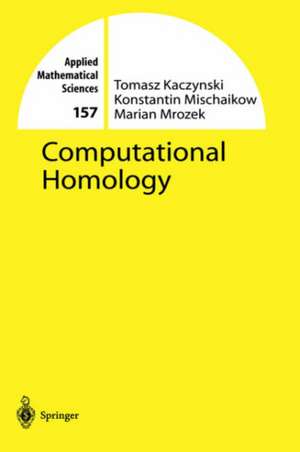
Computational Homology: Applied Mathematical Sciences, cartea 157
Autor Tomasz Kaczynski, Konstantin Mischaikow, Marian Mrozeken Limba Engleză Hardback – 9 ian 2004
Considerăm că volumul Computational Homology, scris de Tomasz Kaczynski, Konstantin Mischaikow și Marian Mrozek, reprezintă o resursă fundamentală pentru cercetătorii care doresc să aplice rigoarea topologiei algebrice în probleme computaționale reale. Aplicabilitatea practică a conținutului teoretic este evidentă încă din primele capitole, unde autorii înlocuiesc abordările abstracte tradiționale cu o metodologie bazată pe complexe cuboidale, mult mai potrivită pentru structura datelor digitale și a rețelelor de pixeli.
Structura lucrării este organizată riguros pentru a ghida cititorul de la fundamente la implementare. Primele secțiuni definesc omologia cuboidală și algoritmii de reducere necesari pentru calculul grupurilor de omologie, în timp ce partea a doua extinde teoria către hărți de lanț și algoritmi de calcul al hărților omologice. Această progresie logică facilitează tranziția către secțiunile finale, care explorează perspective în procesarea imaginilor și dinamica neliniară. Putem afirma că includerea software-ului și a exercițiilor transformă acest text dintr-o monografie teoretică într-un instrument de lucru activ.
În peisajul literaturii de specialitate, acest titlu completează perspectiva oferită de Topology for Computing de Afra J. Zomorodian. În timp ce lucrarea lui Zomorodian se concentrează pe concepte din teoria Morse și grafică pe calculator pentru un public mai larg, Computational Homology adaugă o profunzime algoritmică superioară în ceea ce privește calculul invariantului omologic, fiind axată pe structuri cuboidale în detrimentul celor simpliciale. De asemenea, lucrarea se distinge de An Invitation to Computational Homotopy prin accentul pus pe aplicațiile în sistemele dinamice, oferind un cadru mai robust pentru analiza stabilității și a perturbațiilor în modelele matematice complexe.
Din seria Applied Mathematical Sciences
-
 Preț: 545.32 lei
 -
 Preț: 541.32 lei
 -
 Preț: 560.75 lei
 - 18%
 Preț: 797.46 lei
 - 18%
 Preț: 904.98 lei
 - 24%
 Preț: 775.61 lei
 -
 Preț: 419.28 lei
 - 56%
 Preț: 495.89 lei
 - 18%
 Preț: 2186.79 lei
 - 24%
 Preț: 1034.80 lei
 - 15%
 Preț: 600.85 lei
 -
 Preț: 191.86 lei
 -
 Preț: 394.46 lei
 - 18%
 Preț: 1002.14 lei
 - 15%
 Preț: 618.64 lei
 - 15%
 Preț: 543.81 lei
 -
 Preț: 385.53 lei
 - 18%
 Preț: 758.64 lei
 - 18%
 Preț: 819.08 lei
 - 18%
 Preț: 1054.89 lei
 -
 Preț: 387.82 lei
 - 18%
 Preț: 1426.76 lei
 - 18%
 Preț: 1166.94 lei
 - 18%
 Preț: 1183.90 lei
 - 15%
 Preț: 627.93 lei
 -
 Preț: 398.68 lei
 - 15%
 Preț: 670.35 lei
 - 15%
 Preț: 662.95 lei
 -
 Preț: 372.15 lei
 - 18%
 Preț: 824.93 lei
 - 18%
 Preț: 900.48 lei
Preț: 847.46 lei
Preț vechi: 1033.49 lei
-18%
Carte tipărită la comandă
Livrare economică 27 noiembrie-11 decembrie
Specificații
ISBN-10: 0387408533
Pagini: 504
Ilustrații: XVIII, 482 p.
Dimensiuni: 161 x 240 x 33 mm
Greutate: 0.84 kg
Ediția:2004
Editura: Springer
Colecția Applied Mathematical Sciences
Seria Applied Mathematical Sciences
Locul publicării:New York, NY, United States
V-ar putea interesa
-
 -33%Preț: 710.87 lei1054.16 lei
 -
 The Theory of Transformation GroupsKatsuo Kawakubo-33%Preț: 792.44 lei1174.18 lei
 -
 The Classification of Knots and 3-Dimensional SpacesGeoffrey Hemion-33%Preț: 722.68 lei1075.55 lei
 -
 Fibre BundlesDale Husemöller-15%Preț: 527.66 lei620.78 lei
 -
 Rational Homotopy TheoryYves Felix-15%Preț: 734.61 lei864.25 lei
 -
 Fundamentals of Differential GeometrySerge Lang-18%Preț: 647.49 lei789.62 lei
 -
 An Introduction to Galois Cohomology and its ApplicationsGrégory Berhuy-11%Preț: 543.50 lei610.68 lei
 -
 Induced Representations of Locally Compact GroupsEberhard Kaniuth-14%Preț: 750.26 lei872.39 lei
 -
 Algebraic TopologyAllen HatcherPreț: 343.64 lei
 -
 Fundamentals of Algebraic TopologySteven H. Weintraub-45%Preț: 219.84 lei396.28 lei
 -
 Mod Two Homology and CohomologyJean-Claude Hausmann-15%Preț: 600.34 lei706.29 lei
 -
 Sheaves on ManifoldsMasaki Kashiwara-18%Preț: 936.77 lei1142.41 lei
 -
 Algebraic Topology of Finite Topological Spaces and ApplicationsJonathan A. BarmakPreț: 317.90 lei
 -
 Topological Galois TheoryAskold Khovanskii-18%Preț: 817.14 lei996.50 lei
Public țintă
GraduateDe ce să citești această carte
Recomandăm această carte studenților la masterat și cercetătorilor care au nevoie de o metodă riguroasă pentru a analiza proprietățile topologice ale spațiilor prin intermediul computerului. Cititorul câștigă acces la un aparat matematic capabil să gestioneze date zgomotoase sau perturbate, transformând teoria abstractă în algoritmi aplicabili în procesarea de imagini și inginerie. Este resursa ideală pentru a trece de la concepte teoretice la implementări software funcționale.
Descriere scurtă
Cuprins
Recenzii
"...This is an interesting and unusual book written with the intention of serving several purposes. One of them is to demonstrate that methods of algebraic topology, in particular homology theory, that have proved remarkably successful in several areas of pure mathematics can provide powerful, and in some cases indispensable, tools in a number of areas of applied mathematics and science. The second is to provide the necessary theory and "technology" for such applications. This means on the one hand providing all the necessary mathematical foundations of the subject, including definitions and theorems, and on the other hand efficient computational techniques capable of dealing with real life situations. Thus, the book stresses algorithmic and computational approaches; and in fact includes computer code written in a programming language specially designed for this purpose. It is addressed to a varied audience of computer scientists, experimental scientists and engineers while at the same time trying to retain the interest of mathematicians. With this in mind the authors have attempted to produce a modular book, which allows a number of different reading approaches. The basic subdivision of the book is into three parts. The last part contains all the basic pre-requisites from algebra and topology: the most essential facts about Euclidean spaces, point set topology, abelian groups, vector spaces and matrix algebras. This part also contains a description of the programming language used to describe the algorithms found in the book..." --MATHEMATICAL REVIEWS
"This is an interesting and unusual book with the intention of serving several purposes. One of them is to demonstrate that methods of algebraic topology, in particular homology theory … . The second is to provide the necessary theory and ‘technology’ for such applications. … the book admirably achieves all its stated purposes. In addition it will provide much neededammunition for those algebraic topologists who have been feeling besieged by allegations of their subject’s lack of ‘useful’ applications." (Andrzej Kozlowski, Mathematical Reviews, 2005g)
"This book provides the conceptual background for computational homology – a powerful tool used to study the properties of spaces and maps that are insensitive to small perturbations. The material presented here is a unique combination of current research and classical rigor, computation and application." (Corina Mohorianu, Zentralblatt Mathematik, Vol. 1039 (8), 2004)
"In addition to developing a computational homology theory which produces efficient algorithms, the authors demonstrate how these algorithms can be applied to a variety of problems … . I certainly recommend Computational Homology to mathematicians and applied scientists who wish to learn about the potential of algebraic topological methods. … this book is the first comprehensive effort to describe the computational aspects of homology theory … . It is written at a level that is suitable for advanced undergraduate and early graduate courses … ." (Thomas Wanner, SIAM Review, Vol. 48 (1). 2006)
"This is the first textbook on what is necessarily a mixture of classical mathematics, computer science, and applications. … it is a unique feature of Computational Homology that every geometric step, however conceptually simple, is broken down into elementary operations. … The book offers a reliable yet practical introduction to (cubical homology), with a strong emphasis on computational aspects. Hands-on experience can be gained through the many problems within the book and also by means of the software packages … ." (Arno Berger, Zeitschrift für Angewandte Mathematik und Mechanik, Vol. 86 (4). 2006)
Textul de pe ultima copertă
As well as providing a highly accessible introduction to the mathematical theory, the authors describe a variety of potential applications of homology in fields such as digital image processing and nonlinear dynamics. The material is aimed at a broad audience of engineers, computer scientists, nonlinear scientists, and applied mathematicians.
Mathematical prerequisites have been kept to a minimum and there are numerous examples and exercises throughout the text. The book is complemented by a website containing software programs and projects that help to further illustrate the material described within.