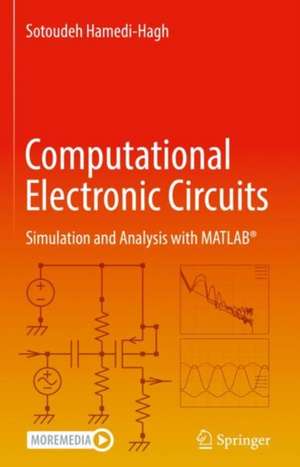
Computational Electronic Circuits
Autor Sotoudeh Hamedi-Haghen Limba Engleză Hardback – 2 aug 2021
- Teaches students and practitioners DC, AC, Transient, Noise and Behavioral analyses using MATLAB;
- Shows readers how to create their own complete simulator in MATLAB by adding materials learned in all 6 chapters of the book;
- Balances theory, math and analysis;
- Introduces many examples such as noise minimization, parameter optimization, power splitters, harmonic traps and passes, directional couplers, polyphase filters and electro-static discharge that are hardly referenced in other textbooks;
- Teaches how to create the fundamental analysis functions such as linear and nonlinear equation solvers, determinant calculation, random number generation and Fast Fourier transformation rather than using the built-in native MATLAB codes.
Preț: 573.57 lei
Preț vechi: 708.11 lei
-19%
Puncte Express: 860
Carte tipărită la comandă
Livrare economică 12-18 decembrie
Livrare prin curier în România Termenul estimat este afișat lângă disponibilitate.
Transport gratuit pentru acest produs Plată online sau ramburs, în funcție de opțiunile comenzii.
Retur gratuit în 14 zile Comandă securizată și suport în română.
Specificații
ISBN-13: 9783030755676
ISBN-10: 3030755673
Pagini: 464
Ilustrații: XXXI, 431 p. 482 illus., 189 illus. in color.
Dimensiuni: 160 x 241 x 29 mm
Greutate: 0.89 kg
Ediția:1st ed. 2022
Editura: Springer
Locul publicării:Cham, Switzerland
ISBN-10: 3030755673
Pagini: 464
Ilustrații: XXXI, 431 p. 482 illus., 189 illus. in color.
Dimensiuni: 160 x 241 x 29 mm
Greutate: 0.89 kg
Ediția:1st ed. 2022
Editura: Springer
Locul publicării:Cham, Switzerland
V-ar putea interesa
-
 -8%Preț: 142.91 lei155.48 lei
-
 Applied Numerical Methods for Chemical EngineersNavid Mostoufi-15%Preț: 488.09 lei571.56 lei
-
 Signals and Systems Using MATLAB®Aydin Akan-31%Preț: 678.33 lei981.55 lei
-
 -40%Preț: 624.04 lei1035.66 lei
-
 -30%Preț: 471.38 lei676.70 lei
-
 -39%Preț: 628.79 lei1028.93 lei
-
 The Art of ElectronicsPaul Horowitz-9%Preț: 706.10 lei775.93 lei
-
 Circuit Analysis For DummiesJohn SantiagoPreț: 139.14 lei
-
 CMOSR. Jacob Baker-23%Preț: 910.54 lei1182.53 lei
-
 -19%Preț: 462.24 lei570.66 lei
-
 Principles and Applications of Electrical Engineering ISEGiorgio Rizzoni-25%Preț: 395.45 lei527.08 lei
-
 -13%Preț: 570.26 lei655.48 lei
-
 -13%Preț: 631.41 lei725.76 lei
-
 Signals and SystemsChi-Tsong ChenPreț: 156.42 lei
-
 Foundations of Analog and Digital Electronic CircuitsAnant Agarwal-27%Preț: 553.17 lei754.30 lei
-
 Electric Circuit Analysis with EasyEDAFarzin AsadiPreț: 431.25 lei
-
 Signals and Systems with MATLAB® and Simulink®Farzin AsadiPreț: 431.01 lei
-
 Advanced Topics in Electric CircuitsZdzislaw Trzaska-18%Preț: 928.69 lei1132.56 lei
-
 -18%Preț: 1016.85 lei1240.06 lei
Cuprins
Introduction.- Framework.- DC Analysis.- Transient Analysis.- AC Analysis.- Noise Analysis.- Behavioral Analysis.
Notă biografică
Ahmet Bindal received his M.S. and Ph.D. degrees in Electrical Engineering Department from the University of California, Los Angeles CA. His doctoral research was the material characterization and analysis of HEMT GaAs transistors. During his graduate studies, he was a research associate and technical consultant for Hughes Aircraft Co. In 1988, he joined the technical staff of IBM Research and Development Center in Fishkill, NY, where he worked as a device design and characterization engineer. He developed asymmetrical MOS transistors and ultra thin Silicon-On-Insulator (SOI) technologies for IBM. In 1993, he transferred to IBM in Rochester, MN, as a senior circuit design engineer to work on the floating-point unit for AS-400 main frame processor. He continued his circuit design career at Intel Corporation in Santa Clara, CA, where he designed 16-bit packed multipliers and adders for the MMX unit for Pentium II processors. In 1996, he joined Philips Semiconductors in Sunnyvale, CA, where he was involved in the designs of instruction and data caches, and various SRAM modules for the Trimedia processor. His involvement with VLSI architecture also started in Philips Semiconductors and led to the design of the Video-Out unit for the same processor. In 1998, he joined Cadence Design Systems as a VLSI architect and directed a team of engineers to design self-timed asynchronous processors. After approximately 20 years of industry work, he joined the Computer Engineering faculty at San Jose State University in 2002. His current research interests range from nano-scale electron devices to nano-scale architectures and robotics. Dr. Bindal has over 30 refereed scientific publications and 10 invention disclosures with IBM. He currently holds three U.S. patents with IBM and one with Intel Corporation.
Dr. Hamedi-Hagh received his Ph.D. from the University of Toronto, Canada in 2004. He joined the Electrical Engineering Department at San Jose State University (SJSU) in 2005. His areas of research and expertise include high frequency modeling of semiconductor device structures and design of Radio Frequency, Analog and Mixed-Signal integrated circuits for wireless and wireline communication systems. Dr. Hamedi-Hagh has developed the Radio Frequency Integrated Circuits laboratory and curriculum at both graduate and undergraduate levels with over $0.5M research funding and through close collaborations with industries. He has received several California State University (CSU) professional development grants, CSU Research Funds, Research, Scholarship and Creative Activity (RSCA) grants, SJSU Planning Council Grants, College of Engineering professional development grants and Junior Faculty Career Development Grants. He is a founding member of SJSU Smart Technology and Computing Center for Complex Systems (STCCS). In 2016, he was appointed as the Mixed-Signal endowed chair of the Electrical Engineering department. Dr. Hamedi-Hagh has over 30 refereed scientific journal and conference paper publications in prestigious national and international Institutes and societies. He received the best paper award at the Micronet Symposium in Quebec, Canada in 2001 and the IEEE International Symposium on Personal, Indoor and Mobile Radio Communications in Barcelona, Spain in 2004. Dr. Hamedi-Hagh has advised several hundred projects on design of integrated circuits and systems. He holds seven US and world patents on wireless circuits, systems and cryptography. His latest patent introduces suspendance® and trajectance® laws as alternatives to Kirchhoff's laws for circuit analysis.
Textul de pe ultima copertă
This textbook teaches in one, coherent presentation the three distinct topics of analysis of electronic circuits, mathematical numerical algorithms and coding in a software such as MATLAB®. By combining the capabilities of circuit simulators and mathematical software, the author teaches key concepts of circuit analysis and algorithms, using a modern approach. The DC, Transient, AC, Noise and behavioral analyses are implemented in MATLAB to study the complete characteristics of a variety of electronic circuits, such as amplifiers, rectifiers, hysteresis circuits, harmonic traps and passes, polyphaser filters, directional couplers, electro-static discharge and piezoelectric crystals. This book teaches basic and advanced circuit analysis, by incorporating algorithms and simulations that teach readers how to develop their own simulators and fully characterize and design electronic circuits.
- Teaches students and practitioners DC, AC, Transient, Noise and Behavioral analyses using MATLAB;
- Shows readers how to create their own complete simulator in MATLAB by adding materials learned in all 6 chapters of the book;
- Balances theory, math and analysis;
- Introduces many examples such as noise minimization, parameter optimization, power splitters, harmonic traps and passes, directional couplers, polyphase filters and electro-static discharge that are hardly referenced in other textbooks;
- Teaches how to create the fundamental analysis functions such as linear and nonlinear equation solvers, determinant calculation, random number generation and Fast Fourier transformation rather than using the built-in native MATLAB codes.