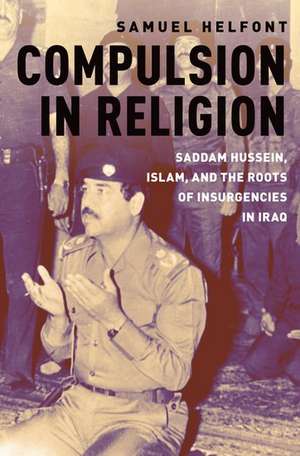
Compulsion in Religion: Saddam Hussein, Islam, and the Roots of Insurgencies in Iraq
Autor Samuel Helfonten Limba Engleză Paperback – 12 oct 2021
Aplicabilitatea practică a volumului Compulsion in Religion rezidă în capacitatea sa de a redefini înțelegerea noastră asupra modului în care regimurile autoritare manipulează religia pentru a-și securiza supraviețuirea politică. Samuel Helfont utilizează arhivele partidului Ba'th pentru a deconstrui mitul unei „convertiri” ideologice a lui Saddam Hussein în anii '90. Putem afirma că lucrarea demonstrează riguros că ceea ce mulți observatori au considerat a fi o derivă spre islamism a fost, în realitate, o campanie de control instituțional începută încă de la preluarea puterii în 1979. Notăm cu interes modul în care autorul urmărește construcția acestor mecanisme de supraveghere care au permis regimului să utilizeze simbolistica islamică fără a ceda autoritatea politică liderilor religioși independenți.
Această perspectivă este esențială pentru a înțelege haosul post-2003. Cartea acoperă aceeași arie ca State and Sufism in Iraq de David Jordan, dar cu o abordare mult mai axată pe mecanismele de stat și pe documentele interne de partid, oferind o explicație structurală pentru emergența insurgențelor. În timp ce Jordan se concentrează pe interacțiunea cu misticismul islamic, Helfont analizează cum distrugerea acestor structuri coercitive de către invazia americană a lăsat un vid de putere în care extremismul religios, anterior „încătușat” de stat, a putut exploda.
În contextul operei autorului, Compulsion in Religion servește drept o prefață analitică necesară pentru The Iraq Wars. Dacă în lucrările sale anterioare Samuel Helfont a examinat logica conflictelor armate, aici el oferă fundamentul sociopolitic al acestora. Tonul este unul precis, academic, evitând speculațiile și ancorându-se ferm în datele de arhivă, ceea ce face din acest volum o resursă indispensabilă pentru studenții la relații internaționale și geopolitică, oferind o claritate rară asupra rădăcinilor Statului Islamic și ale mișcărilor sadriste.
Preț: 199.48 lei
Preț vechi: 236.70 lei
-16%
Carte disponibilă
Livrare economică 13-18 noiembrie
Specificații
ISBN-10: 019760126X
Pagini: 304
Dimensiuni: 234 x 155 x 20 mm
Greutate: 0.45 kg
Editura: Oxford University Press
Colecția OUP USA
Locul publicării:New York, United States
V-ar putea interesa
-
 PoliticsPeter Ferdinand-20%Preț: 383.48 lei479.68 lei
 -
 Britain Votes 2017Jonathan Tonge-24%Preț: 121.21 lei159.05 lei
 -
 -17%Preț: 96.15 lei116.26 lei
 -
 Inclusion: The Politics of Difference in Medical ResearchSteven EpsteinPreț: 246.09 lei
 -
 Preț: 260.64 lei
 -
 The Myth of Presidential RepresentationB. Dan WoodPreț: 230.49 lei
 -
 Dynamics of American Political PartiesMark D BrewerPreț: 283.57 lei
 -
 Direct Democracy and the CourtsKenneth P. MillerPreț: 246.36 lei
 -
 -32%Preț: 397.49 lei580.90 lei
 -
 -27%Preț: 267.95 lei367.91 lei
 -
 Gandhi and Bin Laden: Religion at the ExtremesJames L. Rowell-27%Preț: 276.37 lei378.08 lei
 -
 -28%Preț: 273.80 lei378.71 lei
 -
 An American Political Archives ReaderGlenn Gray-33%Preț: 710.28 lei1057.70 lei
 -
 The Supreme Court and Individual RightsDavid G. SavagePreț: 534.14 lei
 -
 The Supreme Court and the Powers of the American GovernmentDavid G. SavagePreț: 540.89 lei
 -
 The SAGE Handbook of Comparative PoliticsTodd Landman-23%Preț: 1109.18 lei1440.49 lei
 -
 Vital Statistics on American PoliticsHarold W. Stanley-27%Preț: 892.31 lei1222.33 lei
 -
 Preț: 312.89 lei
De ce să citești această carte
Recomandăm această carte cercetătorilor și studenților interesați de geopolitica Orientului Mijlociu și de mecanismele dictaturii. Cititorul va obține o înțelegere factuală, bazată pe documente de arhivă, despre cum a fost controlată religia în Irak și de ce prăbușirea regimului Ba'th a dus inevitabil la ascensiunea extremismului. Este o lectură critică pentru a înțelege de ce intervențiile externe eșuează atunci când ignoră structurile de control social preexistente.
Despre autor
Samuel Helfont este un specialist recunoscut în istoria modernă a Irakului și în dinamica securității în Orientul Mijlociu. Expertiza sa se bazează pe o analiză metodică a documentelor de stat irakiene capturate, oferind o perspectivă rară din interior asupra funcționării regimului Ba'th. În alte lucrări relevante, precum Iraq against the World sau The Iraq Wars, autorul explorează intersecția dintre politica internă a Irakului și ordinea internațională, analizând modul în care ambițiile regimului de la Bagdad au modelat peisajul geopolitic global timp de trei decenii.
Descriere
Recenzii
Helfont gives us a compelling picture of religious life under Saddam. This book can serve as an invaluable resource for anyone who wants to understand Iraq and its sectarian conflicts better. The Western media and politicians love to paint Iraq in single colors, focusing on corruption or the constant violence. Helfont gives us a nuanced and rich view of the Iraqi religious landscape.
Compulsion in Religion is the definitive account of the religious policies of Saddam's regime and mosque-state relations in Ba'thist Iraq. It will be of interest to scholars of Iraq, religion, comparative politics, and general readers searching for an antidote to inaccurate information on the subject.
This work is indispensable for scholars of religion and authoritarianism as a hypothesis-generating case study and is a welcome contribution to the field of religion and politics in particular.
[S]cholars have been hard at work refining and challenging conventional narratives regarding Ba'thist Iraq. ... Compulsion in Religion forms a significant contribution to this more general effort. â [It] will be of great interest to students of Iraqi history and modern Iraqi politics alike.
[A] fascinating new book.
Samuel Helfont has provided us with groundbreaking insights into the way Saddam Hussein's Ba'th Party used Islam to control the Iraqi population during his dictatorship-and how the abrupt removal of that control influenced the insurgencies that erupted in the wake of the American invasion in 2003. Most importantly, this book illuminates why those insurgencies were so virulent, and how the wake of Saddam Hussein's use of Islamic institutions to control the Iraqi population will continue to ignite conflict in the Middle East for generations to come."
Samuel Helfont tackles an important subject that is significant not only for its historical aspects but also for its relevance to current affairs given the rise of Islamic fundamentalism and ISIL. He has tapped the Iraqi archives, providing a real contribution to the literature on Iraq's history and issues related to current politics."
Compulsion In Religion is one of a series of recent books to use the Baathist documents to shed new light on the former regime. Helfont provides a totally original look at how Saddam observed, co-opted, repressed, and then operationalized religion to secure his rule and use it as another means to control society. He counters much of the previous research that largely dismissed religion in Iraq under the Baath. The book could also lead to a whole new range of research into how the insurgency and militias emerged in post-2003 Iraq. It's therefore essential reading for Iraq researchers." - Musings on Iraq